
A die casting machine generates more heat per hour than most people expect. Molten aluminum enters the die at 650–700°C, the hydraulic system runs continuously under load, and the workshop ambient temperature adds another layer of heat that the chiller must remove. An undersized chiller forces the die to run hot, extends cycle time by seconds per shot, and drives defects—porosity, soldering, dimensional instability—that trace directly back to inadequate heat removal. An oversized chiller inflates capital cost and wastes energy every hour the plant operates.
Size a die casting chiller by calculating heat load from alloy specific heat, shot weight, and shots per hour—not machine tonnage alone. Add 15–20% for parasitic loads from hydraulics and ambient temperature. Choose water-cooled for high heat loads and stable performance; choose air-cooled when cooling tower infrastructure is unavailable. Target ±1°C temperature control and 1.5–3 m/s water velocity.
This guide provides the capacity calculation method, water-cooled vs. air-cooled comparison, key operating parameters, and troubleshooting framework for die casting cooling systems.
How Do You Calculate the Required Chiller Capacity for a Die Casting machine?
Calculate heat load using alloy-specific factors: aluminum = lbs/hr × 325 = BTUH; zinc = lbs/hr × 95 = BTUH. Add 15–20% for hydraulic and ambient parasitic loads, then convert BTUH to tons (12,000 BTUH = 1 ton). A cell running 500 lbs/hr of aluminum requires approximately 13.5–16.3 tons.
Step-by-Step Capacity Calculation
Step 1: Determine alloy heat load.
Different alloys carry different thermal energy per pound. The industry-standard factors are:
| Alloy | BTUH Factor | Formula |
|---|---|---|
| Aluminum | 325 BTUH per lb/hr | lbs/hr × 325 = BTUH |
| Zinc | 95 BTUH per lb/hr | lbs/hr × 95 = BTUH |
Step 2: Add parasitic heat loads.
Hydraulic systems, pumps, and elevated workshop ambient temperatures add 15–20% to the base heat load. A chiller sized only for the metal heat load will run at its limit during summer months or peak production.
Step 3: Convert BTUH to refrigeration tons.
Chiller tons = Total BTUH ÷ 12,000
Worked Example: Aluminum Cell at 500 lbs/hr
Metal heat load: 500 × 325 = 162,500 BTUH
Parasitic load (18%): 162,500 × 0.18 = 29,250 BTUH
Total heat load: 191,750 BTUH
Required chiller capacity: 191,750 ÷ 12,000 ≈ 16 tons
If the same cell ran zinc instead of aluminum:
Metal heat load: 500 × 95 = 47,500 BTUH
Parasitic load (18%): 8,550 BTUH
Total: 56,050 BTUH → 4.7 tons
The alloy choice alone changes the chiller requirement by more than 3×. Sizing by machine tonnage without accounting for alloy and throughput produces either an undersized system or unnecessary capital expense.
Flow Rate Verification
Capacity in tons is only half the specification. The chiller must also deliver sufficient flow at the required pressure. Nominal design uses 2.4 gpm per ton at a 10°F temperature difference. For a 16-ton system:
Required flow ≈ 16 × 2.4 = 38.4 gpm
If the mold cooling circuit requires higher flow due to small channel diameters or long runs, the pump curve—not just the tonnage—determines whether the system performs.
Should You Choose a Water-Cooled or Air-Cooled Chiller for Die Casting?
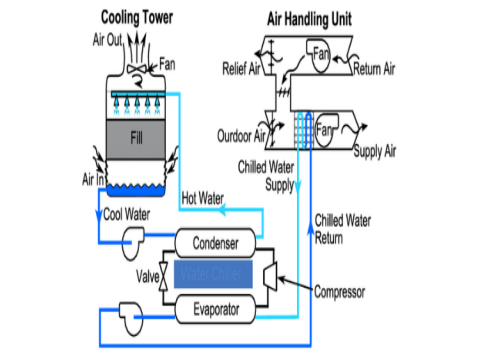
Choose water-cooled chillers for high heat loads, stable performance regardless of ambient temperature, and facilities with cooling tower infrastructure. Choose air-cooled chillers when water access is limited, installation space is available, and ambient temperature variation is acceptable. Water-cooled systems offer higher efficiency per ton; air-cooled systems simplify installation.
Water-Cooled vs. Air-Cooled Comparison
| Factor | Water-Cooled | Air-Cooled |
|---|---|---|
| Heat rejection | Cooling tower or mains water | Ambient air via fans |
| Performance stability | Stable regardless of ambient temperature | Capacity drops as ambient temperature rises |
| Installation | Requires cooling tower, piping, water treatment | Simpler; needs ventilation and clearance |
| Maintenance | Water treatment, tower cleaning, corrosion control | Coil cleaning, fan maintenance |
| Best fit | High heat loads, continuous production, hot climates | Moderate loads, limited water infrastructure, space available |
Water-cooled chillers maintain consistent performance because the condenser rejects heat to water at a controlled temperature rather than to variable ambient air. Air-cooled units simplify installation and suit facilities without cooling tower infrastructure, but they lose capacity on hot days—exactly when the die casting cell needs cooling most. A facility running high-volume aluminum production in a warm climate should default to water-cooled unless water availability or capital budget makes that impossible.
What Operating Parameters Matter for Die Casting Chiller Performance?
Target chilled water temperature of 10–30°C, temperature control accuracy of ±1°C, water velocity of 1.5–3 m/s, and supply pressure of 0.2–0.5 MPa. Cooling channel diameter should be 8–20 mm with a distance of approximately 20 mm from the die surface. Avoid coolant temperatures below 20°C to reduce die cracking risk.
Key Operating Parameters
| Parameter | Recommended Range | Why It Matters |
|---|---|---|
| Chilled water temperature | 10–30°C | Below 10°C risks die cracking; above 30°C reduces heat removal |
| Temperature control accuracy | ±1°C | Consistent die temperature = consistent part quality |
| Water velocity | 1.5–3 m/s | Maintains turbulent flow for efficient heat transfer |
| Supply pressure | 0.2–0.5 MPa | Balances heat exchange efficiency and energy consumption |
| Cooling channel diameter | 8–20 mm | Smaller diameters improve uniformity but increase pressure drop |
| Channel distance from die surface | ~20 mm | Balances cooling effectiveness and die stress |
Water delivers approximately 2–4× the heat transfer efficiency of oil cooling, which is why water remains the default coolant for aluminum and zinc die casting. The trade-off is corrosion risk—water-cooled systems require water treatment and regular channel cleaning. Oil cooling becomes relevant for magnesium alloys or processes requiring die temperatures above 200°C.
Haichen’s cooling optimization guidance specifies water flow ≥1.5 m/s and pressure stable at 0.2–0.5 MPa for efficient heat exchange and energy savings. Avoid setting coolant temperature below 20°C; the thermal shock increases die cracking risk without meaningfully improving cycle time.
What Defects Trace Back to Improper Cooling, and How Do You Fix Them?
Inadequate cooling causes porosity (uneven solidification traps gas and shrinkage voids), soldering (overheated die sections bond to liquid metal), dimensional instability (parts warp because they solidify non-uniformly), and thermal cracking (rapid temperature cycling fatigues the die steel). Fixes include verifying chiller capacity, balancing cooling circuits, and maintaining stable coolant temperature.
Defect-to-Cooling Mapping
| Defect | Cooling-Related Root Cause | Corrective Action |
|---|---|---|
| Shrinkage porosity | Uneven cooling creates isolated hot spots that cannot feed shrinkage | Balance cooling circuits; verify flow to hot sections; increase local cooling |
| Soldering | Localized die overheating causes aluminum to bond to steel | Reduce die surface temperature; improve cooling at soldering location; check spray pattern |
| Dimensional instability / warpage | Non-uniform solidification produces differential shrinkage | Equalize mold temperature across both die halves; verify chiller temperature stability |
| Thermal cracking / heat checking | Rapid temperature cycling fatigues die steel | Stabilize coolant temperature; avoid excessive temperature swings; maintain consistent flow |
A 10% deficit in cooling capacity is enough to push the die into a hotter operating range, extending cycle time by several seconds per shot. Over multiple shifts, those seconds compound into significant annual output loss. Thermal shock from unstable coolant temperature accelerates die fatigue and shortens tool life even when the chiller technically “works”.
Troubleshooting: Temperature Instability or Insufficient Cooling
When the chiller runs but the die temperature drifts or cooling becomes inconsistent, check these points in order:
- Flow rate at the die. Verify actual flow against the design value. A clogged filter, scaled cooling channel, or partially closed valve reduces flow without triggering a chiller alarm.
- Coolant temperature setpoint and stability. Confirm the chiller maintains the setpoint within ±1°C. Overshoot or oscillation indicates refrigerant charge issues, condenser fouling, or control valve problems.
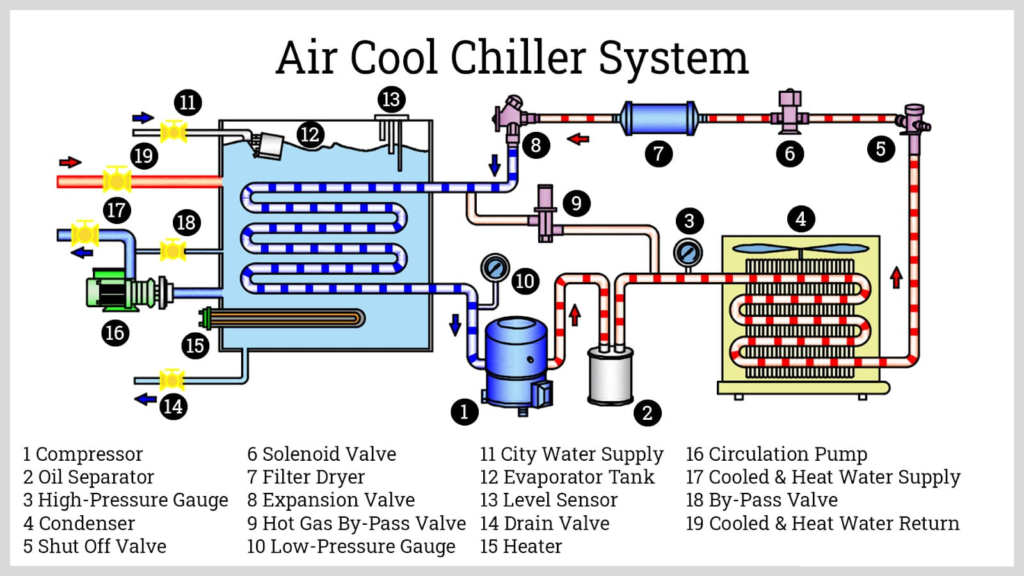
- Condenser heat rejection. For water-cooled units, check cooling tower water temperature and flow. For air-cooled units, verify coil cleanliness and airflow clearance.
- Parasitic heat load changes. If production volume or hydraulic system load increased without chiller capacity adjustment, the system may now be undersized.
Haichen’s die casting chiller guidance emphasizes that proper cooling process optimization maintains thermal balance, reduces scrap rate, and extends equipment life—but only when capacity, flow, and temperature control are correctly matched to the cell.
FAQ
How do I calculate the chiller tonnage for my die casting machine?
Calculate heat load from alloy throughput, not machine tonnage. Use aluminum = lbs/hr × 325 BTUH or zinc = lbs/hr × 95 BTUH, add 15–20% for parasitic loads, then divide total BTUH by 12,000 to get tons. A 500 lbs/hr aluminum cell requires approximately 16 tons including parasitic load.
Is a water-cooled or air-cooled chiller better for die casting?
Water-cooled chillers deliver stable performance regardless of ambient temperature and suit high heat loads, but require cooling tower infrastructure. Air-cooled chillers are easier to install and suit facilities without water access, but capacity drops as ambient temperature rises. High-volume aluminum production in warm climates generally favors water-cooled.
What water temperature should a die casting chiller be set to?
Maintain chilled water temperature between 10°C and 30°C. Avoid setting below 20°C to reduce die cracking risk from thermal shock. The optimal setpoint depends on alloy, die design, and cycle time requirements, but ±1°C stability matters more than the absolute value.
What causes porosity in die casting related to cooling?
Porosity traces to uneven cooling. When isolated hot spots solidify last, they cannot feed shrinkage, creating internal voids. Cooling circuits must be balanced so that thick sections receive sufficient flow and the die temperature gradient stays within a controlled range.
How often should I maintain a die casting chiller?
Clean cooling tower and heat exchanger quarterly. Check water flow and filter condition monthly. Verify refrigerant charge and condenser performance before peak summer production. Water-cooled systems require ongoing water treatment to prevent scale and corrosion in cooling channels.
Can one chiller serve multiple die casting machines?
A central chiller can serve multiple cells if the total heat load, flow rate, and pressure drop across all circuits fit within the chiller’s capacity. However, individual die temperature control still requires separate TCUs or flow control at each machine. A dedicated chiller per cell simplifies troubleshooting and avoids cross-contamination between cooling circuits.


