Die Casting Robot Automation: Payload Selection, Cycle Time, and ROI Guide
Die casting cells run at 300–350°C near the die, cycle every 15–90 seconds depending on part size and alloy, and expose operators to burn and musculoskeletal risks every…
Die casting cells run at 300–350°C near the die, cycle every 15–90 seconds depending on part size and alloy, and expose operators to burn and musculoskeletal risks every time a casting is removed. A robot changes all three conditions—but only if the payload, reach, cycle rate, and safety envelope match the specific die casting machine and part family. A 6kg casting on an 800T machine running 200 cycles per hour demands a different robot than a 25kg structural part on a 1,250T machine running 90 cycles per hour.
Select a die casting robot by matching payload (workpiece + gripper + 20% margin), reach (~1,500mm for most HPDC extraction), extraction cycle time (1–3 seconds typical), and heat protection (IP54 minimum, 200–400°C resistance for end effectors). A two-robot cell with $101,800 total investment can achieve a 1.5-year payback through labor savings and scrap reduction.
This guide covers robot selection criteria, cycle time benchmarks, extraction and spray integration, ROI calculation, and safety compliance for automated die casting cells.
What Robot Payload and Reach Does Your Die Casting Machine Require?
Robot payload must cover casting weight plus gripper weight with a 20% safety margin. For a 6kg casting, select a robot rated at 8kg or higher. Typical HPDC extraction robots use ~1,500mm reach and 10–25kg payload. Larger castings on 800T–1,250T machines may require 25–50kg payload.
Payload Calculation Rule
A 6kg workpiece requires a robot rated at ≥8kg payload. The 20% margin accounts for gripper weight, extraction forces, and dynamic load during acceleration. HPDC extraction systems typically specify 10–25kg payload for standard automotive and structural castings, with reach around 1,500mm and extraction cycle time of 1–3 seconds.
Casting Weight
Gripper Weight (est.)
Required Payload (with 20% margin)
3–5 kg
2–3 kg
6–10 kg
6–10 kg
3–5 kg
11–18 kg
11–20 kg
5–8 kg
19–34 kg
20–50 kg
8–15 kg
34–78 kg
Reach and Mounting Position
For die casting machines above 1,250T, the spray robot arm usually mounts above the fixed platen, with most of the working area falling under the robot base. Extraction robots mount beside or above the machine depending on die height and part trajectory. A reach of ~1,500mm covers most standard HPDC extraction layouts; larger machines may require 2,000mm or more.
Heat and Protection Requirements
Fixtures and end effectors must withstand 200–400°C radiated heat from the die and casting. Water-cooled fixtures, high-temperature silicone or ceramic coatings, and stainless steel splash guards are common solutions. The robot itself needs IP54 protection or higher, with sealed guide rails and cylinders to keep die lubricant and metal dust out.
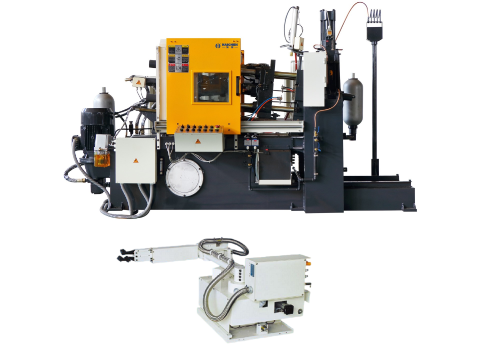
Automated die casting with robot
What Cycle Time Can a Die Casting Robot Achieve?
HPDC extraction cycle times typically run 1–3 seconds. Integrated extraction-and-spray systems achieve 6–7 seconds for the combined sequence. Standard die casting machine cycles run 15–90 seconds depending on part size and alloy. Robot cycle rate must match or exceed the die casting machine’s open-to-close interval.
Extraction Cycle Time Benchmarks
USA Robotics lists extraction cycle time of 1–3 seconds for HPDC systems, depending on die and casting size. Synapse Robotics reports consistent 6–7 second extraction cycles in production aluminum PDC and GDC applications. A two-axis robot for 500T–800T machines runs at 7.3 seconds per cycle. Integrated extraction-and-spray systems using a single 6-axis robot can achieve a combined cycle under 12 seconds for castings ≤10kg.
Matching Robot Cycle Rate to Die Casting Machine
The robot must complete extraction, spray, and return-to-home before the die closes. If the die casting machine runs a 15-second cycle, a robot with a 10-second extraction-and-spray sequence leaves 5 seconds of margin. If the robot sequence exceeds the die open time, the die casting machine waits, and output drops.
Die Casting Machine Cycle
Robot Sequence Budget
Recommended Robot Configuration
10–15 s
≤8 s
High-speed servo extraction, integrated spray
15–30 s
≤15 s
Standard 6-axis extraction + separate sprayer
30–60 s
≤30 s
Standard extraction, spray can run in parallel
60–90 s
≤45 s
Extraction and spray sequential is sufficient
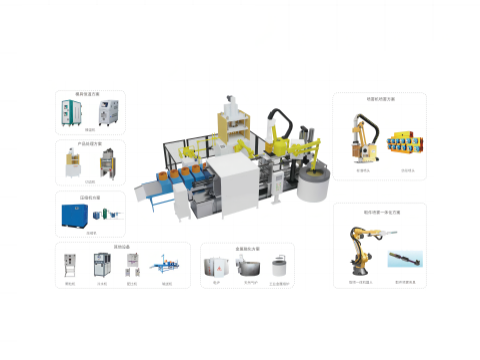
industrial robots for die casting machine
How Do You Calculate the ROI of a Die Casting Robot?
A two-robot die casting cell with $101,800 total investment—including robots, integration, grippers, and spray cassettes—can achieve a 1.5-year payback through $67,500 annual labor savings and scrap reduction. Typical payback ranges from 12–24 months, depending on labor cost and production volume.
Documented Cost Breakdown and Results
A published case study documented a two-robot die casting tending installation with the following economics:
Cost Item
Amount
Two ABB M994 4400L robots + software
$74,000
Robot cell integration
$8,700
Biscuit grippers, air signals, part detection, mounting plates, spray cassettes
Production expanded to three 8-hour shifts per day without additional operators
Moka reports a broader range: one robot replaces 2–3 workers, saves ¥250,000–600,000 in annual labor cost, reduces defective rate by 40–60%, and achieves payback in 12–18 months. Hejuda reports 2–4 operators saved per cell, uptime improvement over 20%, and payback within two years.
ROI Calculation Template
Annual labor savings = (Operators replaced × Annual cost per operator × Shifts covered) Annual scrap savings = (Scrap rate reduction × Annual production volume × Unit cost) Annual energy savings = (kWh saved per cycle × Cycles per year × Electricity rate) Payback (years) = Total investment ÷ (Annual labor + scrap + energy savings)
For a single-robot cell replacing 2 operators at $25,000/year each, with 5% scrap reduction on 500,000 parts at $2/part:
Labor savings: 2 × $25,000 = $50,000 Scrap savings: 0.05 × 500,000 × $2 = $50,000 Total annual savings: $100,000 If total investment is $120,000 → Payback = 1.2 years
What End-of-Arm Tooling Does Die Casting Automation Require?
Die casting robots use three main end-effector types: pneumatic grippers for regular castings, vacuum suction cups for flat panels, and custom fixtures for irregular parts. Spray robots use 6-axis arms with 8–20kg payload, 1.5–2.5m reach, and multi-nozzle spray heads. Integrated extraction-spray systems combine both functions on one arm.
Gripper and Vacuum Selection
Pneumatic grippers offer strong universality and suit regular casting shapes. Vacuum suction cups work for flat surfaces like die-cast panels but require high-temperature-resistant materials such as silicone and metal mesh. Irregular parts—engine blocks, transmission housings—require custom fixtures designed to the part geometry.
Spray System Integration
A die casting sprayer robot is most commonly a 6-axis articulated arm with 1.5–2.5m working reach and 8–20kg payload, sized to hold the spray head. The spray head may carry multiple nozzles for die release agent application. On machines above 1,250T, the spray robot arm typically mounts above the fixed platen, with the working area under the robot base.
Integrated vs. Separate Extraction and Spray
A single 6-axis robot can perform both extraction and spraying, but the combined sequence may lengthen cycle time. A separate sprayer (servo 3-axis or dedicated spray robot) running in parallel with the extraction robot reduces die-open time. One industry analysis notes that a combined extraction-spray robot may be 2 seconds slower per cycle than a split configuration. The trade-off is between capital cost (one robot vs. two) and cycle time (parallel operation vs. sequential).
What Safety Requirements Apply to Die Casting Machine Robot?
Die casting robot cells must comply with EN ISO 10218-1/-2 for industrial robot safety. Safety fencing minimum height is typically 1,400mm, with safe distance determined by fence height and opening size (e.g., 200mm distance for 40×40mm mesh). The cell needs interlocked gates, emergency stops, and a documented risk assessment.
Fence Height and Safe Distance
EN ISO 10218-2 specifies that separating protective equipment must meet minimum height requirements. Common practice uses a minimum fence height of 1,400mm when no hazard exists within 1,100mm of the fence; where hazards are closer, the fence must be taller or set farther back. For a 40×40mm wire mesh fence, the safe distance from the robot’s maximum space is typically 200mm, provided the fence is high enough to prevent reaching over.
Interlocks and Risk Assessment
The robot cell must include interlocked access gates that stop robot motion when opened, emergency stop devices within reach of the operating position, and a documented risk assessment per EN ISO 10218-2. ABB’s safety whitepaper notes that EN ISO 10218-1 and -2 define how to safely limit the robot’s space, and the fence must connect to protective earth to prevent electric shock.
Haichen always use automated die-casting with robots during die casting process. Like below photo show, aluminium frying pan die casting process uses automated robot to pick the finished pan from the mould.
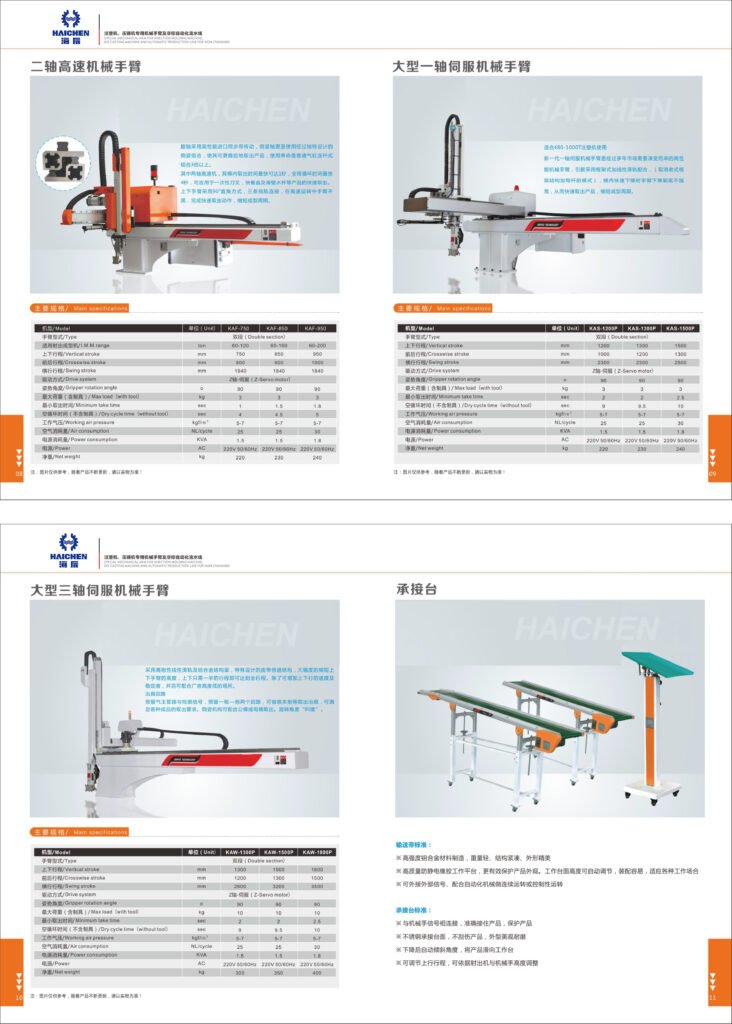
The features of Haichen autmated die casting machine robots include a synchronized six-axis or linear robot for precise part extraction, trimming, and spray operations, all governed by a centralized control system. This setup ensures impeccable timing, maximizes machine uptime, and achieves consistent cycle times. The automation guarantees gentle handling of delicate castings, drastically reduces manual labor, and enhances workplace safety by removing operators from hazardous areas. Ultimately, Haichen’s robotic integration delivers superior efficiency, repeatability, and a significant boost in overall productivity for high-volume manufacturing.
FAQ
What payload robot do I need for a 6kg die casting?
A 6kg casting requires a robot rated at 8kg or higher to account for gripper weight and a 20% safety margin. For 800T machines running 200 cycles per hour, select a robot with ~1,500mm reach and IP54 protection minimum.
What is the typical cycle time for robotic die casting extraction?
HPDC extraction cycle times typically run 1–3 seconds. Integrated extraction-and-spray sequences achieve 6–7 seconds for the combined operation. The robot sequence must fit within the die casting machine’s open time to avoid slowing production.
What is the ROI of a die casting robot?
A documented two-robot cell with $101,800 total investment achieved a 1.5-year payback through $67,500 annual labor savings and scrap reduction from 10% to 3%. Broader industry data shows payback ranging from 12–24 months depending on labor cost and production volume.
What safety fence height is required for a die casting robot cell?
EN ISO 10218-2 commonly requires a minimum fence height of 1,400mm when no hazard exists within 1,100mm of the fence. Safe distance depends on fence height and opening size—200mm for a 40×40mm mesh fence that prevents reaching over.
Can one robot handle both extraction and spraying?
Yes, but a combined extraction-spray robot may add 2 seconds or more to the cycle compared to separate extraction and spray systems running in parallel. The choice depends on whether cycle time or capital cost is the binding constraint.
What protection level does a die casting robot need?
The robot should have IP54 protection or higher to keep die lubricant and metal dust out. End effectors and fixtures must withstand 200–400°C radiated heat, using water cooling, ceramic coatings, or heat-resistant alloys as needed.
From Technical Insight to Equipment
Recommended Die Casting Equipment for Your Next Project
Explore production-ready Haichen equipment selected to help turn the technical guidance in this article into a reliable die casting process.
The HCD-C cold chamber die casting machine offers locking forces from 350 to 20800 kN for producing aluminum and magnesium parts. Haichen cold chamber…
Turn Your Die Casting Requirements into a Production-Ready Solution
Fill out the form below, and we will be in touch shortly.
As the manufacture of die casting machines, we’d like to share not just our machines, also our experience on the alloy die cating. We’d like to support the die casting solutions free!
We share the solution for all kinds of die casting.
We supply auxiliary device of die casting machines.
We also supply die casting automation: automatic ladles, die sprayers, extractors, and robots.