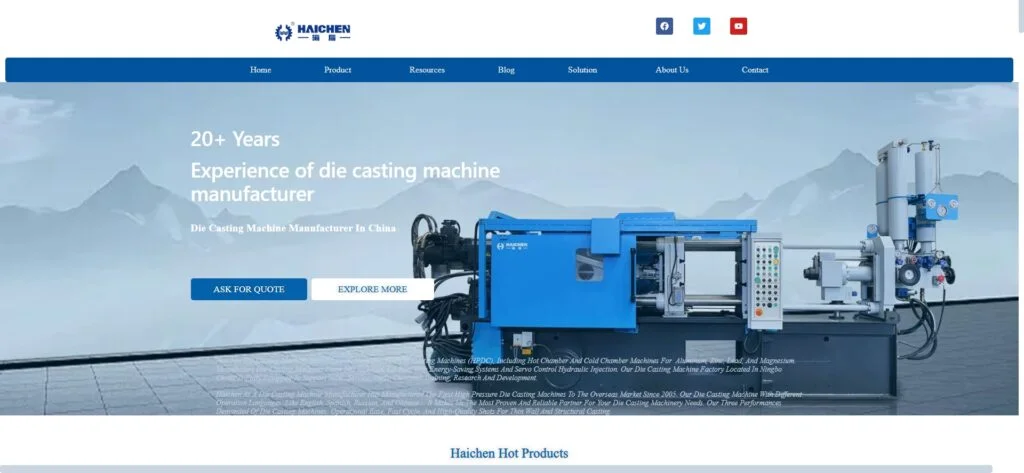
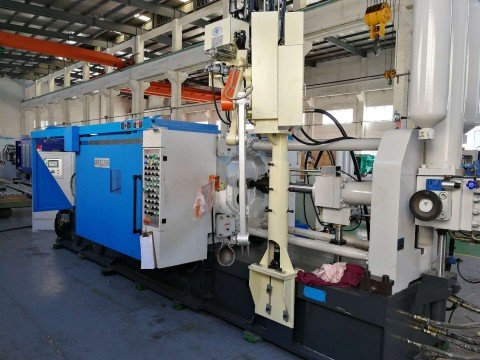
A die casting machine is made up of several systems that work together to produce metal parts under high pressure.
The main components include the injection system, clamping system, die, ejection system, hydraulic system, and electrical control system.

Each part has a different job. For example, the injection system pushes molten metal into the die, while the clamping system keeps the die closed during injection.
After the metal solidifies, the ejection system removes the casting.
So, how do all these parts work together? Let’s take a closer look.
What Are the Main Components of a Die Casting Machine?
Injection System
The injection system is one of the most important parts of a die casting machine.
It pushes molten metal into the die cavity at high speed and pressure.
The exact design depends on whether the machine uses a cold chamber or hot chamber system.
For a cold chamber die casting machine, the main injection components usually include:
- Shot sleeve
- Plunger tip
- Plunger rod
- Injection cylinder
- Accumulator
- Injection valves
The shot sleeve receives the measured amount of molten metal. Then, the plunger tip moves forward and pushes the metal into the die.
The injection system needs fast and stable movement because die casting often uses a very short filling time.
If injection speed or pressure is unstable, defects such as cold shuts, porosity, flash, or incomplete filling may occur.
Die Clamping System
The clamping system holds the two halves of the die together during injection.
It must provide enough clamping force to resist the pressure created when molten metal enters the cavity.
The main parts include:
- Fixed platen
- Moving platen
- Tie bars
- Clamping mechanism
- Hydraulic cylinder
- Toggle mechanism on applicable machines
The machine’s rated clamping force is an important specification. If the force is too low, the die may open slightly during injection. This can cause flash around the casting.
Therefore, manufacturers need to select a machine based on die size, projected casting area, injection pressure, and required safety margin.
Die Casting Die
The die forms the final shape of the metal part.
A typical die contains two main halves:
- Fixed die half
- Moving die half
The die may also contain:
- Cavity
- Core
- Sliders
- Inserts
- Runner
- Gate
- Overflow
- Cooling channels
- Ejector holes
The cavity creates the outside shape of the casting, while cores form internal features such as holes and deep sections.
Sliders are useful when a casting has side holes, undercuts, or other features that cannot be released directly from the main die opening.
Because the die works under high temperature, pressure, and repeated thermal cycles, die material, cooling design, venting, and surface treatment all affect die life and casting quality.
Ejection System
After the metal has cooled enough to hold its shape, the ejection system pushes the casting out of the moving die half.
The main components include:
- Ejector pins
- Ejector plate
- Ejector rod
- Ejector cylinder
- Return mechanism
The ejector pins must apply force at suitable positions. If the force is not balanced, the casting may deform or become stuck in the die.
A good ejection system also helps reduce cycle time and supports stable automatic production.
Hydraulic System
The hydraulic system provides the power needed for many machine movements.
Depending on the machine design, it can control:
- Die opening and closing
- Injection movement
- Ejection
- Core or slider movement
- Other hydraulic functions
The hydraulic system normally includes pumps, valves, cylinders, pipes, filters, and an oil tank.
For high-speed die casting, hydraulic response is important. Stable pressure and fast valve response help the machine achieve repeatable injection and clamping performance.
Electrical and Control System
The electrical control system acts as the machine’s control center.
It controls and monitors important machine functions such as:
- Injection speed
- Injection pressure
- Clamping movement
- Die opening and closing
- Ejection
- Cycle time
- Temperature
- Alarms and safety functions
A modern die casting machine normally uses a PLC and an HMI or industrial control interface.
Operators can set and monitor process parameters through the control system. This makes it easier to repeat the same production cycle and find problems during operation.
Lubrication and Cooling System
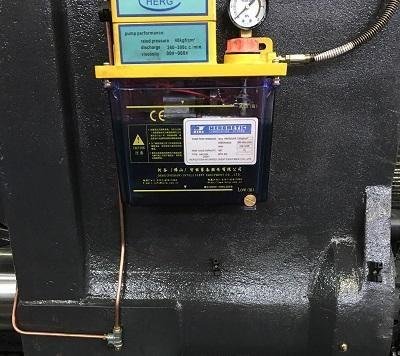
Die casting machines also need lubrication and cooling systems for stable long-term operation.
The lubrication system reduces friction between moving components and helps protect parts from wear.
The cooling system removes excess heat from areas such as the hydraulic oil, machine body, and other components.
For the die itself, cooling channels are also important. Proper die cooling can control die temperature, shorten cycle time, and improve casting quality.
Cold Chamber vs. Hot Chamber Die Casting Machine
Not every die casting machine uses the same injection components.
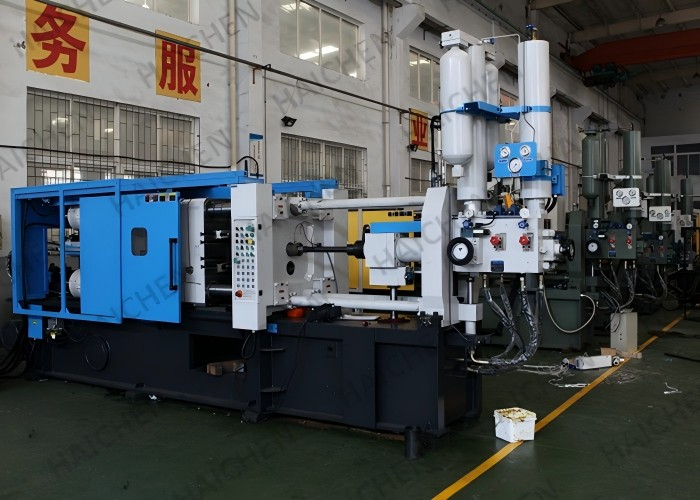
Cold Chamber Die Casting Machine
In a cold chamber machine, molten metal is normally supplied from a separate melting or holding furnace.
A ladle transfers a measured amount of metal into the shot sleeve. The plunger then pushes the metal into the die.
The basic process is:
Furnace → Ladle → Shot Sleeve → Plunger → Die Cavity
Cold chamber machines are widely used for aluminum and magnesium alloys and for applications that require higher injection pressure.
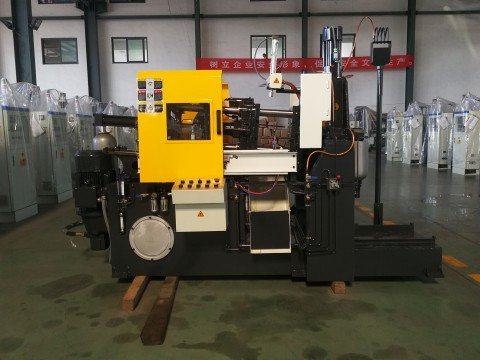
Hot Chamber Die Casting Machine
In a hot chamber machine, the injection mechanism is connected more closely with the molten metal bath.
Typical components include:
- Melting pot
- Gooseneck
- Plunger
- Nozzle
- Injection cylinder
The metal is drawn from the pot and pushed through the gooseneck and nozzle into the die.
Hot chamber machines are commonly used for metals such as zinc and other alloys that are suitable for this process.
How Do the Components Work Together?
A die casting machine does not work through one component alone. The main systems must work together.
The basic production cycle looks like this:
1. Die closing → 2. Molten metal preparation → 3. Metal injection → 4. Die filling → 5. Pressure holding → 6. Cooling → 7. Die opening → 8. Ejection
First, the clamping system closes the die and applies the required force.
Next, the injection system pushes molten metal into the cavity at high speed.
The die then controls the shape and cooling of the casting.
After the metal solidifies, the clamping system opens the die. Finally, the ejection system pushes the finished casting out.
This is why machine performance depends on the coordination of the whole system rather than only one component.
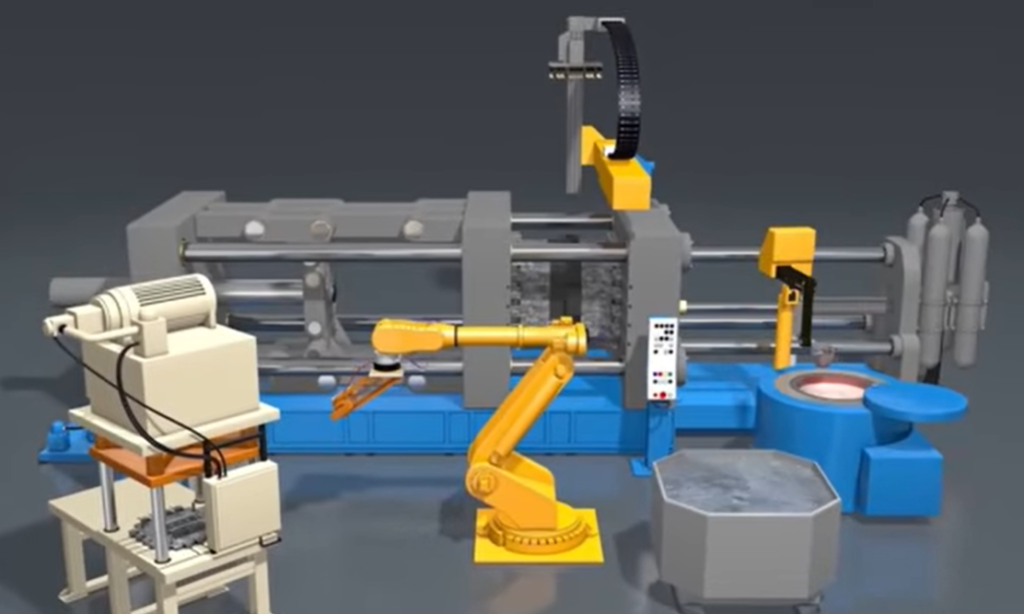
What Auxiliary Equipment Does a Die Casting Machine Need?
A complete die casting production line normally needs more than the main machine.
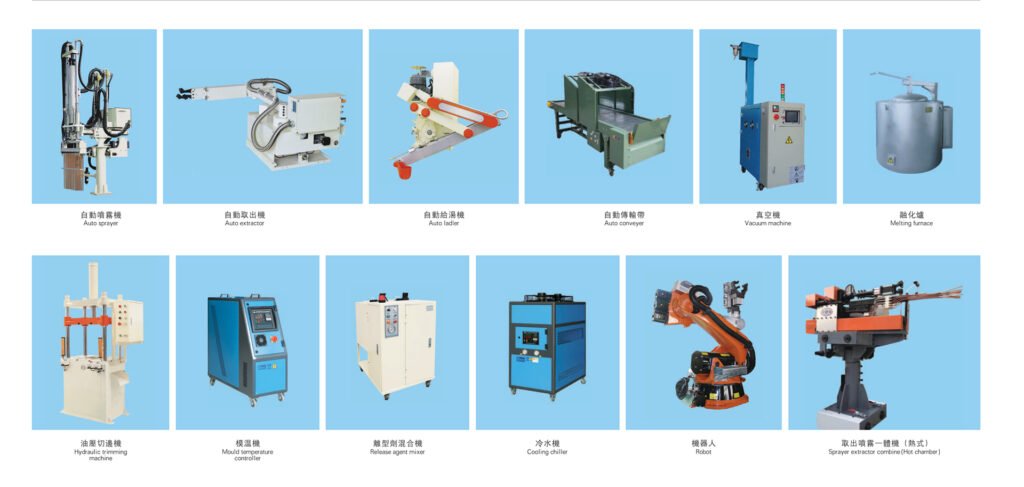
Depending on the application, auxiliary equipment may include:
- Melting or holding furnace
- Automatic ladle
- Die temperature controller
- Die spray machine
- Cooling system
- Trimming machine
- Part collection system
- Conveyor
- Industrial robot
- Lubrication system
For automated production, robots can remove castings, transfer parts, and connect different production steps.
This can reduce manual work and make cycle times more consistent.
How to Choose the Right Die Casting Machine?
When selecting a die casting machine, do not look only at the machine’s tonnage.
You should also check:
Clamping Force
Make sure the machine provides enough clamping force for the die and projected casting area.
Injection Performance
Check injection speed, pressure, shot weight, and acceleration. These parameters are especially important for thin-wall and complex castings.
Die Size
Confirm that the die fits the machine’s platen size, tie-bar spacing, and maximum die height.
Shot Capacity
The injection system must provide enough metal volume for the casting, runner, and overflow system.
Automation
If you plan to run high-volume production, check whether the machine can work with automatic ladles, sprayers, robots, conveyors, and other auxiliary equipment.
Haichen Die Casting Machine Supplier
Haichen is a die casting machine manufacturer in Ningbo, China. The company supplies both cold chamber and hot chamber die casting machines for different metal casting applications.
For customers producing aluminum parts, zinc parts, automotive components, hardware, cookware, and other pressure-cast products, machine selection should be based on the casting material, part size, die dimensions, required production output, and injection requirements.
Haichen can also provide auxiliary equipment and technical support for a complete die casting production line.
If you are not sure which die casting machine is suitable for your product, you can provide the casting drawing, material, part weight, die information, and expected production volume.
These details can help the machine supplier recommend a more suitable model.