
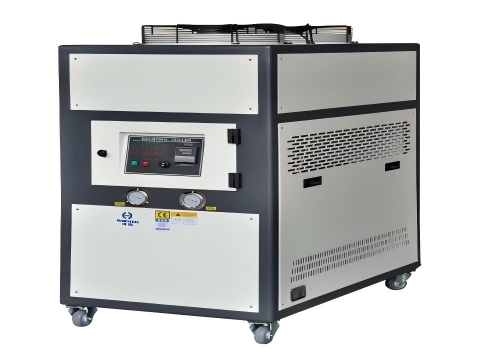
What does a mould temperature controller actually do? A mould temperature controller (MTC) is a device that heats the die casting mold to its operating temperature before production starts and then maintains that temperature throughout the entire casting cycle. It circulates a liquid heat transfer medium—either water or thermal oil—through internal channels in the mold, and it constantly adjusts the temperature using a controlled cycle of heating and cooling.
If you are a procurement professional evaluating auxiliary equipment, the mould temperature controller directly affects your casting quality, cycle time, mold life, and overall production cost. A well-chosen MTC delivers consistent parts, fewer defects, and longer tool life. An undersized or poorly matched unit causes scrap, downtime, and expensive mold repairs.
This guide walks you through the key functions of a mould temperature controller and what they mean for your die casting operation.
Why Mold Temperature Matters in Die Casting
The mold temperature plays a decisive role in how heat dissipates from the molten metal, how the metal fills the cavity, and how the die casting solidifies. When the mold temperature falls outside the optimal range, you get defects. Uneven or improper mold temperature causes dimensional instability, part deformation during ejection, thermal stress, soldering, surface sinks, internal shrinkage, and hot bubbles.
A mould temperature controller prevents these problems. It keeps the mold at the right temperature for your specific alloy, ensuring that the metal flows smoothly into every corner of the cavity and solidifies uniformly.
How the Temperature Control System Works
The mould temperature controller operates through a closed-loop system. Here is what happens in each cycle:
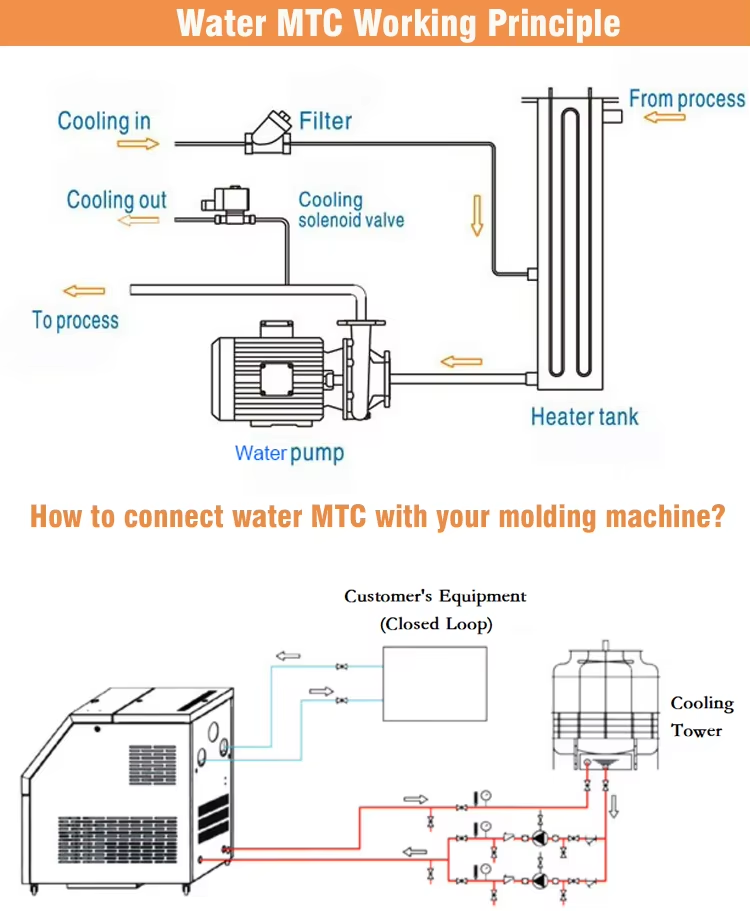
Heating phase. The controller uses electrical or gas energy to heat a heater, which transfers heat to the circulating medium (water or thermal oil). The heated medium then flows through the mold, raising its temperature to the set point.
Cooling phase. When the mold exceeds the set temperature, the controller routes the medium through a cooling circuit. This removes excess heat from the mold and discharges it.
Closed-loop control. Temperature sensors monitor the medium temperature in real time and feed the data back to the control system. The system uses PID (Proportional-Integral-Derivative) algorithms to adjust heating and cooling power dynamically. High-end controllers achieve temperature control precision of ±0.1°C.
What this means for you: The controller does not just heat or cool. It actively balances the thermal input and output of the mold, responding to each injection cycle to maintain stability.
How Temperature Control Improves Casting Quality
A mould temperature controller directly improves the surface quality, structural integrity, and dimensional accuracy of your castings.
Eliminating surface defects. Uneven temperature causes cold shuts, flow marks, bubbles, and shrinkage holes. The MTC controls temperature differences within ±1°C, ensuring that the molten metal fills the cavity smoothly and completely. For aluminum alloy die casting, mold temperatures below 180°C often produce flow marks, while temperatures above 270°C cause soldering and thermal cracks.
Optimizing internal structure. Stabilizing the temperature field promotes sequential solidification, which reduces internal porosity and improves the density and mechanical properties of the casting.
Ensuring dimensional stability. When the mold temperature stays consistent, the casting shrinks predictably and comes out within specification every time. Temperature fluctuations cause dimensional drift and rejections.
What this means for you: Better quality means fewer rejects, less rework, and more parts that meet your customer’s specifications.
How It Extends Mold Service Life
A mould temperature controller extends mold life by more than 30%. It does this through several mechanisms:
Preheating protection. The controller preheats the mold evenly before production starts. This prevents the sudden contact of a cold mold with high-temperature molten metal, which causes thermal shock and initiates cracks.
Reducing thermal stress. Maintaining a constant temperature slows down thermal fatigue on the mold surface and inhibits the expansion of thermal cracks. Thermal cycling—repeated heating and cooling—is the primary cause of heat checking in die casting molds.
Reducing soldering risk. Accurate temperature control reduces the amount of release agent you need. Less release agent means fewer chemical interactions that can damage the mold surface.
What this means for you: A longer-lasting mold means fewer replacements, lower tooling costs, and less downtime for mold changes.
Boosting Production Efficiency with Thermal Management
A mould temperature controller improves production efficiency by 20% to 30%.
Shortening cycle time. The controller accelerates the cooling process, reducing pressure-holding and cooling time. Studies show that optimized temperature control can achieve cycle time reductions of 18% on average, and in some cases up to 40%.
Stabilizing production rhythm. Temperature fluctuations cause variations in filling time and spraying time. The MTC eliminates these variations, ensuring continuous, predictable production.
What this means for you: Shorter cycles and stable operation increase your output without adding new machines. You produce more parts in the same amount of time.
Energy Efficiency Through Intelligent Control
The mould temperature controller optimizes energy consumption through intelligent control. The PID algorithm outputs power only when needed, avoiding wasteful overheating. This precise power management reduces your energy bills while maintaining process stability.
What this means for you: Lower energy consumption reduces your operating costs and supports your sustainability goals.
Types of Thermal Control Units
Water-cooled units. These units use water as the cooling medium. Water offers high thermal conductivity and low cost, making it suitable for medium-to-low temperature control. They work well for zinc alloys (160–200°C) and magnesium alloys (180–240°C). Standard water units reach maximum flow temperatures of 90°C, while pressurized water units can reach 180°C.
Oil-cooled units. These units use high-temperature thermal oil as the medium. Oil’s high specific heat capacity suits high-temperature applications, such as copper alloys at 280–350°C. Oil units can reach flow temperatures up to 350°C. They deliver uniform heating and reduce thermal shock, making them ideal for large aluminum or magnesium alloy molds.
Air-cooled units. These units use forced air convection for cooling. They offer lower efficiency than water or oil systems but work cost-effectively for simple molds or auxiliary cooling.
What this means for you: Your choice depends on your alloy, operating temperature, and production requirements.
How to Select the Right Temperature Control Equipment
Match the temperature range to your alloy. Different alloys require different mold temperatures:
- Zinc alloys: 160–200°C
- Magnesium alloys: 180–240°C
- Aluminum alloys: 200–250°C
- Copper alloys: 280–350°C
Consider the mold structure and cooling conditions. Complex molds with deep cavities or thin walls may require zone-specific temperature control. Some advanced systems use spot cooling to target hot spots such as gates and thick walls.
Evaluate temperature accuracy requirements. Within ±10°C prevents shrinkage and thermal cracking caused by temperature fluctuations. For high-precision applications, look for controllers with ±0.1°C accuracy.
Check safety protection features. Magnesium alloy die casting requires explosion-proof design—water spray cooling is prohibited. Look for automatic leakage detection, electronic temperature limiters, and fault alarms.
What this means for you: The right MTC matches your specific production conditions, not just a generic specification.
Questions to Ask Your Supplier
- “What temperature range does this controller support?” – Make sure it covers your alloy’s requirements.
- “What is the temperature control accuracy?” – Look for ±0.1°C for high-precision applications.
- “Does it use water or oil as the medium?” – Each suits different temperature ranges and alloys.
- “What safety features does it include?” – Overheat protection, flow alarms, and emergency shutdown matter.
- “How does it integrate with my die casting machine?” – Communication interfaces and coordinated control capabilities are important.
- “What is the expected energy consumption?” – This affects your operating costs.
- “Can you provide case studies from similar applications?” – Proven results matter more than promises.
Haichen’s Temperature Control Solutions
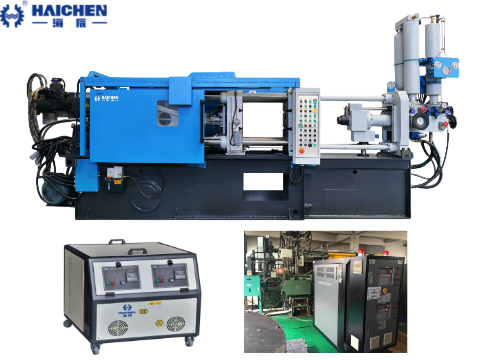
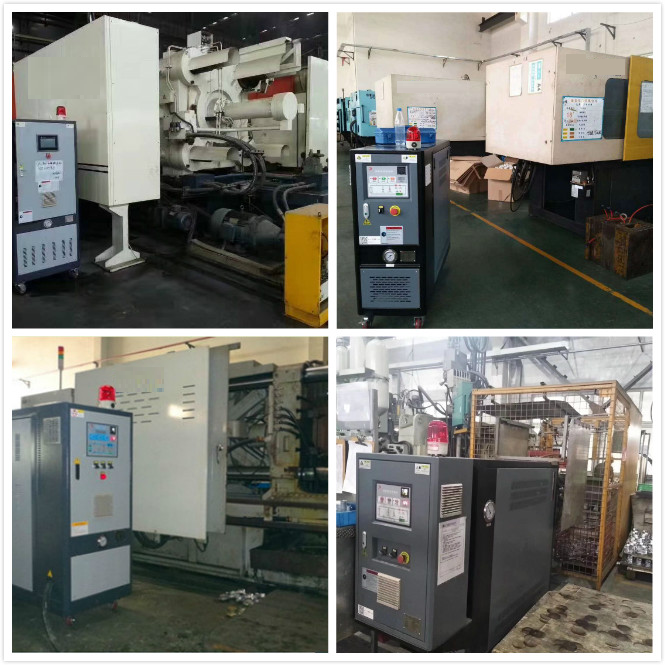
Haichen Machinery manufactures die casting machines and auxiliary equipment, including mould temperature controllers. Haichen’s fourth-generation mould temperature controller delivers rapid heating, stable temperature maintenance, and minimal leakage. It fulfills industrial clients’ requirements for intelligent and digital upgrades.
Haichen’s MTCs achieve temperature control precision of ±0.1℃, enhance temperature regulation efficiency by 10%, and extend service life by 60%. The controllers employ intelligent control systems that maintain precise and stable mould temperatures with minimal variation. This directly enhances the consistency of casting surface quality and internal structure. Their efficient heating and cooling systems reduce production cycles while lowering energy consumption. The robust construction ensures long-term, stable operation within the high-temperature, dusty environments typical of die-casting workshops. Requiring minimal maintenance, the controllers provide reliable support for achieving high productivity and low operating costs.
Haichen offers both water-cooled and oil-cooled mould temperature controllers to match different alloy types and temperature requirements. Our technical team can help you select the right controller based on your mold structure, alloy type, and production targets.


