Die casting spray nozzles are the final link in your spraying system, yet they often get overlooked in purchasing decisions. That is a mistake. The right nozzle directly affects your demolding success rate, mold life, casting quality, and production pace. Choose wrong, and you will deal with sticking parts, uneven cooling, and costly downtime. Choose right, and you gain consistency, efficiency, and longer tool life.
As a procurement professional, you need to know what separates a good nozzle from a bad one. This guide walks you through the key selection factors, common nozzle types, material considerations, and real-world applications—so you can make a confident purchasing decision.
Why Spray Nozzles Matter More Than You Think
Many buyers focus on the die casting machine itself and treat nozzles as an afterthought. But spray nozzles play a crucial role in your entire production setup. They deliver release agent and cooling media to the mold surface. Their performance determines whether the casting releases cleanly, whether the mold stays at the right temperature, and whether you get consistent part quality cycle after cycle.
Poor nozzle selection leads to:
- Uneven release agent distribution – causing sticking and surface defects
- Inadequate cooling – leading to longer cycle times and thermal fatigue on the mold
- Clogging and downtime – disrupting your production schedule
- Wasted release agent – driving up your consumable costs
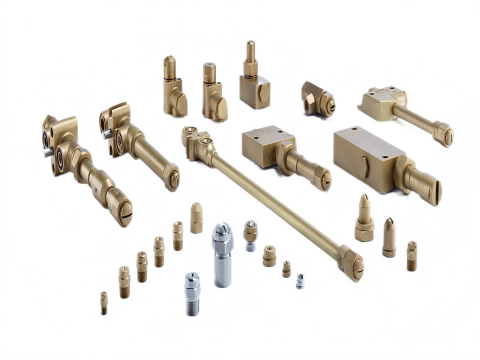
On the flip side, the right nozzle helps you reduce defects, extend mold life, and lower your overall cost per part.
Five Key Factors for Selecting Spray Nozzles
When evaluating die casting spray nozzles, focus on these five critical factors:
Spray Flow Rate and Pressure
You need to match the flow rate (measured in GPM or LPM) and operating pressure to your specific application requirements. Too much flow wastes release agent and creates overspray. Too little flow leaves parts of the mold unprotected.
For most die casting applications, recommended air pressure falls between 2.5 and 3.5 bar (36–50 psi), though some spray guns support up to 6 bar. Common nozzle diameters range from 1.2 mm to 1.8 mm, with some fine spray models going as small as 0.28 mm.
Spray Pattern and Angle
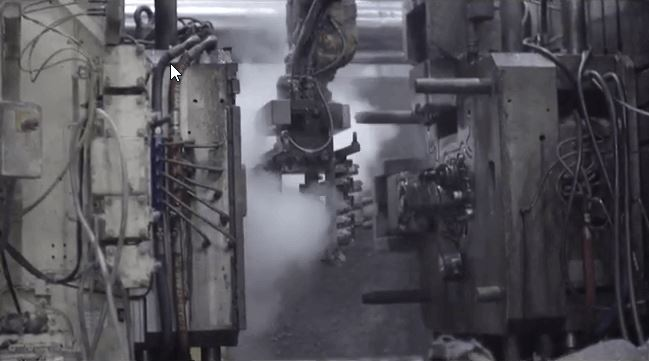
Different spray patterns suit different mold geometries:
- Flat fan nozzles provide wide coverage for large, flat mold cavity surfaces. They work well for cleaning, rinsing, and coating applications.
- Hollow cone nozzles suit cooling, cleaning, and dust control. Their spray angles range from 43° to 180°.
- Full cone nozzles produce a uniformly distributed conical spray, ideal for applications requiring full coverage.
- Fine spray nozzles produce small droplets for humidification and atomization.
- Air atomizing nozzles use compressed air to achieve finer droplets for coating and wetting applications.
Wide angle nozzles (110° to 120°) cover large areas quickly, while narrow angle nozzles (80° to 95°) deliver precise application to specific zones.
Spray Liquid Type
Consider what you are spraying—water, lubricant, release agent, or a mixture. Different liquids have different viscosities and require different nozzle designs for proper atomization. Water-based release agents behave differently from oil-based ones.
Nozzle Material
The working environment and liquid characteristics determine the right material choice:
- Brass offers good corrosion resistance at a lower cost, suitable for less demanding applications.
- Stainless steel provides excellent chemical resistance, medium abrasion resistance, and high temperature resistance up to 500°C.
- Aluminum alloy delivers light weight (only 1/3 the density of steel) and excellent corrosion resistance. It works particularly well with water-based coatings.
- Ceramics and tungsten carbide offer superior wear resistance for high-abrasion applications.
Atomization Quality
For applications requiring fine atomization—like coating or wetting—air atomization nozzles deliver smaller, more consistent droplets. Better atomization means more uniform coverage and less waste.
Common Types of Die Casting Spray Nozzles
Different nozzle designs serve different purposes. Here is what you need to know about each type:
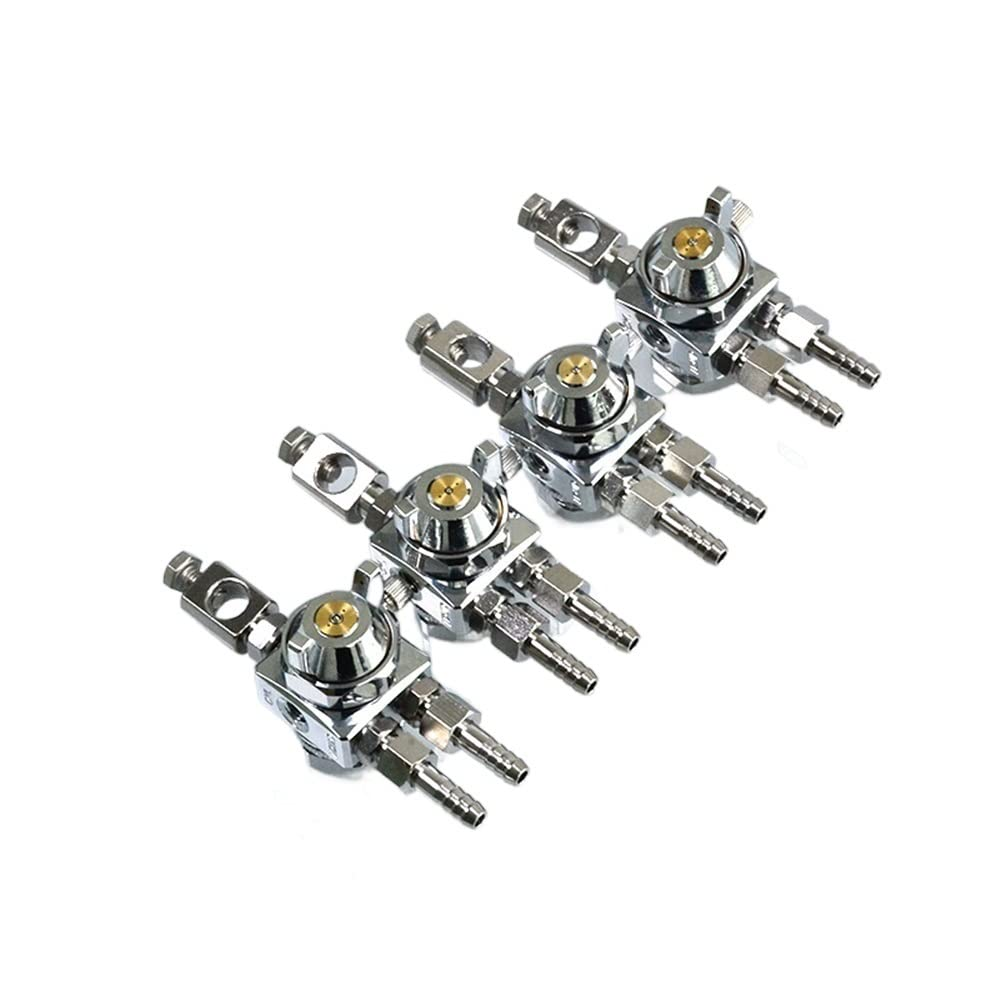
T-Shaped Nozzles feature a central portion with a perpendicular section forming the T shape. This design makes them particularly easy to clean and maintain, reducing downtime and ensuring consistent performance. They work well for lubrication or cooling in specific regions of the die casting process.
Cross Nozzles come fitted with four outlets that spray evenly across the mold cavity. The symmetrical arrangement minimizes turbulence and enables balanced filling—critical for complex geometries and intricate designs.
Y-Shaped Nozzles split the flow of molten metal into two distinct directions. This configuration works especially well when filling diverse cavities in complex molds that have more than one gate.
Pinch Nozzles use a “pinching” motion to control the flow of molten metal, minimizing splashing and enhancing filling accuracy. They are indispensable for high-precision die casting processes.
High-Pressure Nozzles are built to withstand the stringent pressure requirements of die casting systems. Durable materials ensure they maintain performance during prolonged use under harsh conditions.
Material Selection: What Works for Your Application
The spray gun body and Die casting spray nozzles material directly impact durability and performance. Here is a quick breakdown:
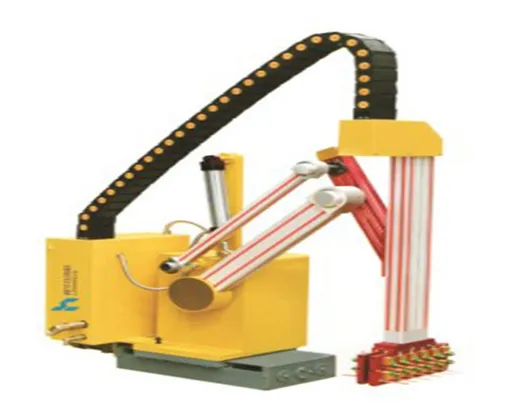
Aluminum alloy offers light weight (density is only 1/3 of steel) and excellent corrosion resistance. It works particularly well with water-based coatings and dissipates heat effectively in high-temperature environments. Haichen uses 280-ton large-scale die-casting machinery followed by CNC machining on internal channels to achieve enhanced concentricity control, minimized porosity defects, and optimized structural stability.
Stainless steel delivers chemical resistance, medium abrasion resistance, and high temperature resistance up to 500°C. Die-cast stainless steel nozzles work well for mass-produced larger nozzles.
Ceramics offer excellent wear resistance for high-abrasion applications but come at a higher cost.
Choose your material based on your operating temperature, the chemicals you are spraying, and your expected production volume.
Maintenance and Cleaning: What to Expect
Even the best nozzles need regular maintenance. Clogging is the most common issue—impurities in the release agent or water supply gradually block the nozzle orifice.
Basic cleaning involves removing the nozzle, clearing blockages with a thin wire or solvent, blowing it out with compressed air, and reinstalling it. A more thorough process includes removal, soaking, brushing, rinsing, drying, and reassembly.
Haichen addresses clogging proactively. Our anti-clogging nozzles reduce downtime by 30%. We also add fine secondary filters to the spray unit and separate air and release agent lines to prevent fluid thickening.
Ask your supplier about their nozzle cleaning recommendations and whether they offer designs that minimize clogging risk.
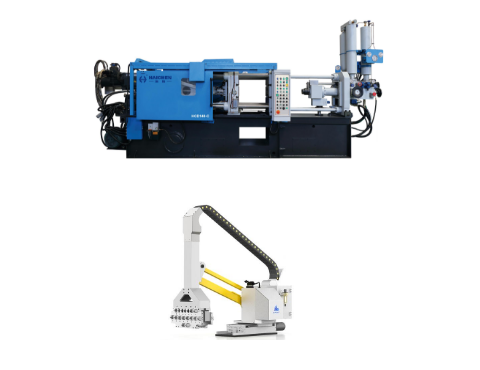
Haichen Case Studies: Real Results from Real Applications
Case 1: Optimized Spray Layout for Complex Molds
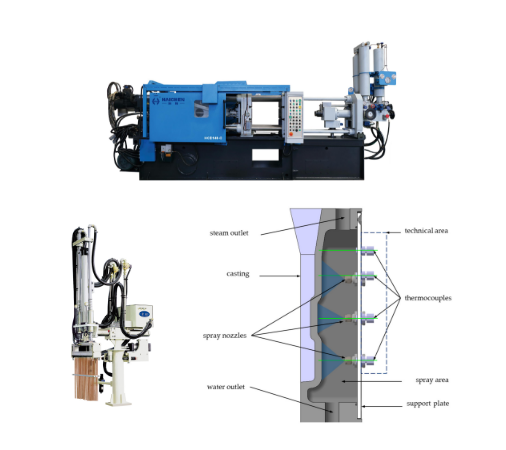
One Haichen customer faced inconsistent cooling and release agent coverage on a complex mold with deep ribs and hot joints. We redesigned their nozzle layout, using atomizing nozzles for the main cavity body and adding direct nozzles at deep ribs and hot joints to enhance cooling. Using Haichen’s multifunctional spraying control system, we independently set spraying time, air pressure, and flow parameters for nozzles in different areas. The result? Consistent coverage, fewer defects, and longer mold life.
Case 2: Servo-Controlled Precision Spraying
Another manufacturer struggled with uneven coating on a large mold with varying thermal requirements across different zones. Haichen configured a spray gun equipped with a high-dynamic-response servo system. By independently setting differentiated coating parameters and paths for different areas of the mold, we achieved precise thermal management. This approach reduced scrap rates and improved overall production efficiency.
Case 3: Reducing Release Agent Waste
Traditional spraying mixes release agent and water together and sprays them onto the mold at once. This method causes some water to evaporate and cool the mold while another part flows down, wasting both release agent and water. Haichen solved this by adding additional nozzle rows on the nozzle head to achieve independent spraying of water and release agent. This approach significantly reduced release agent consumption, lowered emissions, and optimized cooling through computer-controlled independent nozzle action.
Global Track Record
Haichen has successfully supplied die casting spray systems to manufacturers in Russia’s industrial regions, including Tolyatti—a major automotive hub. Our systems are built for real-world production environments, not just lab conditions.
Questions to Ask Your Nozzle Supplier
Before you place an order, ask these questions:
- “What nozzle type do you recommend for my mold geometry?” – Flat surfaces need different nozzles than deep cavities.
- “What materials do you offer, and why do you recommend one over another?” – The answer should reflect your operating conditions.
- “How does your nozzle design prevent clogging?” – Look for anti-clogging features and filtration recommendations.
- “What is the expected service life under my production conditions?” – Get a realistic estimate.
- “Do you offer customized nozzle layouts for complex molds?” – One-size-fits-all rarely works for challenging geometries.
- “What maintenance support do you provide?” – Know what you are getting into before you buy.
- “Can you show me case studies from similar applications?” – Proven results matter more than promises.
Selection Checklist
| Factor | What to Check |
|---|---|
| Flow Rate & Pressure | Match to your specific application requirements |
| Spray Pattern | Flat fan for large surfaces; cone for deep cavities; fine spray for atomization |
| Spray Angle | Wide angle (110-120°) for large areas; narrow (80-95°) for precision |
| Material | Aluminum alloy for water-based; stainless steel for chemicals/high temps |
| Atomization | Air atomizing for fine droplets; standard for general cooling |
| Clogging Prevention | Anti-clogging design; filtration system compatibility |
| Maintenance | Ease of cleaning; availability of spare parts |


