Aluminum is the most widely used material for die casting.
Aluminum alloy is the most widely used material in die casting due to its lightweight, high strength-to-weight ratio, good corrosion resistance, and excellent mechanical properties.
Among them, aluminum alloy A380 (ANSI/AA A380.0) is the most widely used specific alloy grade.
Which provides the best combination of performance and ease of processing.
And is suitable for a variety of applications such as electronic equipment, automotive components, and communication equipment.
Even if you’re not fully genned up on your metals, you’ll most likely know that they all offer different qualities.
In fact, in the desire to harness the best of these qualities many of the ‘metals’ on today’s market are not actually pure metals but alloys, so it’s important to be clear on what exactly a metal alloy is.
Put simply, it is when at least one metal is combined with another metal, or non-metal, to combine qualities e.g. making them stronger, lighter or more resistant to corrosion.
In die casting, alloys are frequently used to ensure the optimum characteristics are achieved for cast’s intended use.
There are a variety of alloys and metals that can be utilized in the die-casting process.
As mentioned earlier, the type of metal used influences the final characteristics of the manufactured products and these products have varied uses and applications.
What is die-casting?
Understanding what the process entails is a key part of finding out the different types of metals used and the differences observed in the characteristics of the finished products.
Die-casting is a metal fabrication process that involves subjecting the molten metal to very high pressures in specifically shaped reusable metal dies.
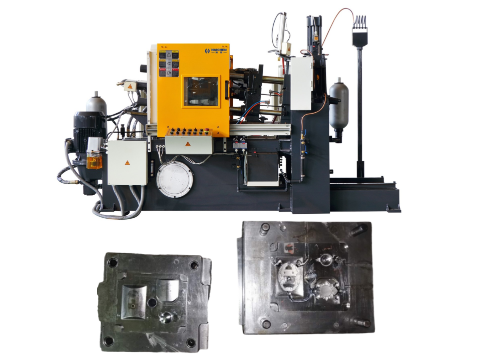
Die-casting enables the manufacturing of metal components with incredibly accurate specifications, smooth surfaces, and remarkable quality.
The main advantages of using the die-casting process are that it is relatively simple, fast, stable, and provides consistently good final results.
The process begins when you create a steel mold in two (or more) sections to enable casting ejection.
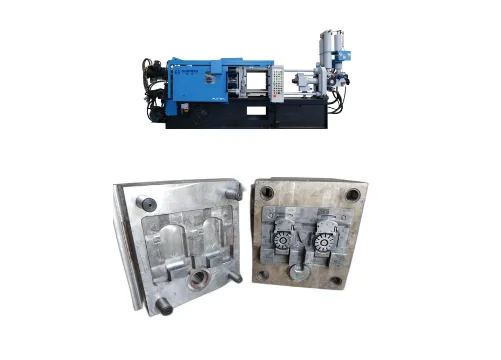
This mold has the ability to produce thousands of castings in very short periods of time.
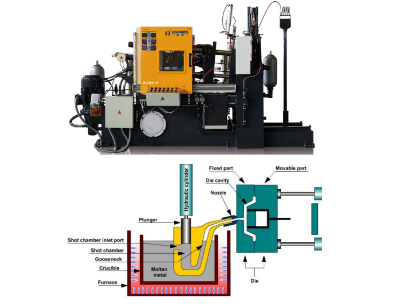
After mounting each section onto the machine, you arrange one half as fixed and the other as movable.
The machine clamps them together, marking the start of the process.
It injects molten metal into the mold and lets it solidify.You then release the two halves and remove the final casting.
Aluminum properties
- Lightweight
- High Strength-to-Weight Ratio
- Corrosion Resistance
- Excellent Thermal and Electrical Conductivity
- Dimensional Stability
- Recyclability
Additionally, aluminum’s recyclability and versatility further contribute to its popularity in the die casting industry.
Aluminum stands out for its lightweight nature, high strength, and corrosion resistance.
These properties make it ideal for a wide range of applications, including automotive parts, aircraft components, household appliances, and electronic devices.
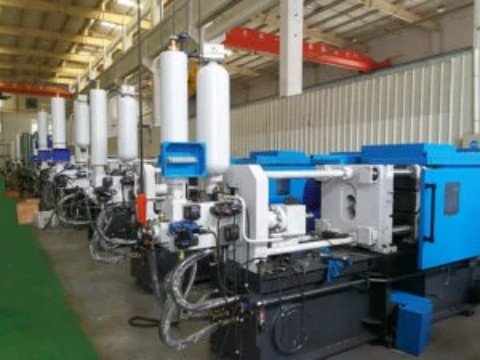
Lightweight
Aluminum has a low density, making it ideal for applications where weight reduction is critical, such as in the automotive and aerospace industries.
High Strength-to-Weight Ratio
Aluminum alloys used in die casting offer good strength while remaining lightweight.
Corrosion Resistance
Aluminum naturally forms a protective oxide layer, making it resistant to corrosion.
Excellent Thermal and Electrical Conductivity
Using aluminum widely used in components that require heat dissipation or electrical conductivity.
Dimensional Stability
Aluminum die cast parts maintain their shape and dimensions even under varying temperatures.
Recyclability
Aluminum is highly recyclable, making it an environmentally friendly choice.
Applications of Aluminum Alloy Die Casting
Automotive: Engine components, transmission housings, brackets, and structural parts.
Aerospace: Lightweight structural components and housings.
Electronics: Heat sinks, housings, and connectors.
Consumer Goods: Appliance components, power tools, and decorative hardware.
Industrial Machinery: Pump housings, valves, and hydraulic components.
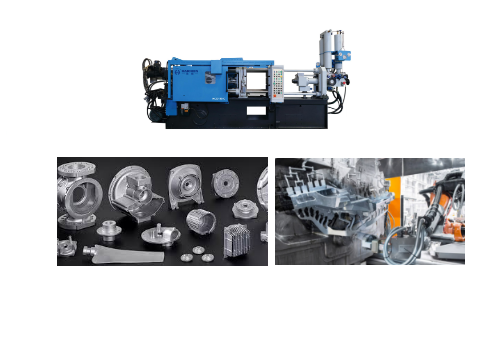
Other commonly used materials for die casting
- Zinc (Zinc)
- Magnesium
Zinc (Zinc)
Zinc alloy serves as another common die casting material, offering excellent corrosion resistance, easy casting, and high dimensional accuracy.
Actually,hot chamber die casting machines usually produce zinc die castings, which are suitable for manufacturing thin-walled and complex-shaped parts.
Their excellent mechanical properties and machinability make them widely used in die casting.
Magnesium
Magnesium alloys are the lightest die castable metal available, with high strength and good thermal properties.
Then cold chamber die casting machines typically produce magnesium alloy die castings.
Which are suitable for manufacturing parts that require light weight and high strength.
Then their low density and high strength make them widely used in the aerospace and automotive industries.
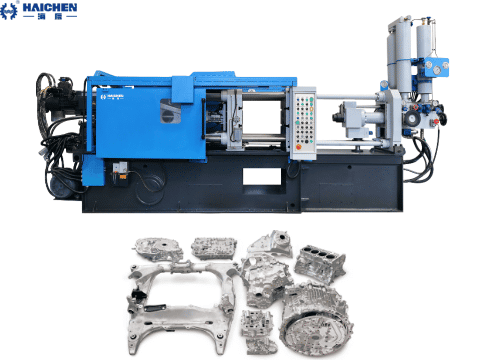
Haichen die casting machines supplier
Haichen is a well-known manufacturer and supplier of die casting machines, particularly recognized for producing high-quality cold chamber die casting machine, hot chamber die casting machines and auxiliary equipments.
We cater to a wide range of industries, including automotive, electronics, and consumer goods.
Reliability, precision, and advanced technology make Haichen’s machines a popular choice for die casting operations worldwide.
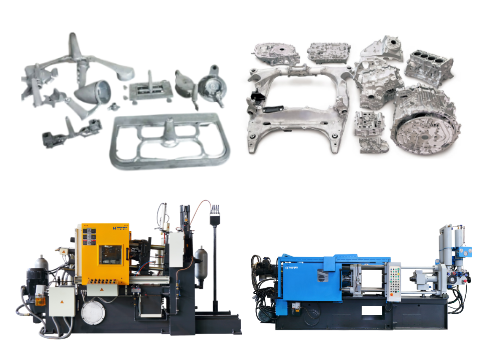
Key Features of Haichen Die Casting Machines
High Precision and Efficiency: Haichen machines are designed for high-performance die casting, thereby ensuring consistent quality and productivity.
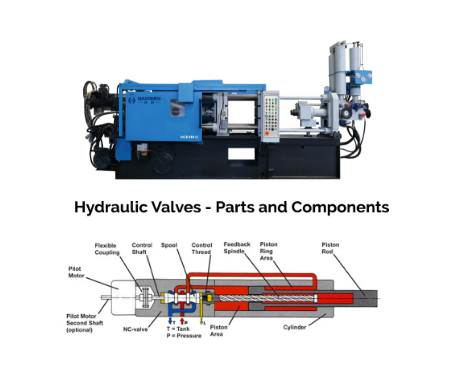
Advanced Control Systems: Haichen die casting machines often come with user-friendly PLC (Programmable Logic Controller) systems for precise control over the casting process.
Durable Construction: High-quality materials build Haichen machines, giving them longevity and low maintenance requirements.
Wide Range of Models: We offer machines with varying clamping forces, making them suitable for small to large-scale production needs.
Customization Options: Haichen provides tailored solutions to meet specific customer requirements.


