Die cast aluminum vs processes:Die cast aluminum offers several advantages over other manufacturing processes, such as high precision, lightweight, and strong parts, making it ideal for applications in automotive, aerospace, and consumer electronics.
Die casting is an integral manufacturing process used for producing a variety of metal components. Aluminum is one of the materials used in die casting, and it is particularly recognized for its unique set of characteristics. When comparing processes, aluminum die casting stands out for its ability to produce thin‑wall, lightweight parts at high volumes.
It is equally fails to compare die cast aluminum with other materials and processes. The following sections highlight where die cast aluminum outperforms sand casting, forging, and plastic injection molding.
This article will illustrate the advantages and applications associated with other processes and die cast aluminum. Key decision factors include part geometry, production volume, mechanical requirements, and cost targets.
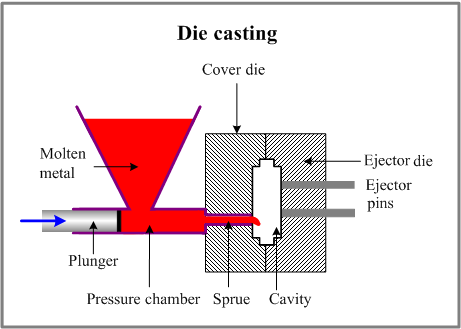
Die Casting Basics: Definition and Aluminum Die Casting Process
The Nature of Die Casting
Die casting is a metal casting process in which molten metal is injected at high pressure into a previously fabricated steel mold, or die. After cooling and solidification, high-precision part is formed. It is most beneficial when mass producing parts with intricate shapes and is able to provide them with exceptional dimensional stability and surface quality.
Key Steps in Aluminum Die Casting
The procedure begins with preparing the steel molds using a CNC machine.
Mold Preparation:
We machine the steel molds (typically H13 or similar tool steel) and then heat them before they enter the die casting machine. After heating, we cool the molds to approximately 25°C for final machining. We then remove the die inserts and mount them into the die construction for final finishing.
Molten Aluminum Injection:
The process continues as the ladle pouring equipment charges the holding ladle. We then mount the ladle and lower the entire holding assembly into the vertical furnace or crucible. A piston, capable of withstanding up to 10,000 psi, drives the molten metal under high pressure into the ladle holding equipment. This action creates a siphon-like effect that efficiently moves the metal.
Cooling and Ejection:
After a set cooling interval, we open the heated molds and remove the bottom piston, allowing compressed gases to escape freely. The cooling process then begins.
Post-Processing:
After cooling, the pressure drops, and the gas escapes to ambient air. The ejector pins push out the semi-solidified parts, and we remove the entire setup. Operators then perform manual tasks, such as removing the gates. After trimming the gates, we carry out surface treatments like anodizing and sandblasting to finish the parts.
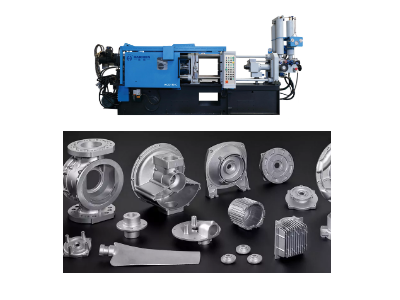
Comparison of Die Casting Process Types: Hot Chamber vs. Cold Chamber vs. Other
Mainstream Processes: Hot Chamber vs. Cold Chamber Die Casting
| Parameters | Hot Chamber | Cold Chamber |
| Applicable Metals | Low-melting-point alloys (zinc, tin, lead, magnesium) | High-melting-point alloys (aluminum, copper, some magnesium) |
| Working Principle | The injection system is immersed in a pool of molten metal and automatically draws in the molten metal | the molten metal is manually or automatically ladled into the cold chamber for injection |
| Production Efficiency | Very high (15–30 cycles/minute) | Low (5–15 cycles/minute) |
| Cost Structure | Low equipment cost, high maintenance cost (high-temperature corrosion) | High equipment investment, but a significant portion of material costs |
| Typical Applications | Small precision parts (gears, electronic components) | Large structural parts (engine blocks, vehicle frames) |
Cost‑Performance Comparison with Alternative Processes
| Process | Tooling Cost | Per‑Part Cost (10k units) | Max Wall Thickness | Surface Finish (Ra μm) | Typical Lead Time |
|---|---|---|---|---|---|
| Die Cast Aluminum | High ($20k‑80k) | Low ($0.5‑2) | 0.8‑4 mm | 0.8‑3.2 | 4‑8 weeks |
| Sand Casting | Low ($2k‑8k) | Medium ($3‑8) | 5‑20 mm | 6‑25 | 2‑4 weeks |
| Forging (Al) | Medium ($10k‑30k) | Medium ($2‑5) | 5‑15 mm | 1‑3 | 6‑12 weeks |
| Plastic Injection | Medium ($10k‑40k) | Low ($0.3‑1.5) | 1‑6 mm | 0.4‑1.6 | 3‑6 weeks |
Die cast aluminum is most cost‑effective for thin‑wall parts weighing under 5 kg and volumes above 20,000 pieces. For very thick sections (>8 mm) or low volumes (<2,000 pieces), sand casting or forging may be more economical.
Process Selection Decision Rule of Thumb
Choose die cast aluminum for parts with wall thickness under 4 mm, annual volume above 20,000 pieces, and weight below 5 kg. Choose sand casting for parts over 8 mm thickness or low volume (under 2,000 pieces). Choose forging for high-impact applications requiring fatigue resistance. Choose plastic injection for non-metallic applications where strength requirements are moderate. HAICHEN offers free process comparison reports based on customer part drawings.
Other Die Casting Process Variants
- Low-Pressure Die Casting: Air pressure propels the molten metal, reducing porosity and making it suitable for thick-walled parts such as automotive wheels.
- Vacuum Die Casting: Vacuuming the mold cavity reduces gas, increasing casting density and used for high-strength components.
- Semi-solid die casting: Injecting semi-molten metal into the mold to reduce shrinkage, suitable for high-precision magnesium/aluminum parts.
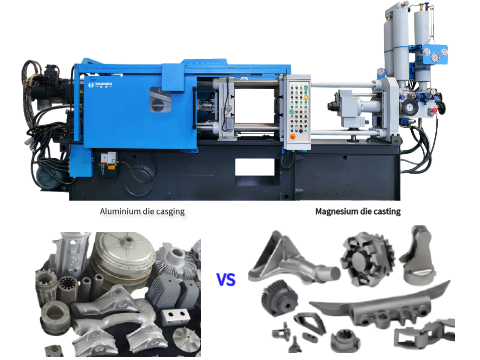
Die cast aluminum vs processes
Die Cast Aluminum
Properties
Die cast aluminum is lightweight, has a high specific strength, and is a strong thermal and electrical conductive material. These attributes, especially when combined, are useful in applications that require reduction in weight and high performance, for example, the automotive and aerospace industries.
Advantages
- Lightweight: Aluminum helps in achieving a lower vehicle weight and is therefore advantageous to fuel economy and vehicle handling.
- Strength: Aluminum’s high strength to weight ratio makes it a durable choice for structural components.
- Thermal Conductivity: Aluminum is widely used in applications that require the removal of waste heat, for instance, in the engines of vehicles and other electronics.
Typical Mechanical Properties of Die Cast Aluminum Alloys
| Alloy | Tensile Strength (MPa) | Yield Strength (MPa) | Elongation (%) | Hardness (HB) | Typical Use |
|---|---|---|---|---|---|
| A380 | 320 | 160 | 3.5 | 80 | Engine brackets, housings |
| ADC12 | 310 | 150 | 2.5 | 85 | Electronics, thin‑wall parts |
| A360 | 320 | 170 | 3.0 | 75 | Corrosion‑resistant components |
| A383 | 310 | 150 | 3.5 | 75 | Complex, thin‑wall castings |
Compared to sand cast A356 (T6: 280 MPa tensile, 6% elongation), die cast A380 offers higher as‑cast strength but lower elongation. For parts requiring heat treatment or welding, permanent mold or sand cast alloys may be preferred. HAICHEN machines are calibrated to handle all common die cast aluminum alloys with stored process parameters.
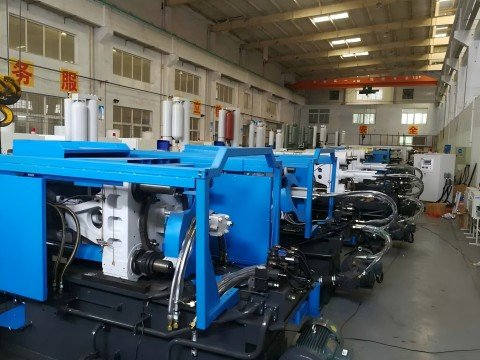
Choosing the Right Process
Application Needs
The decision of using die cast parts aluminum or other alternatives hinges upon the application’s needs. Considerations include the size of the part, its complexity, the desired material characteristics, and the production scale.
Cost Considerations
In die casting’s case, the price per part is lower when the volume is higher, making this method the go-to option for mass production. If only a few parts or a prototype is needed, other methods may be best.
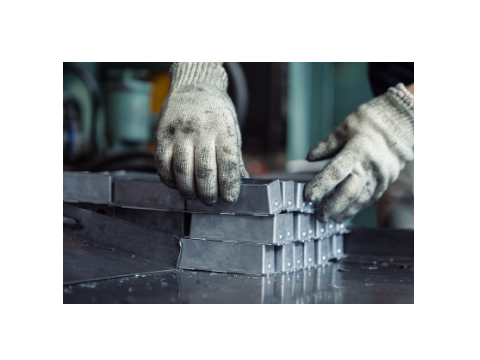
Aluminum Die-Casting Industry Application Examples
Automotive Manufacturing (Core Market)
- Powertrain: Critical components include cylinder blocks, cylinder heads, and crankcases. (More than 30% weight savings translates to better fuel efficiency.)
- Body Structure: Integral cast components include door frames and instrument panel brackets, reducing the overall structure weight of the vehicle and thus, increasing fuel efficiency.
- Electric Vehicle Components: Battery pack and motor housings. (Both need to be lightweight and have effective thermal management.)
Electronics and Consumer Industry
- Cooling Components:Heat sinks for CPUs and LED housings serve as Cooling components (Offers high thermal conductivity and precision molding.)
- Casing Structure: Provided to a laptop and other gadgets, a laptop chassis and other appliance housings. (Important to have a high quality surface finish and corrosion resistant).
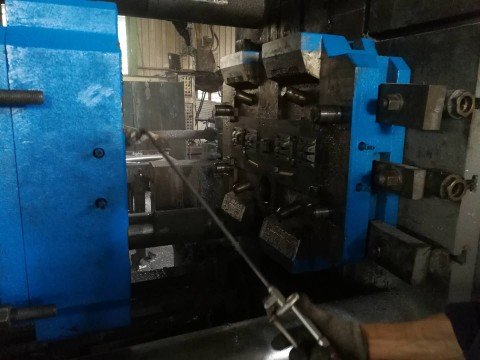
HAICHEN: Your Partner in Die Casting Excellence
HAICHEN: Your Partner in Die Casting Excellence At HAICHEN, we manufacture die casting machines to high standards, ensuring precision and efficiency at every stage of the production process. Our machines are equipped with advanced modern features that provide for consistent production and the manufacture of high quality products. Whatever your products are, be it automotive parts, consumer electronics, or any others, HAICHEN has the solutions to fulfill your requirements.
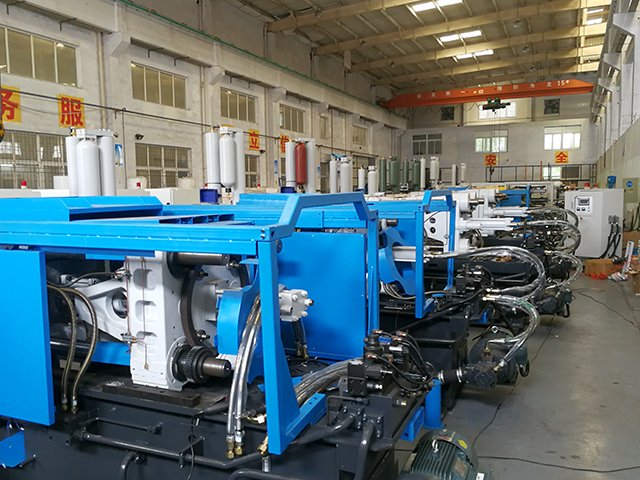
For making the right choice for your production requirements, understanding the differences between die cast aluminum and other processes is crucial. Die cast aluminum is favored by many industries because it is lightweight, strong and has excellent thermal conductivity.


