Ladle Components in die casting include ladle cup, main frame, pouring spout, handle & lever mechanism, temperature control features, and etc.
In the die casting process, the ladle is an important component used to transfer catalyst metal from the furnace pipe to the die casting mold cavity.
The ladle plays a key role in both cold chamber and hot chamber die casting.
And its design and use directly affect the quality of castings and production efficiency.
Ladles are used as the vessel to transport and pour molten metals.
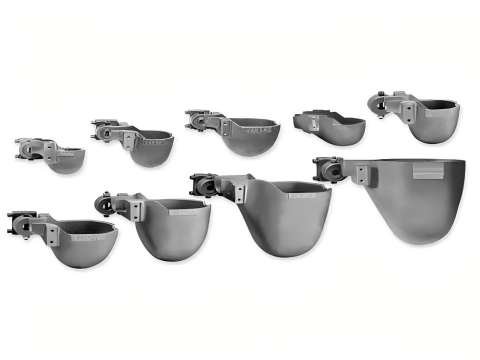
They range in size to accommodate the pour weights needed.
Ladles are made of different materials for different alloys.
Steel and Iron Ladles are often large and use air or hydraulics to move and lift them.
These steel-fabricated shells feature refractory lining to insulate against heat and maintain metal temperature. Designers offer covered or open versions.
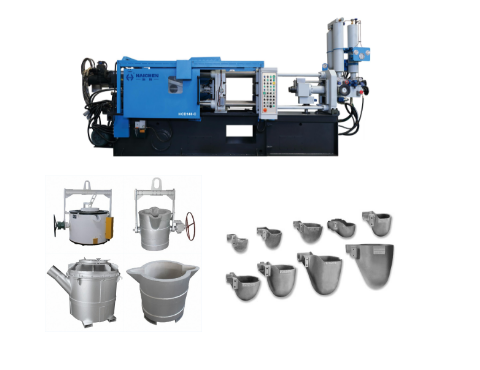
Workers use some ladles for magnesium treatments in ductile iron.
Engineers normally design these specifically, similar to a covered tundish, though they can also take the form of a standard open bull type.
They can be treatment, transfer, or pouring ladles.
Non-Ferrous foundries use the fabricated refractory lined shell-type ladles for large transfers or pouring large parts.
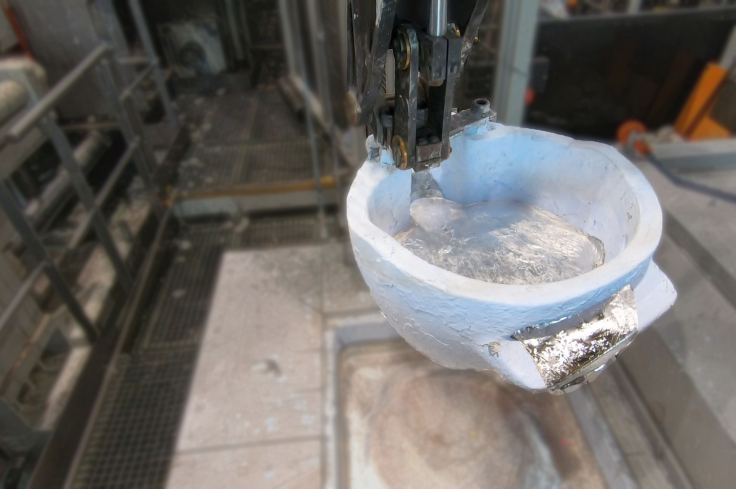
However, most aluminum foundries use hand or robotic ladles made of ceramic, graphite, or coated steel welded to a steel rod.
These are sized for the pour weights of each job.
They can be used by hand or mounted to a robotic arm.
Permanent mold and die casters often use robotic arm ladles.
What is Ladle?
A ladle is a large, refractory-lined vessel used in steelmaking and primary metal processing to transport, hold, and refine molten metal, primarily steel and iron.
It serves as an intermediate container that facilitates the transfer of molten metal from the primary furnace to secondary processing units like casting machines or continuous casting molds.
In the overall steel production chain, the ladle plays a crucial role in metallurgical treatment, temperature adjustment, alloying, and inclusion removal.
It is positioned after the primary melting stage and before casting, acting as a critical link that ensures the molten metal’s quality and consistency before solidification.
The ladle’s fundamental purpose is to maintain the molten metal in a controlled environment.
Allowing for precise temperature management, chemical adjustments, and inclusion control.
It also enables efficient handling and transportation within the steel plant, supporting continuous and batch processing operations.
Ladle Cup
- Function
- Materials
Function
The ladle cup is the core component that scoops and pours molten metal.
It is designed to withstand high temperatures and resist wear.
Materials
Ladle cups can be made from high-duty cast iron or ceramic materials.
Ceramic cups have a high melting point (1860°C ± 10°C) and low thermal expansion, making them suitable for high-temperature environments.
They also prevent oxides from entering the molten metal, reducing defects in the final casting.
Cast iron cups, while less resistant to thermal shock and corrosion, are more cost-effective and have good thermal conductivity.
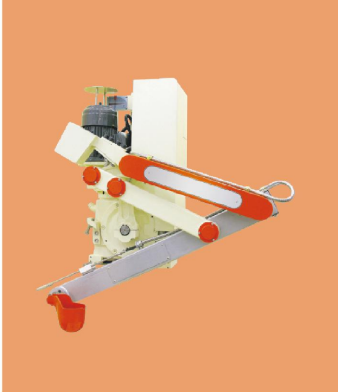
Main Frame
- Function
- Materials
Function
The main frame supports the entire ladle structure, including the moving mechanism, rocker arm mechanism, and ladle cup.
Materials
Typically made from steel, the main frame provides the structural strength needed to handle the weight and movement of the ladle.
Other Components
- Pouring Spout
- Handle & Lever Mechanism
- Temperature Control
- Skimming Edge
- Lifting Lugs / Hooks
- Lid
- Weight & Volume Markings
Pouring Spout
- Designed for controlled metal flow into the die.
- Prevents oxidation and slag inclusion by minimizing turbulence.
- Often tapered to improve accuracy.
Handle & Lever Mechanism
- Allows the operator to tilt the ladle for pouring.
- Manual ladles have a long handle for operator safety.
- Automated systems may use hydraulic/pneumatic actuators for precision.
Temperature Control
- Some ladles include heating elements or ceramic insulation to maintain molten metal temperature.
- Thermocouples may be integrated for real-time monitoring.
Skimming Edge
- Helps remove dross (oxide layer) from the molten metal surface before pouring.
- Ensures cleaner metal enters the die.
Lifting Lugs / Hooks
- Used for mechanical handling (e.g., crane or robotic arm).
- Ensures stability during transport.
Lid (Cover)
- Optional but useful for preventing heat loss and contamination.
- Often used in automated die casting systems.
Weight & Volume Markings
- Helps operators measure the correct amount of molten metal for each shot.
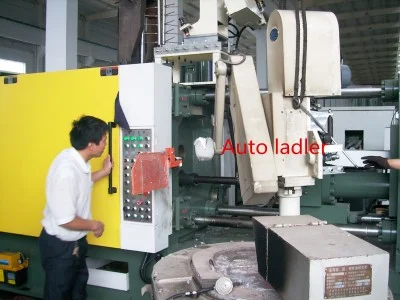
Die-casting machine operates in coordination with the ladle
- Coordinated Control of Automation and Servo Systems
- Intelligent temperature management and temperature control
- Automation operation and positioning
- Precise control and measurement
- Application of Automation and Robotics Systems
Coordinated Control of Automation and Servo Systems
The ladle equipment of the Haichen die-casting machine is usually equipped with high-performance servo valves and pumps.
Which can achieve synchronization between the ladle movement and the die-casting unit.
Enabling rapid acceleration (up to 8m/s) and precise pressure control during the metal injection process.
This automated control ensures the accuracy and stability of the metal injection.
Intelligent temperature management and temperature control
During the metal pouring process, temperature control is crucial.
Haichen combines thermocouples with the ladle system to maintain the optimal temperature of the metal to prevent premature solidification.
This temperature control helps to improve the quality of the castings.
Automation operation and positioning
The ladle usually operates through a linkage mechanism to prevent the device from sinking into the molten pool, and adjusts the inclination angle to control the amount of metal injection.
This automated operation ensures the precise injection of the metal.
Additionally, the ladle can achieve precise control of the injection position and quantity of the metal by horizontally moving the device and vertically elevating the device, ensuring that the metal accurately enters the gate of the mold.
Precise control and measurement
By means of flow rate control, landing point control, and filling weight control, the injection process of metals can be precisely controlled.
Optimizing the pouring speed of the ladle and the rapid transfer process can reduce temperature fluctuations and enhance production efficiency.
Application of Automation and Robotics Systems
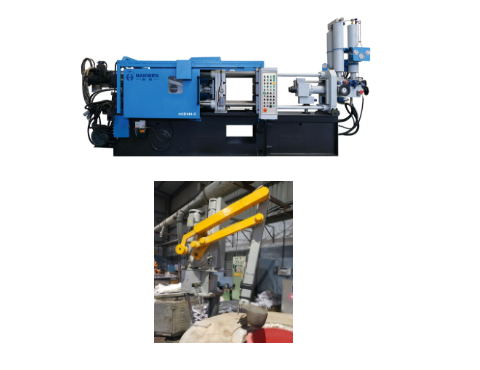
A ladle is usually used in conjunction with automated systems.
Such as robotic arms, encoder synchronization to achieve precise control in continuous production.
For instance, the automatic lifting device and automatic lid opening device of the ladle can reduce temperature loss and enhance operational efficiency.
Die casting ladle supplier: Haichen Machinery
Haichen Machinery is a well-known manufacturer of die-casting equipment, including die-casting ladles (pouring ladles or dosing furnaces) used for transferring molten metal into cold chamber die-casting machines.
Our ladles provide precision, efficiency, and durability in high-pressure die-casting (HPDC) operations.
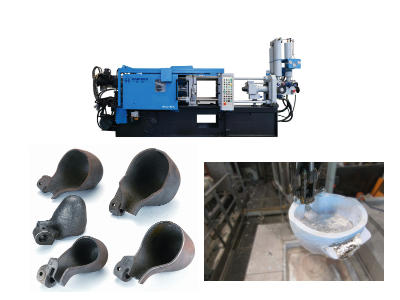
The Haichen Ladle offers several advantages that enhance the efficiency and quality of the die casting process:
- High-Quality Materials
- Minimized Heat Loss and Oxidation
- Long Service Life
High-Quality Materials
Haichen Ladle are made from durable materials such as ductile cast iron, which provides excellent wear resistance and a hardness of 45-50 HRC.
This material ensures that the ladle cups can withstand the high temperatures and repeated use associated with die casting operations.
Minimized Heat Loss and Oxidation
The ladle cups can minimize heat loss and exposure of molten metal to air.
This reduces oxidation and the formation of defects in the cast product.
The preheating and insulation features of the ladle cups help maintain the optimal temperature of the molten metal during the casting process.
Long Service Life
The ladle cups are built to last, with a service life of over 5000 uses.
This longevity reduces the frequency of replacements and maintenance, lowering overall production costs.
If there is any demand for die casting ladles cup, welcome to consult us.


