What does a die casting machine control system actually do? A die casting machine control system manages every phase of the casting cycle—from mold closing and injection to cooling and ejection. It monitors pressure, speed, temperature, and position in real time, and it adjusts these parameters automatically to keep your production running smoothly. It also coordinates peripheral equipment like robots, sprayers, conveyors, and vacuum systems.
If you are a procurement professional evaluating control systems, the die casting machine control system directly affects your scrap rate, cycle time, energy consumption, and operator efficiency. A well-designed control system delivers consistent part quality, reduces downtime, and gives you the data you need to optimize your entire production line.
This guide walks you through the key applications of a die casting machine control system and what they mean for your operation.
Injection Process Control
The injection phase is the most critical part of the die casting cycle. The die casting machine control system manages the speed and pressure of the plunger as it pushes molten metal into the mold cavity.
Multi-stage injection control. Modern control systems divide the injection stroke into multiple stages—slow injection, first fast, second fast, and intensification injection. Each stage requires precise speed and pressure settings. The control system adjusts these parameters on the fly to match the specific requirements of each part design.
Real-time closed-loop control. The system uses high-speed sensors to monitor injection parameters continuously. Haichen installs closed-loop injection control systems with sensors sampling at 1,000 Hz. This allows the system to detect deviations and correct them immediately. For example, if the system detects a pressure drop during the fast-fill stage, it adjusts the hydraulic valve opening automatically to compensate.
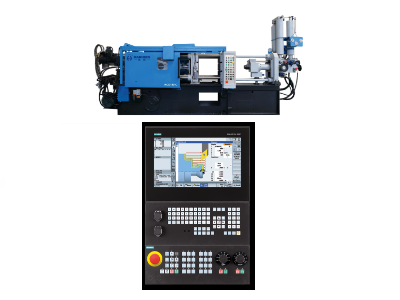
High-speed response. The injection process demands extremely fast response times. One control system achieves response times of 200 microseconds. The die-casting piston needs to accelerate from 0.5 m/s to more than 7-10 m/s within approximately one second. The control system must read and write data fast enough to maintain stability under these extreme conditions.
What this means for you: Precise injection control directly reduces porosity and scrap rates. In one Haichen case, a manufacturer producing aluminum automotive transmission housings reduced porosity rates from 4.2% to 1.1% and cut scrap by 73% after installing a closed-loop injection control system.
Clamping and Mold Control
The clamping unit holds the mold closed during injection, and the die casting machine control system manages this critical function.
Clamping force management. The control system monitors and adjusts clamping force to keep the mold securely closed throughout the injection cycle. It ensures that the mold halves remain properly aligned and that the clamping force distributes evenly across the mold surface.
Low-pressure mold protection. The system includes low-pressure clamping protection functions that prevent damage to the mold during closing. If the system detects an obstruction or misalignment, it stops the closing sequence before damage occurs.
Mold temperature control. The control system regulates cooling channels to maintain consistent mold temperatures. Maintaining mold temperature within the range of 220-235°C is critical for defect-free casting. Deviation from this range increases the occurrence of misruns and shrinkage defects.
What this means for you: Good clamping and mold control extends mold life, reduces defects, and keeps your production running reliably.
Hydraulic System Optimization
The hydraulic system powers the injection and clamping functions, and the die casting machine control system manages its operation efficiently.
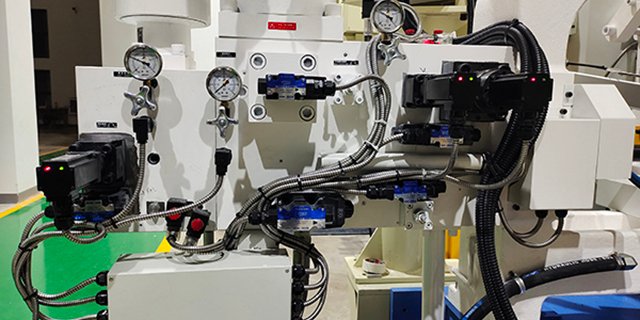
Smart pump management. The control system continuously adapts hydraulic output to actual demand. This reduces wear on hydraulic pumps, increases the service life of the entire hydraulic system, and improves energy efficiency. One retrofit solution integrated smart pump management during ongoing production in just 20 minutes.
Proportional control. Many modern die casting machines use proportional control hydraulic drive systems. These systems achieve multi-stage pressure and speed control through proportional valves. The control system manages these valves to deliver precise, repeatable performance.
Servo energy-saving systems. The control system works with servo motors and oil pumps to achieve high control accuracy and energy savings. This type of system realizes precise hydraulic control through communication between the upper computer and the PLC, as well as operating parameters set on the touch screen.
What this means for you: Optimized hydraulic systems reduce energy consumption and maintenance costs. Smart pump management can lower energy consumption and extend component life significantly.
Peripheral Equipment Integration
A modern die casting cell includes more than just the die casting machine. The die casting machine control system coordinates all peripheral equipment.
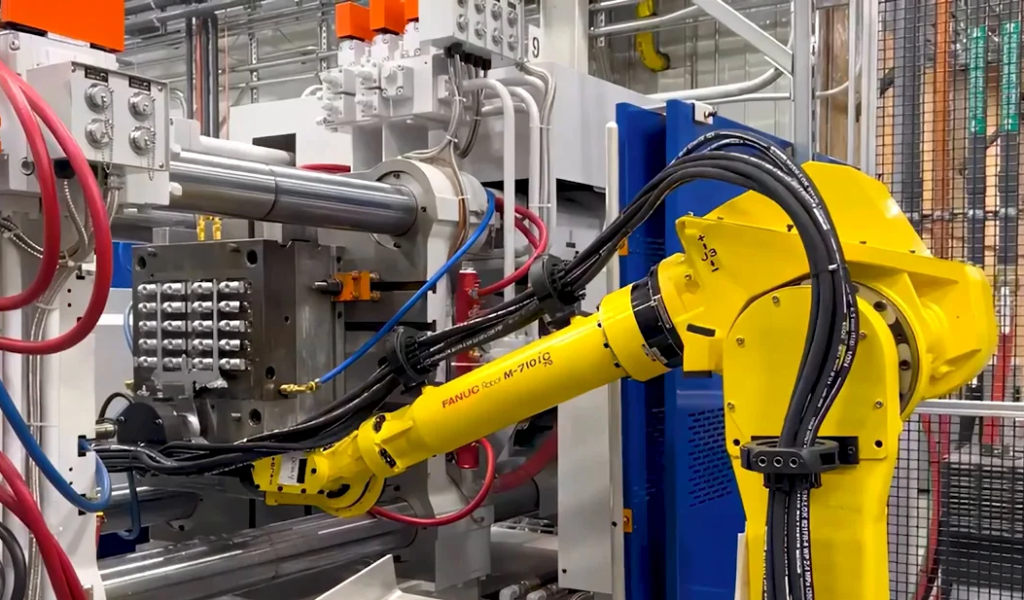
Robot integration. The control system manages robot operations including part extraction, mold spraying, and ladling. It synchronizes robot movements with the machine cycle, ensuring that each action happens at the right time.
Spray system control. The control system manages the spraying of release agent onto the mold surface. It controls spray timing, duration, and pattern to ensure even coverage. AI integration can optimize the spray process for better results.
Vacuum system coordination. For vacuum die casting, the control system manages the vacuum pumps and valves. It ensures that the vacuum reaches the required level before injection begins.
Conveyor and trim press control. The system coordinates part transfer to conveyors and trim presses, managing the entire post-casting material flow.
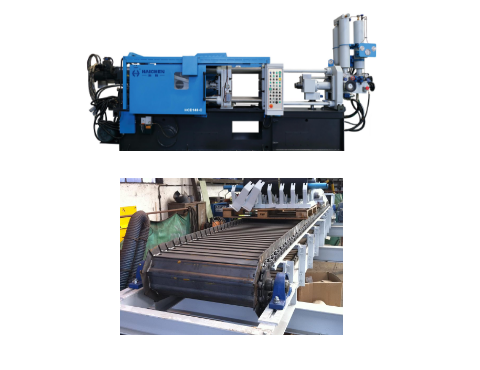
What this means for you: Integrated peripheral control reduces manual intervention, improves consistency, and enables fully automated operation.
Human-Machine Interface and Operator Control
The die casting machine control system provides the interface between operators and the machine.
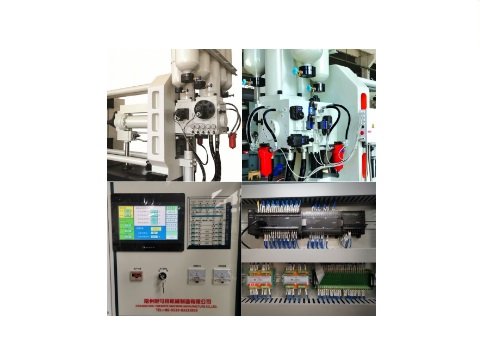
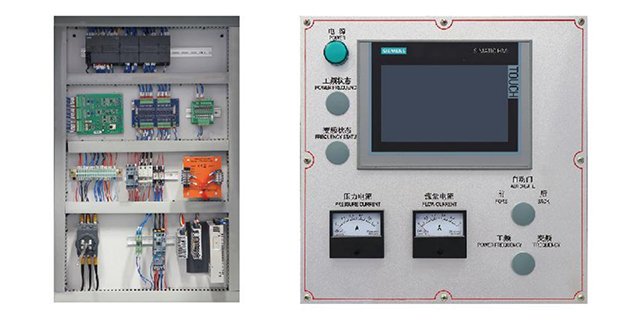
Touch screen HMI. Modern control systems feature large touch screens with well-designed graphical user interfaces based on ergonomics. A 15-inch screen improves the operator’s maintenance and management environment.
Multiple operating modes. The system provides different program modes for different production needs. Haichen’s systems offer “MANU”, “SEMIAUTO”, and “AUTO” modes. Semi-automatic mode runs a single cycle with operator interaction, while automatic mode runs continuously without intervention.
Password protection and user management. The control system restricts access to critical settings. Passwords prevent unauthorized changes to conditions during production and restrict operations by user. Set conditions, monitor, and maintenance functions operate on a per-screen basis.
Multilingual support. Systems support multiple languages for global production management.
What this means for you: An intuitive HMI reduces operator training time, minimizes errors, and gives you better control over your production process.
Real-Time Monitoring and Data Collection
The die casting machine control system continuously monitors the production process and collects data for analysis.
Comprehensive parameter monitoring. The system tracks injection position, injection speed, casting pressure, temperature, and other key parameters. Operators can see machine status, operating parameters, injection data, and production information on the HMI.
Waveform display. The control system displays injection waveforms that show speed, pressure, and position over time. This visualization helps operators understand the injection process and identify issues quickly.
Production data management. The system collects and stores production data for quality control and process improvement. This data supports traceability and continuous optimization.
Remote monitoring capability. Some systems support remote monitoring and diagnostics. This allows technicians to troubleshoot issues without being physically present at the machine.
What this means for you: Real-time monitoring helps you catch problems early, reduces downtime, and provides the data you need to optimize your process.
Quality Control and Defect Prevention
The die casting machine control system plays a direct role in preventing defects and ensuring part quality.
Adaptive control. The system adapts in real time to alloy transitions and changes in mold geometry. This supports more robust, energy-efficient, and quality-stable casting operations.
Predictive adjustments. Visualization modules capture casting temperature, piston velocity, and pressure fluctuations during solidification. This allows predictive adjustments and optimization of process phases without operator intervention.
Fault detection and diagnosis. The system includes failure diagnosis functions that help identify problems quickly. PLC ladder monitoring helps investigate the cause of malfunctions and troubles.
Quality data capture. Some systems track up to 48 quality control items, including temperature and each process time. This comprehensive data helps you maintain consistent quality across production runs.
What this means for you: Better quality control means fewer defects, less scrap, and more satisfied customers.
Energy Efficiency and Sustainability
The die casting machine control system helps you reduce energy consumption and operating costs.
Demand-based hydraulic control. The system adapts hydraulic output to actual demand, reducing energy consumption. One study found that adaptive control systems reduced energy consumption per 1,000 units by nearly 10%.
Servo energy-saving systems. Servo hydraulic systems save significant energy compared to conventional systems. The control system manages these systems for maximum efficiency.
Intelligent thermal management. The system optimizes heating and cooling to minimize energy waste while maintaining proper process temperatures.
What this means for you: Lower energy consumption reduces your operating costs and supports your sustainability goals.
Automation and Production Efficiency
The die casting machine control system enables high levels of automation that increase production efficiency.
Fully automatic operation. The system supports fully automatic, consecutive operation. Once set up, the machine runs continuously without operator intervention, producing parts cycle after cycle.
Quick changeover. The control system stores process parameters for different parts, allowing rapid changeovers between products.
Scalable automation. The system integrates with additional automation equipment as your production needs grow.
What this means for you: Higher automation levels increase throughput, reduce labor costs, and improve consistency.
Haichen’s Control System Solutions
Haichen Machinery integrates advanced control systems into our die casting machines to deliver precision, reliability, and efficiency.
Siemens PLC control. Most high-performance Haichen die casting machines adopt Siemens PLC control systems. These systems support intelligent human-machine interface configuration, making it possible to open and close the mold, set up the lubrication system, and perform other operations quickly and accurately on the screen.
Closed-loop injection control. Haichen installs closed-loop injection control systems with high-speed sensors sampling at 1,000 Hz. This system detects deviations and corrects them in real time, ensuring consistent injection quality.
Multi-stage injection control. Haichen C series horizontal cold chamber die casting machines feature four-stage injection control: slow injection, first fast, second fast, and intensification injection. A magnetic grating ruler controls the injection position through computer PLC, enabling direct control, changes, and adjustments of the four-stage injection position.
Multiple operating modes. Haichen systems provide MANU, SEMIAUTO, and AUTO modes, with PULLING CORE SELECT and DIE HIGH SELECT functions.
Peripheral integration. Haichen systems integrate with robots, sprayers, conveyors, vacuum systems, and other auxiliary equipment.
What this means for you: Haichen’s control systems deliver the precision, reliability, and automation you need to produce high-quality castings efficiently and cost-effectively.
Questions you may have
Before you commit to a die casting machine, ask these questions about the control system:
- “What type of control system do you use—PLC-based or PC-based?” – PLC systems offer reliability; PC-based systems offer more flexibility.
- “What is the control system’s response time?” – Faster response times mean better control during high-speed injection.
- “Does the system support closed-loop control for injection?” – Closed-loop control delivers more consistent results.
- “How many injection stages does the system support?” – More stages give you finer control over the injection process.
- “Can the system integrate with robots and other peripheral equipment?” – Integration capability determines your automation potential.
- “What data does the system collect and how can I access it?” – Data access helps you optimize your process.
- “Does the system support remote monitoring and diagnostics?” – Remote support reduces downtime.
- “What energy-saving features does the system include?” – Energy efficiency affects your operating costs.


