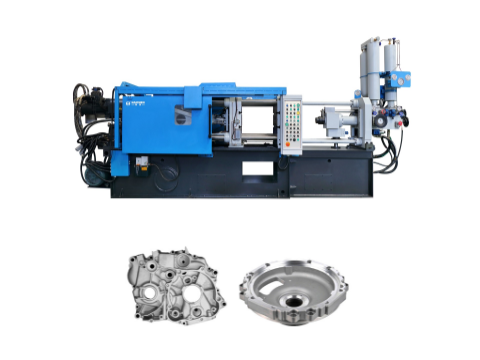
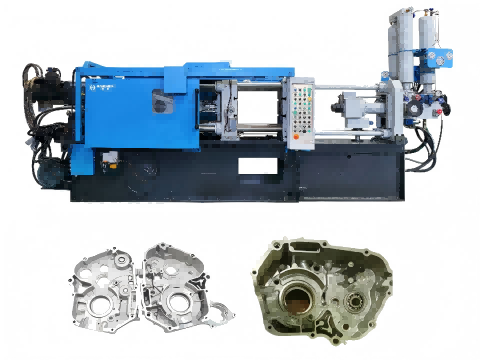
A crankcase die casting machine is used to produce metal crankcases, especially aluminum crankcases for automotive, motorcycle, and industrial engines.
The machine injects molten metal into a steel die at high speed and pressure, allowing manufacturers to produce complex parts with consistent dimensions and good surface quality.
For high-volume production, high-pressure die casting is a practical choice because one mold can produce many identical crankcases with relatively short cycle times.
This article explains the main advantages of using a die casting machine for crankcase production, the basic production process, and how to select suitable equipment.
What Is a Crankcase Die Casting Machine?
A crankcase die casting machine is a high-pressure casting machine designed to form metal components such as engine crankcases.
For aluminum crankcases, manufacturers normally use a cold chamber die casting machine. The aluminum alloy is melted in a separate furnace and then transferred to the shot sleeve.
The injection system pushes the molten metal into the mold at high speed.
The machine mainly includes:
- Clamping system
- Injection system
- Hydraulic or servo hydraulic system
- Control system
- Mold and cooling system
- Ejection system
For complex crankcases, auxiliary equipment such as an automatic ladle, mold sprayer, vacuum system, robot, and conveyor can also be integrated into the production line.
Why Use Die Casting for Crankcase Production?
1. Suitable for Complex Shapes
Engine crankcases usually contain ribs, mounting points, oil passages, bosses, and other complex structures.
High-pressure die casting allows molten aluminum to fill these complex mold cavities quickly.
As a result, manufacturers can produce complicated shapes without machining the entire component from a solid block.
This is especially useful when the crankcase has thin walls and multiple integrated features.
2. High Production Efficiency
Die casting uses a reusable metal mold, so the same mold can produce a large number of identical parts.
Once the mold and process parameters are properly optimized, the machine can operate continuously with automatic metal feeding, spraying, extraction, and conveying.
Therefore, die casting is suitable for automotive and motorcycle manufacturers with large annual production requirements.
3. Good Dimensional Consistency
Crankcases must connect accurately with other engine components. Important areas may include:
- Bearing seats
- Mounting surfaces
- Oil passages
- Cylinder connection areas
- Bolt holes
A rigid die casting machine and a well-designed mold help maintain consistent dimensions during mass production.
However, final dimensional accuracy also depends on mold design, alloy selection, process parameters, cooling, and subsequent CNC machining.
4. Lightweight Aluminum Components
Aluminum alloys are widely used for crankcase production because they provide a useful balance between weight, strength, corrosion resistance, and castability.
A properly designed aluminum crankcase can reduce component weight while maintaining the required structural performance.
Common alloys used in aluminum die casting include A380, A383, ADC12, and other application-specific alloys.
The final alloy should be selected according to mechanical requirements, casting performance, operating temperature, and machining requirements.
5. Good Surface Quality
High-pressure die casting can produce relatively smooth surfaces directly from the mold.
This can reduce the amount of machining required on non-critical surfaces.
However, important functional areas such as bearing bores and precision mounting surfaces normally still require CNC machining after casting.
6. Lower Cost in High-Volume Production
The initial investment in a die casting mold and machine can be significant.
However, the economics become more attractive when production volume is high.
The reusable mold, short production cycle, automated handling, and reduced machining requirements can lower the cost per crankcase over a large production run.
For this reason, die casting is generally more suitable for mass production than low-volume production.
Crankcase Die Casting Process
The basic production process includes several stages.
Step 1: Prepare the Mold
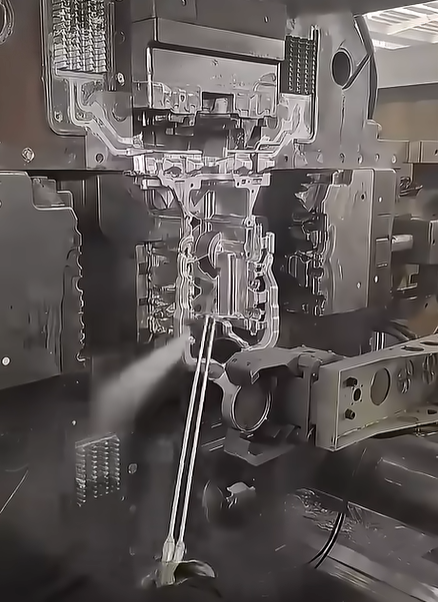
The crankcase mold is designed according to the part geometry, alloy, projected area, wall thickness, cooling requirements, and production volume.
The gating, overflow, venting, and cooling systems are particularly important for complex crankcases.
Step 2: Melt the Aluminum Alloy
The selected aluminum alloy is melted in a furnace and maintained within the required temperature range.
The molten metal is then transferred to the cold chamber of the die casting machine.
Step 3: Inject Molten Metal
The injection system pushes the molten aluminum into the mold cavity at high speed.
Injection speed and pressure must be controlled carefully.
Poor parameter settings can cause defects such as cold shuts, air entrapment, porosity, and incomplete filling.
Step 4: Intensification and Solidification
After the cavity is filled, pressure is maintained while the aluminum solidifies.
The mold cooling system controls heat removal and helps stabilize the casting cycle.
For crankcases that require high internal quality or leak tightness, vacuum-assisted die casting can be considered to reduce trapped gas and porosity.
Step 5: Open the Mold and Remove the Casting
After sufficient solidification, the mold opens and the ejector system removes the crankcase.
An automatic extractor or robot can be used for continuous production.
Step 6: Trimming and Machining
The casting is then trimmed to remove the gate and overflow material.
Depending on the design, additional processes may include:
- Shot blasting
- Deburring
- CNC machining
- Leak testing
- Surface treatment
- Dimensional inspection
How to Choose a Die Casting Machine for a Crankcase?
Choosing the correct machine requires more than looking at the machine tonnage.
1. Calculate the Required Clamping Force
The projected area of the crankcase and the pressure inside the mold determine the required clamping force.
A machine with insufficient clamping force may cause flashing during injection.
Therefore, manufacturers should calculate the projected area of the complete casting, including the runner system, and select an appropriate safety margin.
2. Check the Injection Capacity
The injection system must provide enough shot weight to fill the crankcase mold and runner system.
The required shot capacity depends on:
- Casting weight
- Number of cavities
- Runner weight
- Overflow weight
- Required process conditions
For large aluminum crankcases, injection performance becomes particularly important because the molten metal must fill the mold before premature solidification.
3. Consider Mold Dimensions
The mold must fit within the machine’s platen dimensions and tie-bar spacing.
Check:
- Mold width and height
- Mold thickness
- Tie-bar distance
- Maximum mold opening
- Minimum mold thickness
- Ejection stroke
4. Consider Vacuum Die Casting
If the crankcase requires high density or good leak tightness, vacuum-assisted die casting can be valuable.
Vacuum technology helps remove air from the mold cavity before or during filling. This can reduce gas-related defects and improve casting quality.
5. Consider Automation
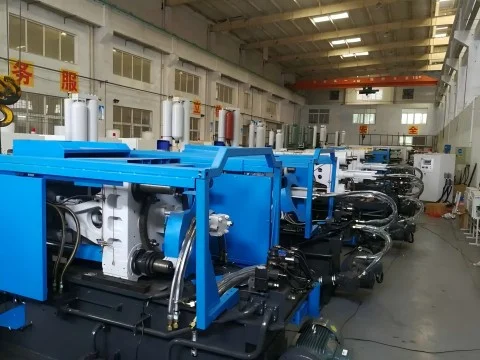
For mass production, automation can significantly improve production consistency.
A crankcase production line may include:
Die casting machine → automatic ladle → mold sprayer → extractor robot → trimming → conveyor → inspection
The exact configuration depends on the casting design and factory layout.
What Are the Main Advantages of a Crankcase Die Casting Machine?
For manufacturers producing aluminum crankcases in medium or high volumes, the main benefits include:
| Advantage | Production Benefit |
|---|---|
| High-pressure filling | Suitable for complex crankcase geometries |
| Reusable steel mold | Supports high-volume production |
| Fast cycle | Increases production output |
| Good dimensional consistency | Reduces variation between parts |
| Aluminum alloy compatibility | Supports lightweight engine components |
| Automation | Reduces manual handling |
| Vacuum option | Helps control internal porosity |
| Integrated production line | Improves overall efficiency |
Haichen Crankcase Die Casting Machine
Haichen provides cold chamber die casting machines for aluminum and magnesium alloy applications.
The HCD-C series covers a wide range of clamping forces and can be configured according to the casting size, projected area, mold requirements, and production volume.
For crankcase production, the machine can be combined with auxiliary equipment such as:
- Automatic ladle
- Automatic mold sprayer
- Vacuum system
- Industrial robot
- Conveyor
- Mold temperature controller
The appropriate machine should be selected according to the actual crankcase drawing and production requirements rather than by tonnage alone.
For example, a manufacturer should provide the casting weight, projected area, mold dimensions, alloy, annual production target, and cycle-time requirement before selecting the machine model.


