In crankcase manufacturing, materials such as cast iron and aluminum alloys are predominantly used.
For many crankcase applications, cast iron remains a preferred material. Because of its strength and ability to resist very high compressive forces.
On the other hand, aluminum alloys are gaining popularity considering their light weight coupled with reasonable strength and resistance to corrosion. This is of particular importance to industries like automotive and aerospace that have a primary focus on weight.
Crankcases serve as vital parts of internal combustion engines. And are usually manufactured with materials tailored to suit very specific requirements needed from them.
Constructing Crankcase manufacturing materials is based on factors like type of engine. Its performance parameters, and other business and manufacturing issues.
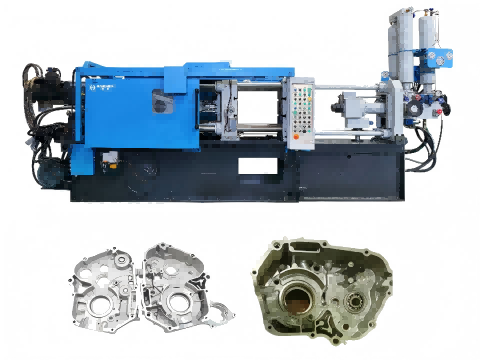
Aluminum Alloys
Over the past few years, the use of aluminum alloys in crankcase construction has increased markedly. While aluminum does not offer the compressive strength provided by cast iron, advances in engineering. And the development of a large number of aluminum alloys practically make it possible to use aluminum in numerous engine components.
- Advantages: Good thermal conductivity and ease of casting make aluminum alloys in increasing demand for crankcase manufacturing.
- Properties: The use of aluminum within engines makes sense due to its reasonable strength, durability, and corrosion resistance.
- Applications: Aluminum crankcases are commonly found in automotive engines and small to medium-sized engines in various industries.
Common Aluminum Alloys for Crankcases
A380 and ADC12 are the most widely used aluminum alloys for die cast crankcases. A380 offers high strength (tensile 320 MPa) and good machinability, suitable for passenger car engine blocks. ADC12 provides better fluidity, ideal for complex rib structures and thin walls. For high‑performance applications requiring heat treatment, A356 alloy is preferred despite lower castability, because its elongation (6‑8% after T6) provides better fatigue resistance under cyclic loads.
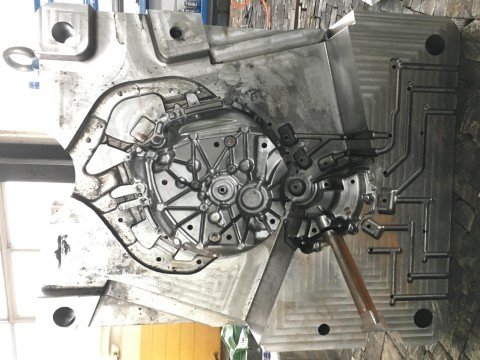
Cast Iron
Cast iron has been a popular material for crankcase manufacturing. It is easy to work with due to its durability and low cost and has many uses such as in engines and industrial machines.
- Advantages: Heavy applications are best serve with cast iron as it possesses high strength, thermal stability, and wear resistance.
- Properties: In specific engine designs, the benefits of reduced vibrations. And greater durability offered by cast iron crankcases prove to be invaluable.
- Applications: We frequently make use of cast iron crankcases in heavy-duty engines. Which include truck and tractor engines, as well as industrial machines.
Cast Iron Grades for Heavy‑Duty Crankcases
Gray cast iron (grades GJL‑250 to GJL‑300) is standard for truck and tractor crankcases due to its excellent vibration damping and compressive strength (over 800 MPa). Ductile cast iron (GJS‑500 to GJS‑700) offers higher tensile strength and impact resistance, used in high‑torque diesel engines. The choice depends on whether the priority is noise reduction (gray iron) or mechanical toughness (ductile iron). Both grades require sand casting or permanent mold casting, not high‑pressure die casting.
Composite Materials
Potential candidates for crankcase manufacturing include other polymer composites like carbon fiber reinforced polymer (CFRP). With time, these composities are likely to be used more commonly in vehicle high-performance. And luxury vehicles due to the decrease in costs and advancement in technology.
- Advantages: Greater strength, lightweight, corrosion resistance. Are some of the advantages of composite materials that provide a unique blend of properties.
- Properties: Design freedom for increased performance optimization permits custom requirements to be placed on composite crankcases.
- Applications: Specific vibration damping and lightweight requirements, along with precise material properties make composite materials ideal for specialized engine applications.
Current Limitations of Composites for Crankcases
Despite theoretical advantages, carbon fiber reinforced polymer (CFRP) crankcases remain limited to research engines and a few high‑end racing applications. Barriers include high material cost (5‑10× cast iron), poor thermal conductivity (which leads to localized overheating), and difficulty in sealing oil passages. Additionally, composite crankcases require metal inserts for bearing seats and fastener threads, reducing weight savings. For production engines, aluminum‑magnesium hybrids currently offer a more practical lightweight solution than full composites.
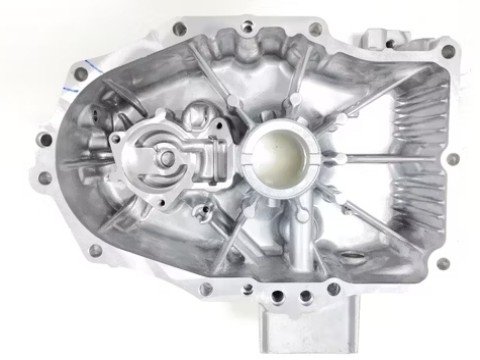
Material Selection Factors in Crankcase Manufacturing
The choice between cast iron, aluminum alloys, and composite materials depends on several key factors:
- Engine Type and Application
- Operating Temperature
- Production Volume
- Cost Considerations
Engine Type and Application
High-performance or racing engines prioritize weight reduction, favoring aluminum or magnesium alloys. Heavy-duty diesel engines in trucks and industrial equipment require the thermal stability and vibration damping of cast iron.
Operating Temperature
Aluminum alloys have higher thermal conductivity, dissipating heat faster than cast iron. This benefits air-cooled engines or high-output applications where heat management is critical.
Production Volume
For high-volume automotive production, aluminum die casting offers cost efficiency through rapid cycle times and minimal machining. Cast iron may be more economical for lower volumes due to lower tooling costs.
Cost Considerations
While aluminum has higher raw material cost than cast iron, the weight savings can offset fuel economy requirements or enable lighter vehicle structures, providing overall value.

The Role of Die Casting in Crankcase Manufacturing
As far as manufacturing processes are concerned. Die casting is the most popular technique applied in the production of crankcases, particularly in those made of aluminum alloys. In the process, molten metal is injected into a mold at high pressure. And the part is manufactured with complex shapes and high precision and dimensional accuracy. Due to the ability to produce crankcases with intricate designs and thin walls. Die casting further helps to reduce weight without compromising strength. Producing crankcases using die casting also proves to be efficient. And economical as the process allows for the production of large quantities of identical and consistently high-quality parts.
Haichen is renowned for making high quality crankcases using die castings
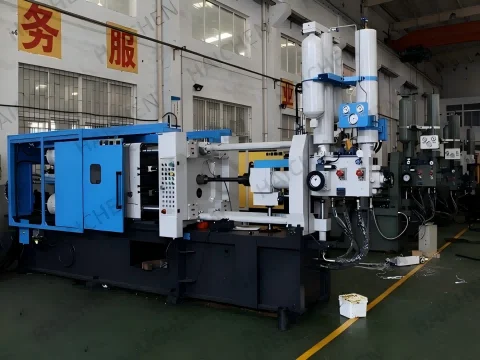
HAICHEN is a trusted brand in the manufacturing of die casting machines. And than to produce crankcases, we custom design their cold chamber die casting machines to use aluminum alloys and magnesium alloys as the raw materials.
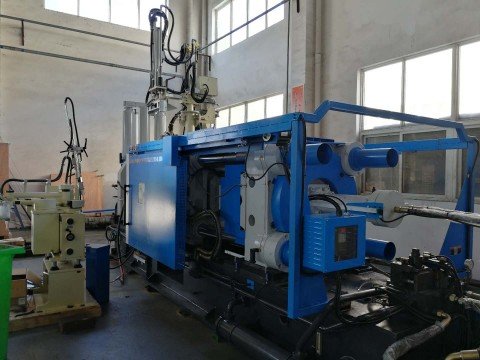
Material versatility
With HAICHEN cold chamber die casting machines, manufacturers are assured of flexibility in choosing project specifications as they can process aluminum alloys and magnesium alloys.
Precision Engineering
Attention to detail is at the core of HAICHEN machine design which ensures the output of complex parts like crankcases is consistent and high quality.
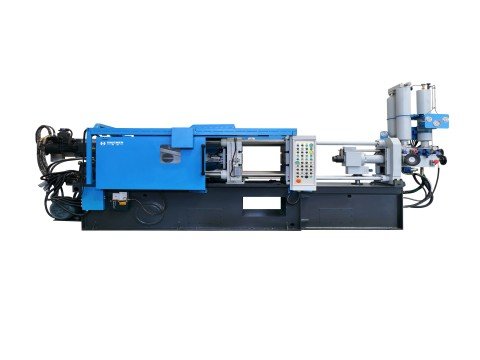
HAICHEN Application Case: Aluminum Crankcase Production
A Japanese automotive supplier producing 1.5L engine crankcases switched to HAICHEN HDC-800 cold chamber machines to increase output. Using A380 aluminum alloy with a four-cavity mold, the system achieved:
- Cycle time: 85 seconds per cycle (four crankcases per cycle)
- Wall thickness consistency: ±0.2mm across all cavities
- Porosity rate: below 1% after vacuum-assisted die casting
- Annual output: 480,000 crankcases per machine
The customer reported 18% faster cycle times compared to previous equipment, with reduced scrap and consistent dimensional accuracy meeting OEM specifications.
The choice of crankcase manufacturing materials depends on a range of factors, including performance requirements, cost considerations, manufacturing processes, and the intended use of the engine.
In conclusion, manufacturers need to carefully select materials to ensure that the crankcase meets the necessary performance, durability, and functionality requirements of the engine in which it is installed.


