Choosing the right die casting machine for aluminum radiators depends on more than the radiator length.
Machine selection should consider the casting size, projected area, part weight, mold dimensions, number of cavities, required production volume, and injection performance.
For many cast aluminum heating radiators, a cold chamber high-pressure die casting machine can provide fast filling, repeatable dimensions, and efficient mass production.
However, the required machine size must be calculated according to the actual radiator and mold design.
This guide explains the key factors to consider when selecting a die casting machine for aluminum radiator production.
What Type of Die Casting Machine Is Used for Aluminum Radiators?
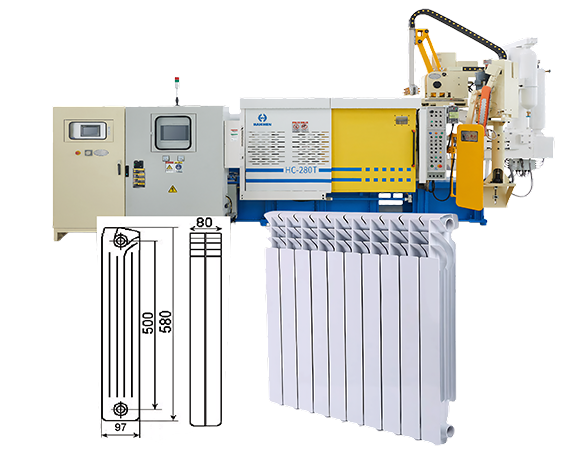
Aluminum has a higher melting point than zinc, so aluminum radiator production normally uses a cold chamber die casting machine.
In a cold chamber machine, molten aluminum is transferred from a holding furnace into the shot sleeve before injection.
The injection system then pushes the metal into the radiator mold at high speed and pressure.
This process can be suitable for aluminum heating radiators with:
- Thin fins
- Complex external profiles
- Repeated sections
- Integrated mounting features
- High production volumes
However, not every aluminum radiator should automatically be produced by high-pressure die casting.
The best process depends on the radiator design, alloy, pressure requirements, production volume, and required thermal performance.
What Factors Determine the Machine Size?
Several factors should be considered before selecting the machine tonnage.
1. Radiator Size
The overall size of the radiator affects the mold dimensions and projected area.
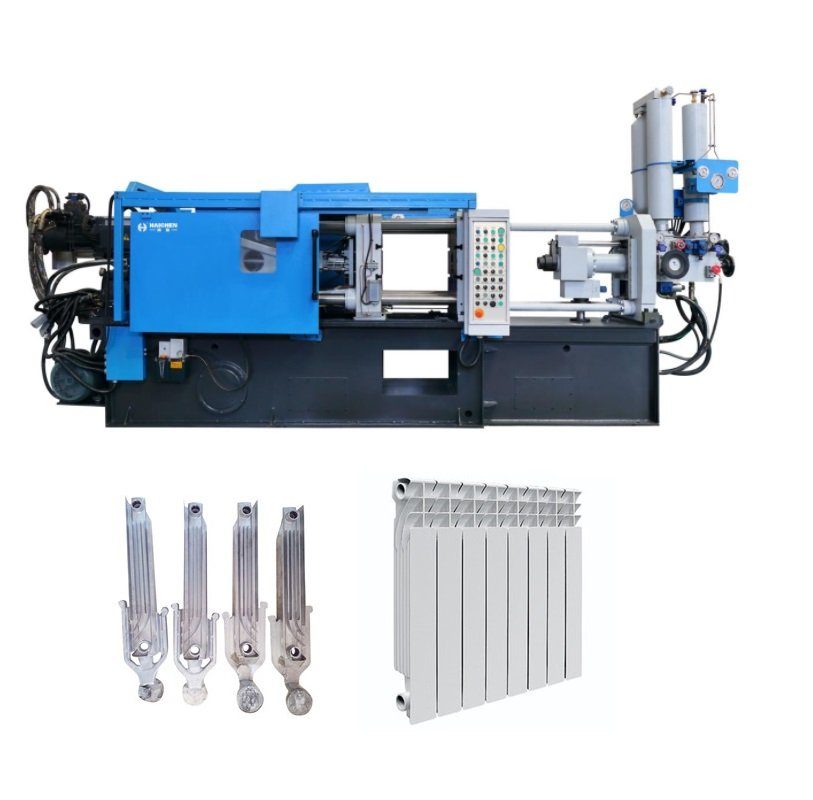
For example, Haichen’s radiator production experience includes different machine configurations for radiator lengths around 350 mm, 500 mm, and 600 mm.
However, radiator length alone should not be used to determine machine tonnage.
Two radiators with the same length can require different machines because their:
- Width
- Wall thickness
- Fin structure
- Projected area
- Casting weight
- Mold design
may be different.
2. Projected Area
Projected area is one of the most important factors when calculating the required clamping force.
During high-pressure injection, molten aluminum creates pressure that tries to separate the mold halves.
The basic relationship can be expressed as:
Required clamping force ≈ Projected area × Effective cavity pressure × Safety factor
The projected area should include the casting and the relevant runner system.
A machine with insufficient clamping force can cause:
- Flash
- Mold opening
- Dimensional problems
- Increased trimming work
Therefore, machine selection should be based on an engineering calculation rather than radiator length alone.
3. Casting Weight and Shot Capacity
The machine’s injection system must provide enough shot capacity for the complete shot.
The required shot weight includes:
Casting weight + runner + overflow + other process material
The actual utilization should also leave an appropriate operating margin.
If the required shot is too close to the machine’s maximum capacity, process stability can become more difficult.
4. Number of Mold Cavities
Mold cavity number directly affects production output.
For example:
- 1-cavity mold → one radiator per shot
- 2-cavity mold → two radiators per shot
A two-cavity mold can increase output, but it also increases:
- Required shot weight
- Projected area
- Mold size
- Clamping force requirement
- Tooling cost
Therefore, increasing cavity number does not simply mean doubling the production capacity.
The machine must be large enough to handle the complete mold and shot.
Example Machine Selection for Aluminum Radiators
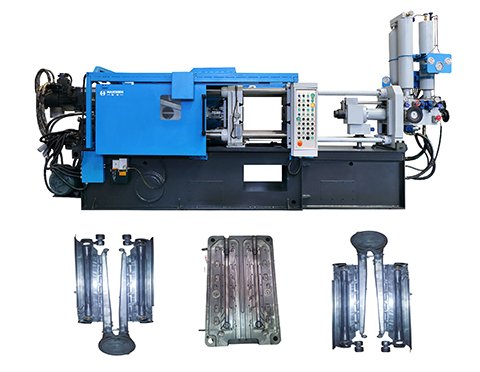
Haichen’s radiator applications provide several reference configurations.
| Radiator Application | Reference Machine | Mold Configuration |
|---|---|---|
| Approximately 350 mm radiator | HCD-300 | 1 cavity |
| Approximately 500 mm radiator | HCD-500 | 1 cavity |
| Approximately 600 mm radiator | HCD-800 | 1 cavity |
| Larger production requirement | HCD-1250 | 2 cavities |
These figures are reference configurations rather than universal rules.
The final machine model should be confirmed using the actual radiator drawing, mold design, casting weight, projected area, and production target.
Why Is Injection Performance Important for Radiators?
Aluminum radiators can contain thin fins and narrow sections.
Molten aluminum must fill these areas before premature solidification.
If filling is too slow or the process is poorly balanced, defects can include:
- Cold shuts
- Misruns
- Incomplete filling
- Porosity
- Dimensional variation
Therefore, the machine should provide suitable injection speed, pressure, and controllability for the specific radiator mold.
Fast Filling
Fast injection helps the molten aluminum reach thin sections before solidification.
However, simply increasing injection speed is not always the solution.
The correct setting depends on:
- Alloy
- Gate design
- Wall thickness
- Mold temperature
- Venting
- Cooling layout
Stable Pressure Control
The injection system should maintain repeatable process parameters from cycle to cycle.
Stable pressure and velocity control can help improve consistency during mass production.
Mold Design Is as Important as Machine Tonnage
A large machine cannot compensate for a poorly designed radiator mold.
The mold should be designed around:
- Runner system
- Gate location
- Overflow
- Venting
- Cooling channels
- Ejection system
- Parting line
- Fin geometry
For thin radiator fins, metal flow must be carefully considered.
Cooling should also be balanced to avoid excessive differences in solidification between different areas of the casting.
Should You Use a Vacuum Die Casting System?
Vacuum assistance can be considered when the casting requires better control of gas porosity or higher internal quality.
During filling, air trapped in the mold cavity can contribute to porosity.
A vacuum system can help evacuate air from the cavity before or during filling.
However, vacuum die casting is not automatically necessary for every radiator.
Its value depends on:
- Casting structure
- Required density
- Leak-tightness requirements
- Post-processing
- Heat treatment requirements
- Quality standards
The vacuum system should therefore be evaluated together with the mold and casting process.
What Auxiliary Equipment Is Needed?
A complete aluminum radiator production line normally includes more than the die casting machine.
Depending on the product, equipment may include:
- Melting or holding furnace
- Automatic ladle
- Die casting machine
- Mold sprayer
- Extractor robot
- Cooling conveyor
- Trimming equipment
- Grinding and polishing equipment
- Leak tester
- CNC equipment
- Inspection equipment
For home heating radiators, additional processes such as welding, surface treatment, leak testing, and finishing may be required depending on the radiator design.
This means that buyers should evaluate the complete production line rather than purchasing the die casting machine alone.
How to Choose Between a 300-Ton, 500-Ton, and 800-Ton Machine?
A simple comparison can help explain the selection process.
300-Ton Machine
A 300-ton cold chamber machine can be considered for relatively small aluminum radiator castings.
For example, Haichen uses an HCD-300 configuration for a radiator around 350 mm with a one-cavity mold.
500-Ton Machine
A 500-ton machine provides more clamping force and injection capacity.
It can be considered for larger radiator castings, such as a reference configuration around 500 mm with one cavity.
800-Ton Machine
An 800-ton machine provides greater mold and shot capacity.
For radiator applications around 600 mm, Haichen uses an HCD-800 reference configuration.
For two-cavity production, however, the machine requirement can increase significantly because both projected area and shot weight increase.
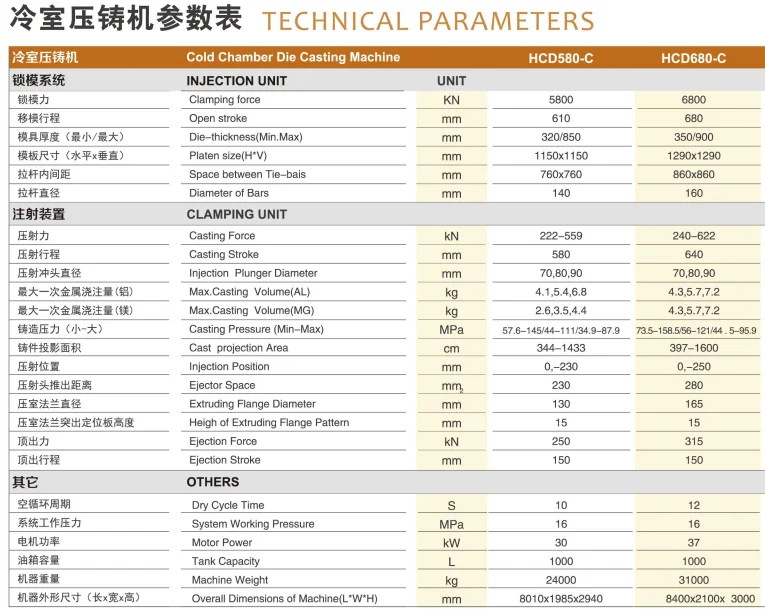
How to Calculate the Required Machine Tonnage
Do not select the machine only according to the radiator’s length.
Before making the final decision, collect:
- Radiator length
- Radiator width
- Casting height
- Casting weight
- Projected area
- Alloy
- Mold cavity number
- Runner weight
- Mold dimensions
- Required annual production
- Target cycle time
- Required secondary processing
The supplier can then calculate the required clamping force and injection capacity.
For example, a 500 mm radiator with a large projected area and a two-cavity mold may require a substantially larger machine than a 500 mm radiator produced with a one-cavity mold.
Common Mistakes When Choosing a Radiator Die Casting Machine
Choosing by Radiator Length Only
Radiator length provides only a rough indication.
Projected area, weight, mold size, and cavity number are equally important.
Choosing the Smallest Possible Machine
A machine that barely meets the calculated clamping force may leave insufficient process margin.
This can increase the risk of flashing and unstable production.
Ignoring the Mold
Machine and mold should be designed as one system.
Tie-bar spacing, platen dimensions, mold thickness, opening stroke, and ejector requirements must all be checked.
Ignoring Post-Processing
A radiator may require trimming, grinding, polishing, welding, leak testing, or surface treatment after casting.
These operations should be included when planning the production line and calculating the total production cost.
Haichen Aluminum Radiator Die Casting Machine
Haichen provides cold chamber die casting machines for aluminum radiator production.
Depending on the radiator design, Haichen can provide different machine sizes together with radiator molds and auxiliary equipment.
The production solution can include:
- Cold chamber die casting machine
- Radiator mold
- Automatic ladle
- Extractor
- Mold spraying system
- Trimming equipment
- Grinding and polishing equipment
- Leak testing equipment
Haichen’s existing radiator applications include reference configurations ranging from HCD-300 to HCD-1250, depending on radiator size and mold cavity requirements.
The exact machine should be selected after reviewing the radiator drawing and production requirements.
What Information Should You Send to a Die Casting Machine Manufacturer?
If you want a machine quotation for an aluminum radiator project, send the following information:
Product information
- 2D drawing
- 3D drawing
- Radiator dimensions
- Casting weight
- Aluminum alloy
- Surface requirements
Production information
- Annual production
- Target cycle time
- Number of cavities
- Working hours per day
Mold information
- Mold dimensions
- Projected area
- Runner design
- Existing mold or new mold
With this information, the machine manufacturer can recommend the required clamping force, injection capacity, mold size, and auxiliary equipment.