Jet cooling in die casting is a local cooling method used to remove heat from areas of a die that are difficult to cool with conventional cooling channels.
It is especially useful for core pins, inserts, deep cavities, and other local hot spots.
Instead of cooling the whole die at the same rate, jet cooling focuses the cooling effect where it is needed most.

This can help control die temperature, reduce thermal stress, improve casting quality, and support more stable production.
From a die casting machine manufacturer‘s perspective, jet cooling should not be treated as a separate device only.
The cooling circuit, mold design, air purge, sensors, and machine control should work together.
What Is Jet Cooling in Die Casting?
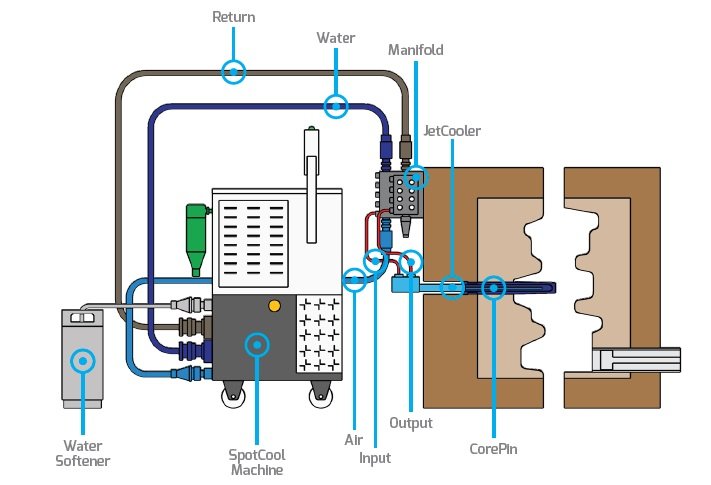
In a typical system, pressurized water flows through small cooling passages inside or near a core pin or insert. The water removes heat from the die component.
After the cooling stage, compressed air purges the remaining water from the circuit.
This process is useful when a conventional cooling channel cannot reach a hot area or when the local heat load is much higher than the rest of the mold.
Where Is Jet Cooling Used?
Jet cooling is commonly considered for:
- Core pins
- Deep inserts
- Sliders
- Thin mold sections
- Areas around deep holes
- Local hot spots
- High-heat areas with soldering or sticking problems
For example, a long and narrow core pin may have very little space for a traditional cooling channel.
A local jet cooling circuit can provide a more direct way to remove heat.
How Does Jet Cooling Work?
The process normally includes four basic stages.
1. Pressurized Water Enters the Cooling Circuit
A hydraulic or cooling unit sends water through a small passage inside the target mold component.
The water absorbs heat from the core pin or insert as it flows through the circuit.
2. Local Heat Is Removed
Because the cooling medium works close to the hot area, it can remove heat more effectively than a cooling channel located farther away.
The exact cooling effect depends on water pressure, flow rate, passage design, cooling time, mold temperature, and the geometry of the insert.
3. Cooling Stops at the Set Time
The cooling controller stops the water supply after the required cooling period.
The timing should be determined through mold testing rather than by using one fixed value for every die.
4. Compressed Air Purges the Circuit
After water cooling, compressed air removes residual water from the cooling passage.
This step is important because water should not remain inside the mold cooling circuit before the next shot.
The complete sequence can therefore be summarized as:
Water cooling → Water stop → Air purge → Next shot
Why Use Jet Cooling Instead of Conventional Die Cooling?
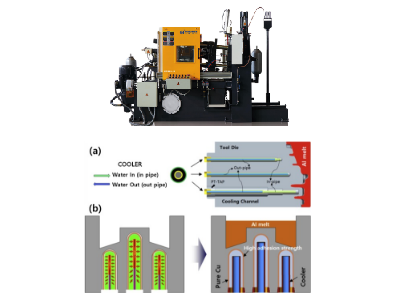
Traditional cooling channels work well for many areas of a die. However, they may not provide enough cooling for small or complex components.
Cooling Difficult Areas
A conventional channel may be too far away from a long core pin or deep insert.
Jet cooling places the cooling flow closer to the heat source.
Controlling Local Hot Spots
Some parts of a die receive much more heat than others.
If these areas remain too hot, they can affect filling, solidification, sticking, soldering, and die life.
Local cooling helps reduce this temperature imbalance.
Improving Casting Stability
Stable die temperature can help keep the solidification process more consistent.
Depending on the casting design and process conditions, better thermal control may help reduce problems such as local shrinkage, soldering, and dimensional variation.
However, jet cooling does not automatically solve every casting defect.
The metal temperature, filling speed, pressure, venting, die design, and alloy also matter.
How Jet Cooling Helps Die Casting Production
Reduce Local Die Temperature
The main purpose is targeted heat removal.
Instead of overcooling the entire die, the system focuses on areas that need additional cooling.
This can make the thermal balance of the die easier to control.
Reduce Soldering and Sticking
Excessive local heat can increase the risk of soldering, especially around core pins and other difficult areas.
Better local cooling can help keep these surfaces within a more suitable working temperature range.
Support Better Casting Quality
A stable thermal condition can improve the consistency of the solidification process.
It may help reduce local shrinkage and porosity when excessive heat is one of the causes.
Still, manufacturers should investigate the complete filling and solidification process before using jet cooling as the only solution.
Improve Die Life
Repeated heating and cooling create thermal stress in the die.
If one small area becomes much hotter than the surrounding material, thermal fatigue can become more serious.
Targeted cooling can help control this local heat load and may reduce thermal stress over long production runs.
What Are the Main Challenges of Jet Cooling?
Jet cooling can be effective, but it also introduces additional system requirements.
Uneven Cooling
A poorly designed cooling circuit can create another temperature problem.
If one area becomes too cold while the surrounding area remains hot, excessive temperature differences may affect casting quality.
Therefore, cooling intensity should match the actual thermal load.
Water Leakage Risk
Water must remain inside the designed cooling circuit.
A leak near molten aluminum or another high-temperature metal can create a serious safety risk.
For this reason, the cooling system should include suitable pressure monitoring, connections, seals, and safety controls.
Residual Water
Water left inside the circuit can cause problems during the next production cycle.
This is why compressed-air purging is an important part of the process.
Additional Maintenance
Compared with a simple cooling channel, a jet cooling system contains more components.
Operators need to check:
- Water pressure
- Flow condition
- Air pressure
- Seals
- Hoses
- Nozzles
- Sensors
- Filters
Regular maintenance helps keep the cooling effect stable.
How to Design Jet Cooling for a Die
Good results start with the mold design.
Match the Cooling Circuit to the Hot Spot
First identify where the die stores excessive heat.
Thermal testing, production experience, or simulation can help locate these areas.
Then design the cooling passage around the actual heat source.
Select Suitable Flow and Pressure
Higher pressure does not always mean better cooling.
The required pressure and flow depend on the passage diameter, length, insert structure, and heat load.
The final values should come from mold trials and system testing.
Allow Enough Space for Maintenance
Cooling passages, connections, and fittings should be accessible for inspection.
A system that works well but is difficult to repair can create unnecessary downtime later.
Jet Cooling and Die Casting Machine Integration
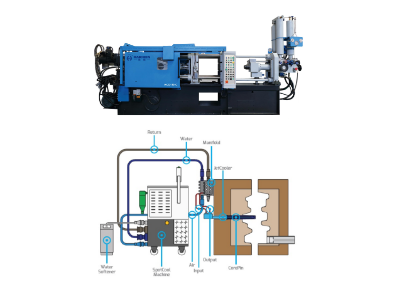
For production use, jet cooling should work together with the die casting machine.
The machine can coordinate:
Die closing → Injection → Solidification → Jet cooling → Air purge → Die opening
The exact sequence depends on the mold and process.
Cooling Timing
Cooling time should be adjustable.
Different products and mold areas may need different cooling times, so fixed timing is rarely ideal for every application.
Pressure Monitoring
Pressure sensors can help identify abnormal conditions such as leakage, blocked passages, or insufficient coolant supply.
An alarm or automatic shut-off can improve system safety.
Automatic Control
For stable mass production, the cooling system can connect to the machine control system.
This allows operators to manage cooling parameters together with the main die casting cycle instead of controlling them separately.
Jet Cooling vs. Conventional Cooling
| Feature | Conventional Cooling | Jet Cooling |
|---|---|---|
| Cooling method | Fixed channels | Targeted local cooling |
| Best for | General die areas | Hot spots and difficult areas |
| Design flexibility | Moderate | High |
| Local heat control | Limited | Better |
| System complexity | Lower | Higher |
| Maintenance | Relatively simple | More components |
In practice, the two methods do not have to compete.
A well-designed die can use conventional cooling for general areas and jet cooling for local hot spots.
This combined approach is often more practical than trying to use jet cooling everywhere.
Practical Example: Cooling a Hot Core Pin
Consider a die with a long core pin used to form a deep hole.
The core pin becomes much hotter than the surrounding die during continuous production. A conventional cooling channel cannot reach the pin effectively because of its small diameter.
As a result, the area may suffer from:
- Excessive heat
- Soldering
- Local shrinkage
- Dimensional changes
- Shorter core-pin life
A dedicated jet cooling circuit can be added to the core pin.
During the cycle, pressurized water removes heat from the pin. After the cooling stage, compressed air purges the remaining water.
The actual water pressure, cooling time, and passage design should be confirmed through testing.
This is the key point: jet cooling should solve a specific thermal problem rather than simply add more cooling capacity.
How to Decide Whether Your Die Needs Jet Cooling
Jet cooling may be worth considering when:
- A core pin remains much hotter than the rest of the die.
- Conventional cooling cannot reach a critical area.
- Soldering occurs repeatedly in one local area.
- Local shrinkage or porosity remains after other process adjustments.
- The die needs better thermal balance.
- A long production cycle results from excessive local heat.
Before adding the system, check the die design and process first.
Sometimes improving the conventional cooling channel, changing the gate, adjusting the metal temperature, or improving venting can solve the problem at a lower cost.
FAQ About Jet Cooling in Die Casting
What Is Jet Cooling in Die Casting?
Jet cooling is a local die cooling method that uses pressurized coolant to remove heat from difficult areas such as core pins and inserts.
Does Jet Cooling Use Water?
Many systems use pressurized water for heat removal and compressed air to purge the remaining water from the cooling circuit.
Can Jet Cooling Reduce Porosity?
It can help when local overheating contributes to shrinkage or porosity. However, porosity also depends on filling, pressure, metal temperature, venting, and alloy conditions.
Can Jet Cooling Extend Die Life?
Better control of local die temperature can reduce excessive thermal stress and help reduce heat-related die damage. The actual improvement depends on the die design and production conditions.
Is Jet Cooling Better Than Conventional Die Cooling?
Not necessarily.
Conventional cooling remains suitable for many parts of a die. Jet cooling is most useful when standard channels cannot provide enough local cooling.
In many applications, combining both methods provides the best balance.
Final Thoughts
Jet cooling in die casting is mainly a solution for local thermal problems.
Its value comes from directing cooling to areas that conventional channels cannot effectively control, such as core pins, deep inserts, and local hot spots.
A successful system requires more than a high-pressure water source. The mold passage, water flow, air purge, sensors, timing, and die casting machine control all need to work together.
From a die casting machine manufacturer’s perspective, the best approach is to start with the actual mold problem. Identify the hot area, check the existing cooling system, and then determine whether jet cooling can provide a practical improvement.
When designed correctly, jet cooling can support better thermal balance, more stable casting quality, reduced heat-related defects, and longer die service life.


