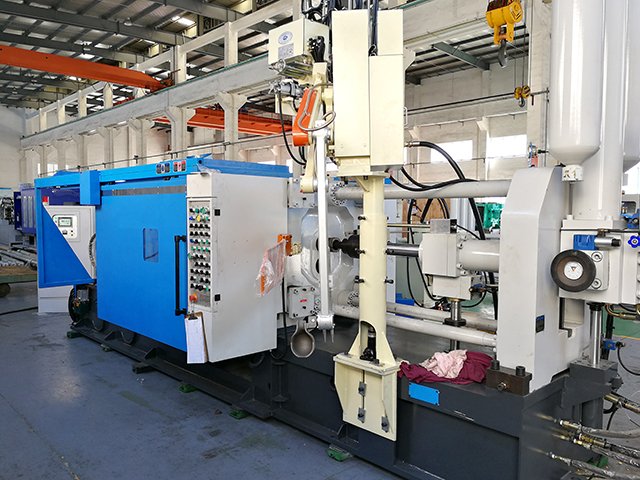
The short answer material selection for die casting is aluminum alloys, zinc alloys, magnesium alloys, and copper alloys. Each one behaves differently in the mold, cools at a different rate, and produces parts with different strengths, weights, and costs.
If you are a procurement professional, you already know that material choice affects your bottom line. The right material lowers your scrap rate, extends your tool life, and delivers parts that meet your customer’s specifications. The wrong material causes defects, delays, and cost overruns.
This guide walks you through the most common die casting materials, what they do well, where they fall short, and how to choose the right one for your specific application.
Why Material Selection Matters to You
Every die casting project starts with a material decision. That decision drives your tooling cost, cycle time, part weight, surface finish, and post-processing requirements. Choose aluminum for lightweight automotive parts, zinc for intricate hardware components, or magnesium for weight-critical electronics housings.
Here is what you need to know about each major material group.
Aluminum Alloys: The Versatile Workhorse
Aluminum alloys dominate the die casting industry. They offer an excellent balance of strength, weight, and cost. A380 and ADC12 are the most common grades, but each serves slightly different purposes.
Key properties of aluminum alloys:
- Lightweight — density is about 2.7 g/cm³
- Good corrosion resistance — forms a protective oxide layer naturally
- Excellent thermal and electrical conductivity
- Good castability and machinability
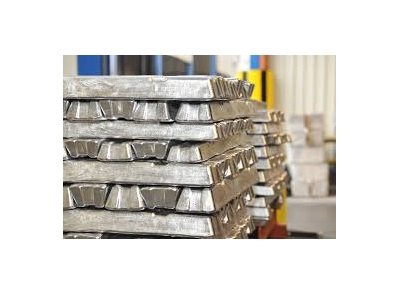
A380 is the most widely used aluminum die casting alloy. It offers high strength with ultimate tensile strength around 324 MPa and yield strength of 160 MPa. North American automotive manufacturers frequently specify A380 for engine components, transmission housings, and heavy-duty industrial brackets. However, its higher copper content (3-4%) means it offers lower corrosion resistance than some alternatives, so you will need protective coatings for outdoor or marine applications.
ADC12 (equivalent to A383 in some standards) contains higher silicon content (9.6-12%). This gives it better fluidity for intricate shapes with thin walls. ADC12 offers improved corrosion resistance compared to A380 because of its lower copper content. It is widely used in Asia for electronics housings, power tools, and furniture components. Many manufacturers blend ADC12 with A380 to balance castability and strength.
A356 contains very low copper (under 0.2%) and is heat-treatable. After T6 heat treatment, A356 can reach tensile strength of 330 MPa and elongation of 13%. It offers the best corrosion resistance among common aluminum die casting alloys. However, it does not flow as easily as A380 or ADC12, so it works best for structural applications rather than thin-walled complex parts.
What this means for you: Aluminum is usually your safest bet if you need a balance of performance and cost.
Haichen’s capability: Haichen’s cold chamber die casting machines handle aluminum alloys efficiently. Our equipment supports the high injection pressures that aluminum requires, and we can help you select the right alloy grade for your specific application.
Zinc Alloys: The Precision Performer
Zinc alloys — particularly the Zamak series — excel at producing small, complex parts with thin walls and excellent surface finish. Over 70% of all North American zinc die castings use Zamak 3.
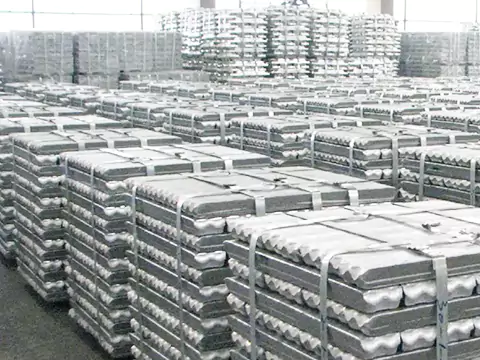
Key properties of zinc alloys:
- Low melting point — reduces energy costs and extends tool life
- Excellent fluidity — fills intricate mold details easily
- Good dimensional stability — holds tight tolerances
- High strength and hardness
- Excellent finishing characteristics for plating, painting, and chromate treatments
Zamak 3 is the most commonly used zinc alloy. It offers ultimate tensile strength of 283 MPa and elongation of 10%. Its popularity comes from an excellent balance of mechanical properties, superb castability, and long-term dimensional stability. Zamak 3 produces high-quality surface finishes suitable for numerous aesthetic treatments.
Zamak 5 offers higher strength (ultimate tensile strength of 328 MPa) and hardness than Zamak 3. It works well for parts that require greater wear resistance.
ZA-8 provides improved wear resistance and hardness. It can be hot-chamber die cast and often competes with ZA-27 for strength applications.
What this means for you: Choose zinc when you need high precision, thin walls, or decorative finishes. Zinc alloys are the material of choice for very small die castings, typically less than one ounce (28 gm).
Haichen’s capability: Haichen produces both cold chamber and hot chamber die casting machines. Zinc alloys work well in hot chamber machines because of their low melting point, which gives you faster cycle times and lower energy costs.
Magnesium Alloys: The Lightweight Champion
Magnesium is the lightest commonly used structural metal, with a density of just 1.8 g/cm³. It is about 33% lighter than aluminum and 75% lighter than zinc. For weight-critical applications, magnesium is often the answer.
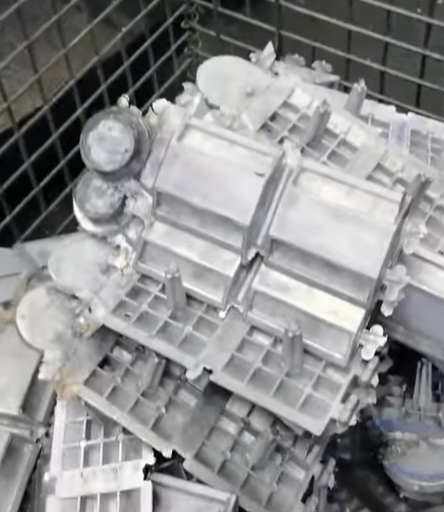
Key properties of magnesium alloys:
- Extremely lightweight — density of 1.74-1.8 g/cm³
- High strength-to-weight ratio — specific strength of 250 MPa/(g/cm³)
- Exceptional damping capacity — absorbs vibration effectively
- Best machinability of any structural metal
AZ91D is the workhorse of magnesium die casting alloys. It contains nominally 9% aluminum and 1% zinc. AZ91D exhibits an excellent combination of mechanical properties, castability, and corrosion resistance. It is commonly used for housings, covers, brackets, chain saw parts, handheld tools, and electronic parts.
AM60B and AM50A offer better elongation, toughness, and impact resistance. They work well for components that require ductility — for example, automotive steering wheels, instrument panel structures, and transmission cases.
What this means for you: Choose magnesium when weight reduction is your top priority. However, magnesium needs stricter process control and often requires protective coatings because of its corrosion susceptibility.
Haichen’s capability: Haichen’s cold chamber die casting machines handle magnesium alloys with the precision and control that these materials demand. We can help you optimize your process parameters for magnesium’s unique characteristics.
Copper Alloys: The Heavy-Duty Specialist
Copper alloys — including brass and bronze — serve niche applications where strength, corrosion resistance, and conductivity are paramount.
Key properties of copper alloys:
- High strength and hardness
- Excellent corrosion resistance, especially in marine environments
- Good electrical and thermal conductivity
- High melting point (up to 1200°C)
Yellow Brass (UNS C85800) is a low-cost, general-purpose alloy with good machinability and soldering characteristics. Applications include general and marine hardware, pumps, impellers, plumbing parts, and gears.
High Silicon Brass (UNS C87800) meets very high requirements for strength and wear resistance. Applications include tools, pump impellers, gears, and marine hardware.
Naval Brass (464) includes a small percentage of tin for enhanced corrosion resistance in marine environments.
What this means for you: Copper alloys are the strongest option, but they are expensive and harder to cast. They place much greater stress on the mold material, so die casting has a niche existence here. Only choose copper when your application truly requires its unique properties.
Haichen’s capability: Haichen’s cold chamber die casting machines handle copper alloys for specialized applications requiring high strength or corrosion resistance. We can help you evaluate whether copper is the right choice for your project.
Material Comparison Overview
Here is how the four main material groups compare side by side:
How to Choose the Right Material: A Buyer’s Checklist
When selecting a material for your die casting project, work through these questions:
- What is your primary performance requirement?
- Lightest weight → Magnesium alloy (AZ91D or AM60B)
- Best overall value → Aluminum alloy (A380 or ADC12)
- Highest precision and surface finish → Zinc alloy (Zamak 3 or Zamak 5)
- Highest strength and corrosion resistance → Copper alloy (Brass)
- What is your part geometry?
- What is your production volume?
- What environment will the part face?
- What are your post-processing requirements?
- What is your total cost target?
Common Mistakes Buyers Make
Chasing the lowest material cost. I have seen buyers choose a cheaper alloy only to pay more in machining, finishing, and scrap. Always look at total cost, not just material price.
Defaulting to aluminum for everything. Aluminum is versatile, but zinc solves tolerance issues better, and magnesium helps when weight is critical.
Ignoring post-processing requirements. Zinc alloys plate beautifully. Aluminum anodizes well. Magnesium often needs protective coatings. Choose your material with your finishing process in mind.
Overlooking die life. Zinc alloys do not attack die steels and cast at relatively low temperatures, so die maintenance costs are lowest for zinc. Aluminum causes more die wear. Factor this into your cost calculations.
Haichen’s Approach to Material Selection
At Haichen, we understand that material selection is not just about the alloy — it is about the entire production system. We manufacture both cold chamber and hot chamber die casting machines, so we can recommend the right machine type for your chosen material.
Cold chamber machines handle aluminum, magnesium, and copper alloys. Hot chamber machines handle zinc and other low-melting-point alloys. The right machine-material match gives you faster cycles, lower energy costs, and better part quality.
Haichen also provides complete production line support — from raw material selection and mold design to equipment debugging and operator training. We help buyers avoid the common mistakes that drive up costs and delay production.
Need help selecting the right material for your die casting project? Contact Haichen Machinery. We will analyze your part requirements, production volume, and budget to recommend the optimal material and machine configuration for your specific needs.