Die casting sprayer types vary widely — from simple manual sprayers to fully automated robotic systems. This guide compares the four main types so you can choose the right one for your workshop, your budget, and your production volume.
Die casting sprayer types vary widely — from simple manual sprayers to fully automated robotic systems. Choosing the right sprayer directly impacts mold life, casting quality, cycle time, and operator safety.
This guide compares the four main die casting sprayer types — manual, copper tube, continuous automatic, and robotic — with performance data, cost considerations, and practical selection tips from HAICHEN installations.
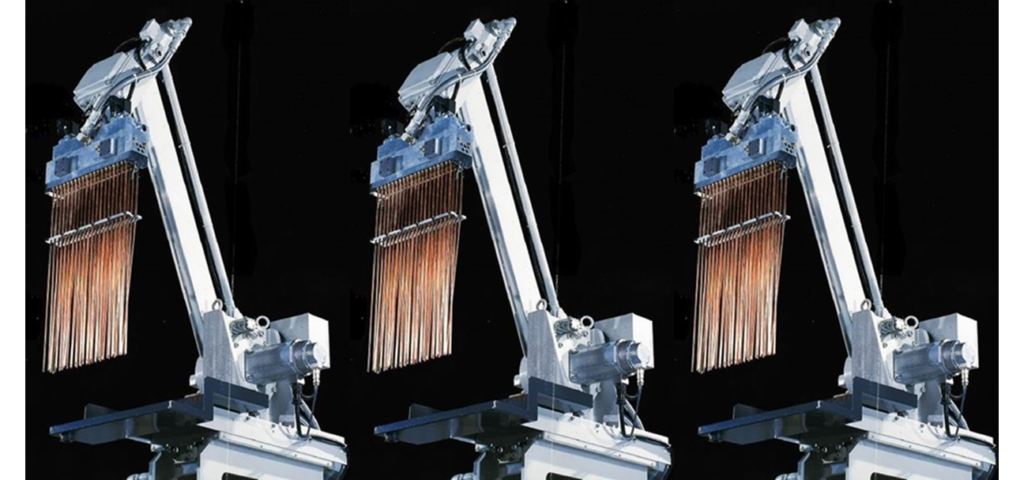
Four Main Types of Sprayer for Die Casting
Manual Sprayer
Manual spraying relies on operators to apply release agent by hand using spray guns. It is the most basic method — labor-intensive and inconsistent, but still common in small workshops.
Advantages: Lowest investment, simple operation, no automation required.
Disadvantages: Uneven application, operator-dependent quality, unsafe environment, slow cycle.
Best suited for: Small batch production, simple mold geometries, low-volume workshops with limited budget.
Traditional Copper Tube Sprayer
This system uses multiple fixed copper tubes with nozzles mounted on a frame. The sprayer moves in and out of the mold area using a pneumatic or hydraulic cylinder.
Advantages: Low cost, simple mechanism, easy to retrofit.
Disadvantages: Fixed spray patterns cannot adapt to complex geometries. Uneven flow distribution leads to inconsistent release agent coverage. High release agent consumption.
Best suited for: Retrofit applications, standard parts, workshops with limited budget seeking basic automation.
Continuous Automatic Sprayer
Continuous automatic sprayers use servo motors and programmable logic controllers (PLC) to precisely control spray timing, flow rate, and nozzle position. Multiple spray heads can be independently controlled.
Advantages: Consistent spray quality, programmable settings, reduced release agent consumption, fast cycle times.
Disadvantages: Higher initial investment than manual or copper tube, requires maintenance and programming.
Best suited for: High-volume production, standard to moderately complex molds, workshops seeking automation.
Robotic Sprayer
Robotic sprayers use 6-axis robots with servo-controlled spray nozzles. They can follow complex 3D paths, reaching deep cavities and intricate geometries with ±0.1mm precision.
Advantages: Maximum precision and flexibility, can handle the most complex molds, reduced release agent waste (15-25% less), minimizes cycle time.
Disadvantages: Highest capital investment, requires skilled programming and maintenance.
Best suited for: Complex molds, thin-wall parts, deep cavities, high-mix production, high-volume automotive and EV component manufacturing.hine sprays: servo-mechanism spray, robotic spray, manual spray, and traditional copper tube spray.
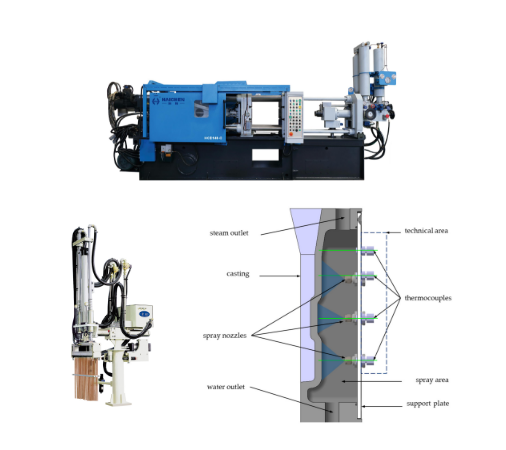
Comparison of Sprayer Types
Each sprayer type offers different performance, cost, and automation levels. Here is how they compare:
| Feature | Manual Sprayer | Copper Tube Sprayer | Continuous Automatic | Robotic Sprayer |
|---|---|---|---|---|
| Automation level | Full manual | Semi-automatic | Fully automatic | Fully automatic + AI |
| Spray consistency | Poor | Moderate | Good | Excellent (±0.1mm) |
| Operator safety | Low (exposed to heat) | Moderate | High | Highest |
| Initial investment | Lowest | Low | Moderate | Highest |
| Maintenance cost | Low | Low | Moderate | Moderate |
| Release agent waste | High | High | Low | Lowest (15-25% less) |
| Best suited for | Small batch, simple parts | Retrofit, limited budget | High-volume, standard parts | Complex molds, high-mix production |
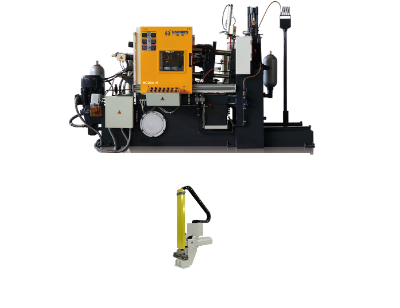
How Sprayers Work in Die Casting
Cooling and Lubrication
In the die casting process, the mold temperature is usually very high. To prevent mold damage due to high temperature or casting defects, the spray system achieves rapid cooling by spraying coolant (such as water or coolant) onto the mold surface.
Mechanical Linkage Principle
HAICHEN‘s spraying devices are usually extended into the mold cavity by means of a mechanical connecting rod principle. This allows for uniform coverage of the mold cavity, ensuring that the release agent adheres effectively to the mold surface, and that the spray position and angle can be adjusted as needed.
Automatic Control
HAICHEN die casting spray systems adopt automatic control technology and adjust parameters such as spraying time, pressure, and PLC-controlled flow according to different production needs. Robotic spraying systems are increasingly popular, capable of automating spraying tasks according to established plans, improving production efficiency and product quality.
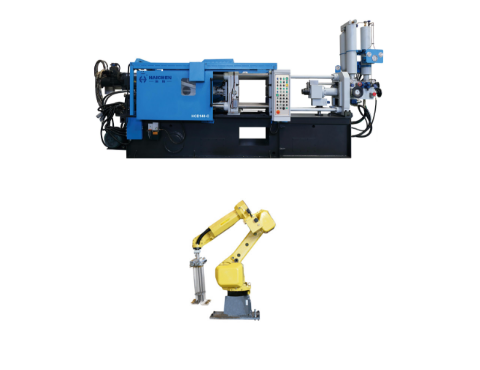
Key Advantages of Modern Spray Systems
| Benefit | Continuous Sprayer | Robotic Sprayer |
|---|---|---|
| Improved mold life | Consistent cooling reduces thermal stress | Precise application reduces local hotspots |
| Improved surface quality | Uniform coverage reduces defects | Target complex geometries precisely |
| Reduced scrap rates | Consistent process reduces variation | Highest precision minimizes defects |
| Production efficiency | Fast cycle times | Fastest cycle, flexible changeover |
| Cost savings | 15-25% less release agent waste | Minimum waste, lower scrap |
| Environmental protection | Optimized usage reduces emissions | Precise usage, minimal overspray |
Selection Guide Based on Production Requirements
| Production Type | Recommended Sprayer | Key Considerations |
|---|---|---|
| High-volume, simple parts | Continuous sprayer | Fixed nozzles, fast cycle, low maintenance |
| High-mix, complex molds | Robot sprayer | Programmable paths, quick changeover |
| Small batch, low budget | Manual sprayer | Low investment, but high labor cost |
| Retrofit existing lines | Copper tube + upgrades | Low-cost option, limited precision |
For most modern die casting operations, servo-driven continuous sprayers or robot systems offer the best balance of performance, consistency, and operator safety.
Selection Guide Based on Production Requirements
| Production Type | Recommended Sprayer | Key Considerations |
|---|---|---|
| High-volume, simple parts | Continuous sprayer | Fixed nozzles, fast cycle, low maintenance |
| High-mix, complex molds | Robot sprayer | Programmable paths, quick changeover |
| Small batch, low budget | Manual sprayer | Low investment, but high labor cost |
| Retrofit existing lines | Copper tube + upgrades | Low-cost option, limited precision |
For most modern die casting operations, servo-driven continuous sprayers or robot systems offer the best balance of performance, consistency, and operator safety.
HAICHEN Sprayer Applications
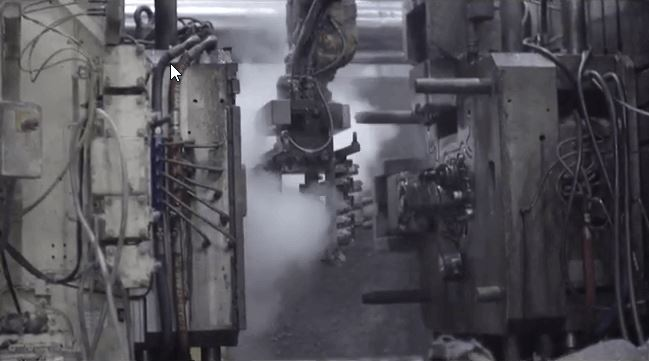
HAICHEN die-casting machines use servo sprayers in the spraying technology with advanced features:
Key features of HAICHEN sprayers:
- Independent control: Independently controls spray position and flow rate for each nozzle, especially effective for complex and special-shaped molds
- Copy sprayer technology: Reduces redundant actions and increases number of nozzles for efficient coverage
- Quick-change nozzles: Nozzle replacement in under two minutes without tools
- Nozzle wear monitoring: Recommended flow measurement every 50,000 cycles
- Reduced material waste: Precise control reduces release agent consumption by 15-25%
- Programmable paths: Multi-mode spraying for different molds and products
Application Case – Improving Yield for Complex Mold
Challenge: A customer producing zinc alloy decorative hardware with complex surface textures faced a 7% scrap rate from inconsistent spray coverage and sticking defects.
HAICHEN Solution: Installed a servo-driven continuous sprayer with programmable nozzle control and optimized spray parameters for the specific mold geometry.
Results:
- Scrap rate dropped from 7% to 1.2%
- Release agent consumption reduced by 20%
- Production cycle time reduced from 32 to 24 seconds
- Full payback achieved within nine months
Frequently Asked Questions
Q: What are the main types of sprayers for die casting machines?
A: The four main types are manual sprayers, traditional copper tube sprayers, continuous automatic sprayers, and robotic sprayers. Each offers different levels of automation, precision, and cost.
Q: Which sprayer type is best for complex molds?
A: Robotic sprayers are best for complex molds with deep cavities and intricate geometries. They can follow 3D paths with ±0.1mm precision to reach every part of the mold surface.
Q: How much can an automatic sprayer reduce release agent consumption?
A: Servo-driven automatic sprayers typically reduce release agent consumption by 15-25% compared to manual or copper tube systems, delivering significant cost savings over time.
Q: What is the payback period for upgrading to an automatic sprayer?
A: For most die casting operations, payback occurs within 8-12 months through reduced release agent consumption, lower scrap rates, and improved production efficiency.
Q: Can I retrofit an automatic sprayer to my existing die casting machine?
A: Yes — HAICHEN offers retrofittable sprayer systems compatible with most major die casting machine brands, allowing upgrades without replacing the entire machine.
Q: How do I know when to replace spray nozzles?
A: HAICHEN recommends measuring nozzle flow every 50,000 cycles. If flow exceeds the original specification by 15%, replace the nozzle. For high-volume production, scheduled replacement every 80,000-100,000 cycles prevents quality drift.


