When people ask, “What is the most popular casting method?”, the answer depends on the material, part design, production volume, and required quality.
Sand casting is one of the most widely used general casting processes, while high-pressure die casting (HPDC) is one of the leading choices for high-volume production of non-ferrous metal parts.
In particular, HPDC is widely used for aluminum, zinc, and magnesium components in the automotive, electronics, and industrial equipment industries.
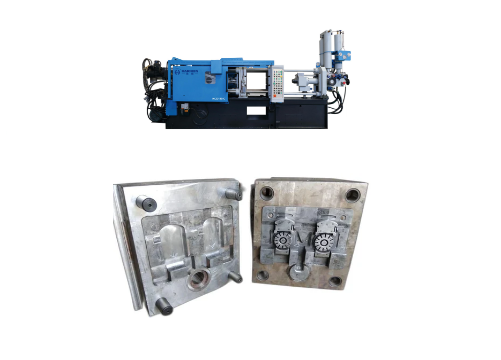
For manufacturers producing thousands or millions of parts, HPDC offers an attractive combination of fast cycle times, repeatable dimensions, thin-wall capability, and high production efficiency.
This guide explains the main casting methods, why HPDC is so popular for mass production.
When other processes are a better choice, and how integrated die casting is changing automotive manufacturing.
What Is the Most Popular Casting Method?
There is no single casting method that is best for every application.
The most suitable process depends on several factors:
- Metal or alloy being cast
- Part size and geometry
- Production volume
- Required dimensional accuracy
- Surface finish requirements
- Mechanical properties
- Tooling budget
- Post-processing requirements
For example, sand casting can be a practical choice for large parts and lower production volumes because its tooling is relatively simple. Investment casting is useful for complex, detailed components.
However, when manufacturers need to produce large quantities of relatively small or medium-sized non-ferrous parts, high-pressure die casting is often one of the most efficient choices.
Therefore, if the question is specifically about mass production, HPDC is one of the most important casting methods to consider.
What Are the Main Types of Casting Methods?
Before choosing a process, it helps to understand how the major casting methods differ.
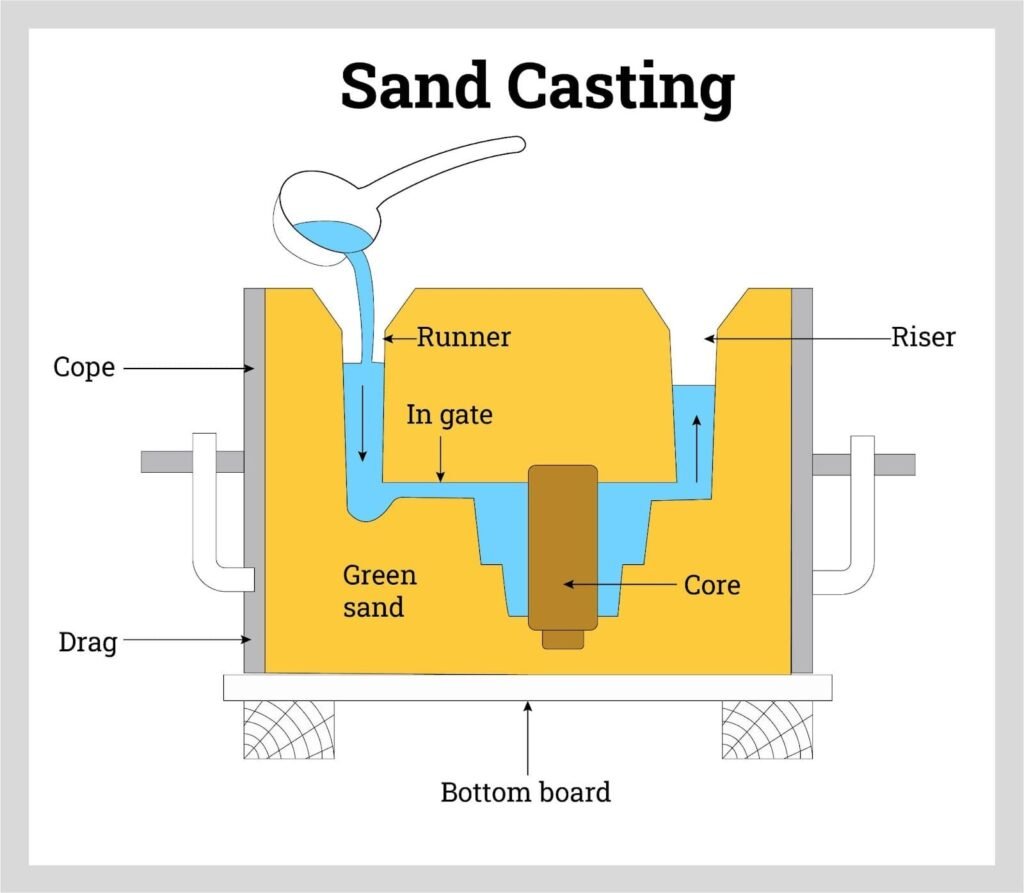
Sand Casting
Sand casting uses a sand mold to form the desired part. It can produce large and complex components and works with many different metals.
Its main advantages include relatively low tooling costs and design flexibility. However, production cycles are generally slower than those of high-pressure die casting, and additional machining may be required.
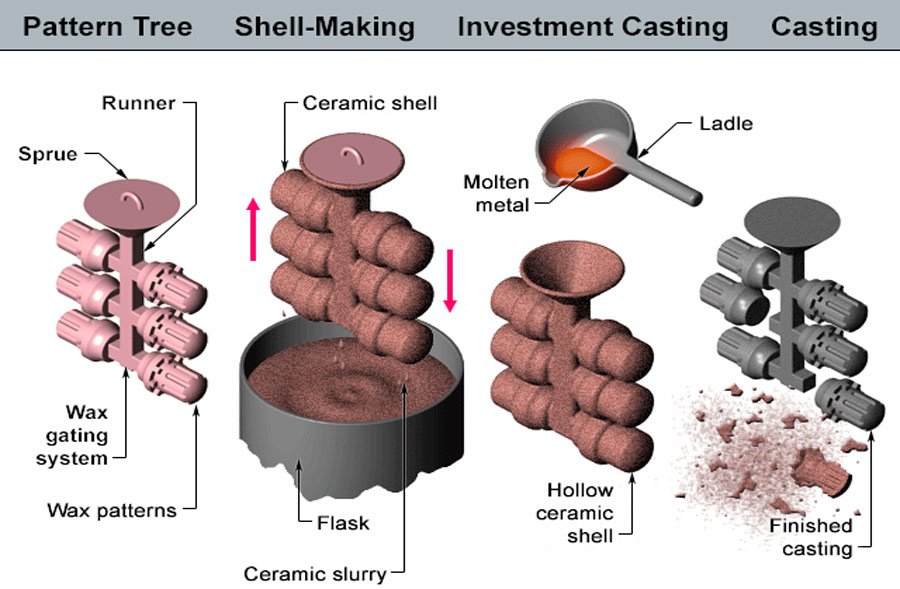
Investment Casting
Investment casting uses a disposable pattern to create a detailed mold. It can produce complex shapes and fine features with good dimensional accuracy.
However, the process usually costs more and is less suitable than HPDC for very high-volume production of simple or moderately complex non-ferrous parts.
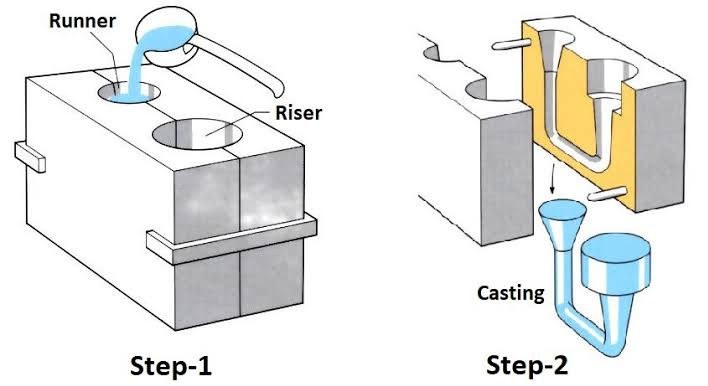
Gravity Die Casting
Gravity die casting fills a permanent metal mold mainly through gravity rather than high injection pressure.
It can provide better productivity and surface quality than many sand casting applications, but filling speed and thin-wall capability are generally lower than those of HPDC.
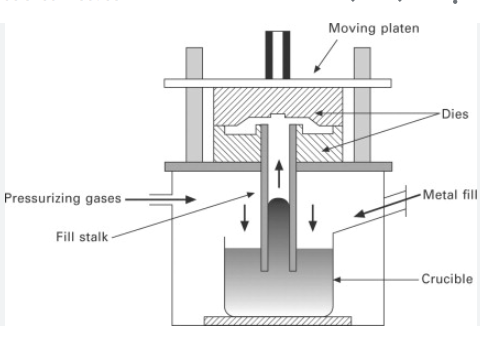
Low-Pressure Die Casting
Low-pressure die casting pushes molten metal into a permanent mold using relatively low pressure.
It is commonly used for aluminum wheels and other components where controlled filling and good internal quality are important.
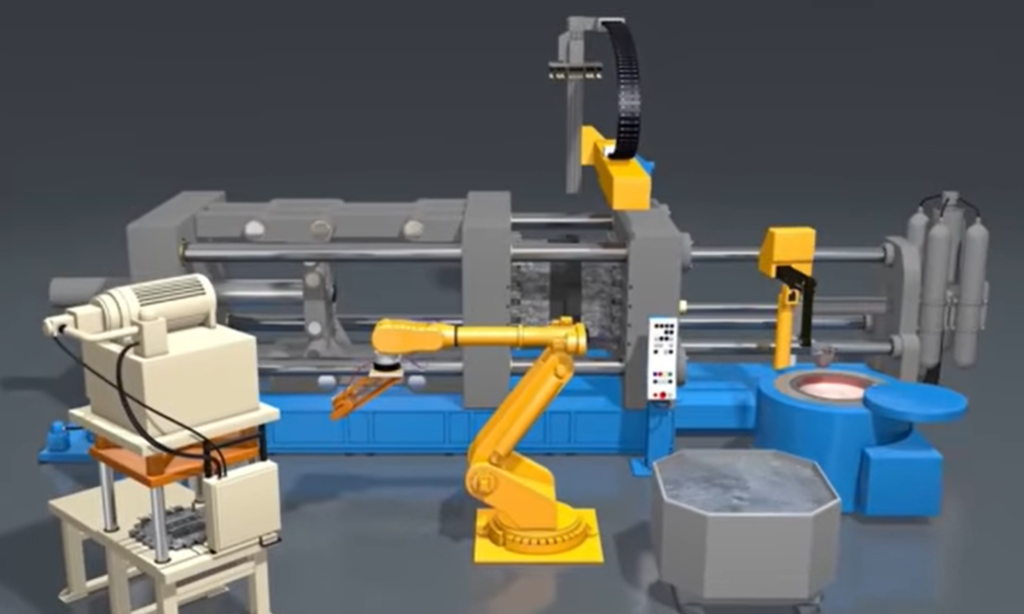
High-Pressure Die Casting
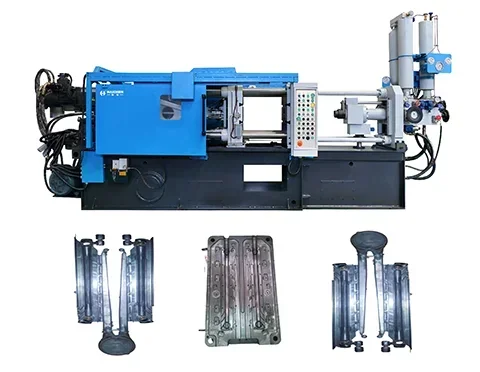
HPDC injects molten metal into a reusable steel die at high speed and pressure.
The process is especially suitable for high-volume production because one mold can produce a large number of consistent parts with short cycle times.
Why Is High-Pressure Die Casting So Popular for Mass Production?
HPDC has become a key manufacturing process for high-volume production of non-ferrous metal components.
High Production Speed
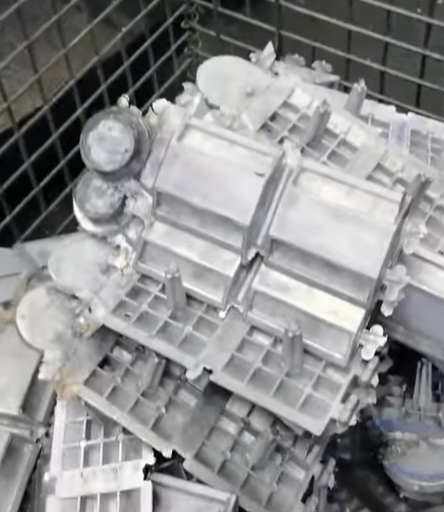
A major advantage of HPDC is its short production cycle.
Once the machine, die, and process parameters are properly set, manufacturers can produce large quantities of parts with consistent cycle times.
This makes HPDC particularly attractive for automotive components, electrical housings, appliance components, and other products with large annual production volumes.
Consistent Part Quality
HPDC uses a rigid steel die rather than a disposable mold.
As a result, manufacturers can achieve repeatable part dimensions from cycle to cycle when the die, machine, alloy, and process parameters are properly controlled.
This repeatability is particularly important for components that need to fit with other parts during assembly.
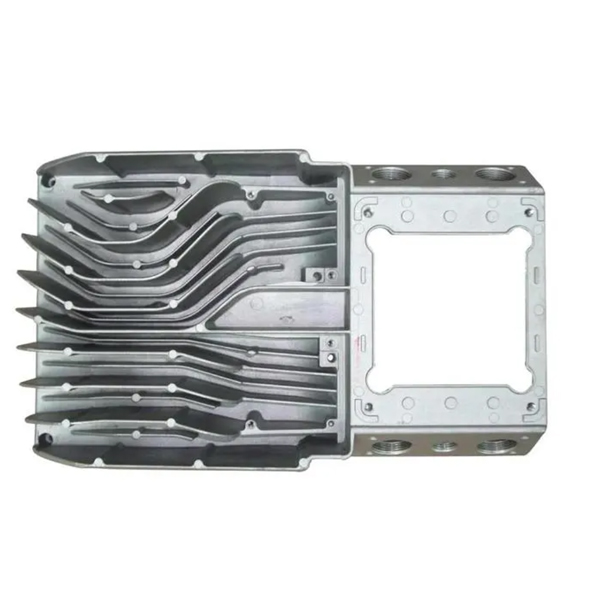
Complex and Thin-Wall Components
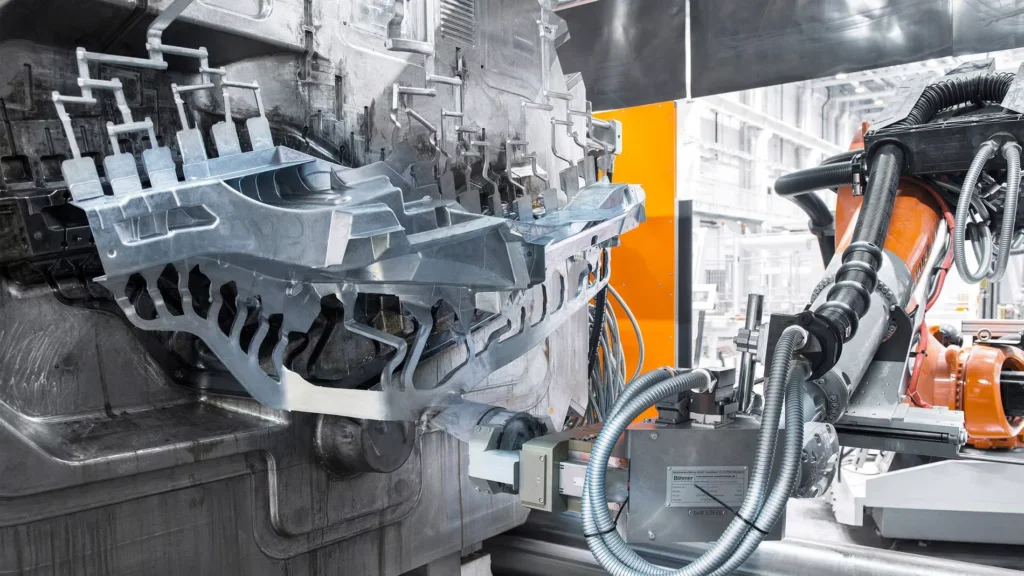
High-speed filling allows HPDC to form complex geometries and relatively thin walls.
This capability is valuable when manufacturers want to reduce material usage while maintaining the required structural performance.
However, the achievable wall thickness depends on the alloy, part geometry, flow length, die design, gating system, and process conditions. It should therefore not be treated as a universal fixed value.
Good Surface Finish
The molten metal fills a precision-machined steel die, allowing the casting to reproduce many of the die’s surface features.
For suitable applications, this can reduce the amount of secondary machining and finishing required.

HPDC vs. Other Casting Methods
The best process depends on the application. Here is a simple comparison:
| Casting Method | Typical Production Volume | Main Strength | Common Applications |
|---|---|---|---|
| Sand Casting | Low to medium | Flexible and economical tooling | Large castings, prototypes |
| Investment Casting | Low to medium | Complex and detailed shapes | Precision components |
| Gravity Die Casting | Medium | Reusable mold and good quality | Aluminum components |
| Low-Pressure Die Casting | Medium to high | Controlled filling | Wheels and structural parts |
| HPDC | High | Fast production and repeatability | Automotive and industrial parts |
This comparison explains why HPDC is so attractive for mass production. However, HPDC is not automatically the best option for every casting project.
When Should You Choose HPDC?
HPDC is usually a strong candidate when several of the following conditions apply:
High Production Volume
The higher the annual production volume, the easier it is to justify the cost of a permanent die and die casting machine.
Non-Ferrous Metals
HPDC is commonly used with alloys such as aluminum, zinc, and magnesium.
The specific alloy must be matched with the appropriate machine configuration, die design, melting system, and process parameters.
Complex Part Geometry
HPDC can combine multiple features into one casting and reduce the number of separate components required.
Short Cycle Time Is Important
For products that require high output, cycle time directly affects production capacity and manufacturing cost.
Consistent Dimensions Are Required
The permanent steel die and controlled machine process can provide repeatable dimensions across large production runs.
What Are the Limitations of High-Pressure Die Casting?
HPDC also has limitations, so manufacturers should not choose it based only on production speed.
Higher Die Cost
A production die requires precision machining and engineering.
The initial tooling investment can therefore be significant, especially for complex automotive components.
Porosity Can Be a Concern
High-speed metal filling can introduce or trap gas inside the casting.
Porosity can affect mechanical performance and may create problems for pressure-tight components.
Vacuum-assisted die casting and optimized gating and venting systems can help reduce this risk.
Product Design Must Match the Process
Draft angles, wall thickness, ribs, bosses, fillets, gates, overflows, and cooling channels all affect die casting performance.
A part designed for another manufacturing process may need to be redesigned before it can be produced efficiently by HPDC.
Conventional HPDC Has Heat-Treatment Limitations
Gas porosity can limit certain heat-treatment applications for conventional HPDC parts.
For demanding structural components, manufacturers may consider vacuum die casting, high-vacuum processes, or specially developed alloys and process technologies.
What Is Integrated Die Casting?
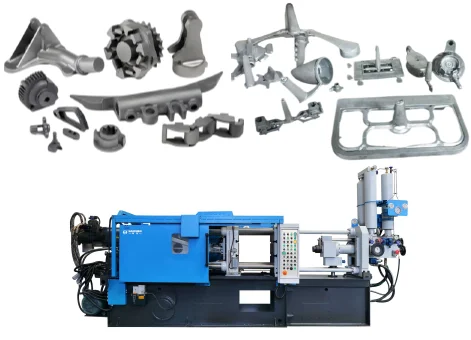
Integrated die casting is an advanced application of high-pressure die casting that has attracted significant attention in automotive manufacturing.
Instead of manufacturing many smaller stamped, cast, or fabricated parts separately and joining them later, manufacturers can use a very large die casting machine to produce a much larger structural component as one casting.
How Integrated Die Casting Works
The basic principle remains high-pressure die casting.
However, the difference is the scale and complexity of the casting.
A large machine injects molten alloy into a large precision die to form a structural component that may replace multiple smaller parts and joining operations.
Why Automakers Use Integrated Die Casting
The main goals include:
- Fewer individual components
- Fewer welding operations
- Lower assembly complexity
- Potential weight reduction
- Shorter manufacturing routes
- Improved production automation
This approach is particularly relevant to electric vehicle manufacturing, where reducing vehicle weight and manufacturing complexity can provide significant benefits.
Why Large Die Casting Machines Are Required
Large structural castings require much higher clamping force than conventional small die castings.
Therefore, integrated die casting has driven demand for ultra-large die casting machines with very high clamping forces.
The required machine size depends on the projected casting area, die design, injection conditions, safety factor, and other engineering factors.
Cold-Chamber vs. Hot-Chamber Die Casting
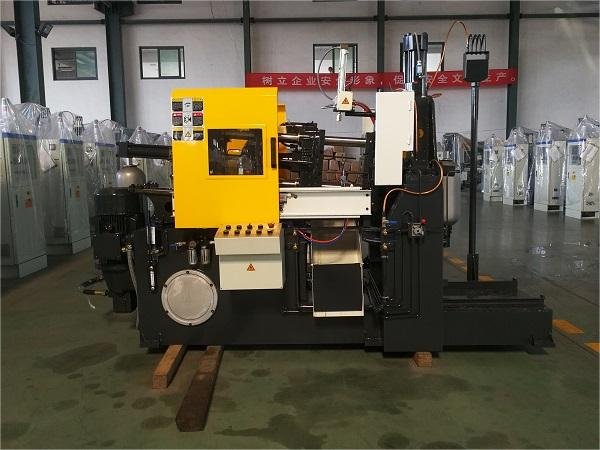
HPDC machines are commonly divided into cold-chamber and hot-chamber configurations.
Cold-Chamber Die Casting
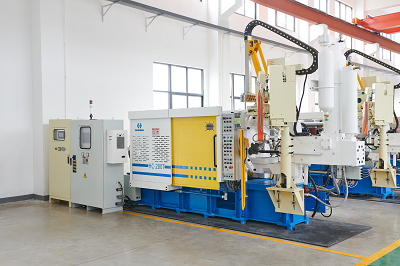
In a cold-chamber machine, molten metal is transferred from a separate melting furnace into the shot sleeve before injection.
This configuration is widely used for alloys with higher melting temperatures, especially aluminum alloys.
For this reason, cold-chamber die casting machines are widely used for automotive and industrial aluminum components.
Hot-Chamber Die Casting
In a hot-chamber machine, the injection system is integrated more closely with the molten metal system.
The process can provide very fast cycling and is commonly associated with lower-melting-point alloys such as zinc.
However, the appropriate machine type depends on the alloy, melting temperature, production requirements, and machine design.
What Materials Are Commonly Used in HPDC?
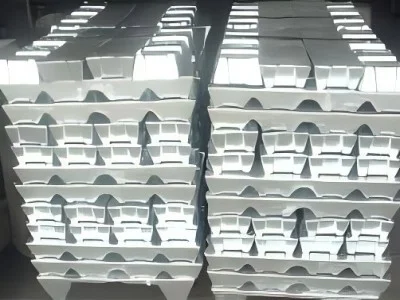
Aluminum Alloys
Aluminum is one of the most important materials for HPDC.
It combines relatively low density with good strength-to-weight performance and is widely used for automotive, electronics, and industrial components.
Zinc Alloys
Zinc alloys are suitable for many small and medium-sized components requiring good dimensional accuracy and surface quality.
They are commonly used for hardware, electronic components, housings, and other precision parts.
Magnesium Alloys
Magnesium is lighter than aluminum and can provide useful weight-saving and electromagnetic shielding properties.
It is therefore used in selected automotive and electronic applications where weight reduction is especially important.
What Is the Best Casting Method for Aluminum?
There is no universal answer.
For aluminum parts, the right casting method depends mainly on part size, geometry, production volume, mechanical requirements, and budget.
For example:
- Sand casting can work well for prototypes, large parts, and lower production volumes.
- Gravity die casting can be suitable for medium-volume permanent-mold production.
- Low-pressure die casting is widely used for applications such as aluminum wheels.
- HPDC is highly attractive for high-volume production of complex, thin-wall aluminum components.
Therefore, for manufacturers producing large quantities of aluminum components, HPDC is often one of the first processes worth evaluating.
How Is HPDC Technology Developing?
The die casting industry continues to improve productivity, casting quality, and material performance.
Vacuum-Assisted Die Casting
Vacuum systems can remove air from the die cavity during filling.
Reducing trapped gas can help improve casting quality and expand the potential applications of HPDC.
Integrated Structural Die Casting
Large structural castings are becoming increasingly important in automotive manufacturing.
This trend has increased the demand for larger machines, advanced die designs, improved process monitoring, and suitable aluminum alloys.
Automation and Process Monitoring
Modern die casting production can integrate automatic ladling, spraying, part removal, trimming, inspection, and data monitoring.
Automation helps reduce manual labor and improve production consistency.
More Efficient Material Use
Manufacturers are also focusing on reducing scrap, improving recycling, optimizing process parameters, and lowering energy consumption.
These improvements are becoming increasingly important as manufacturers seek to reduce both production costs and environmental impact.
How Should You Choose a Casting Method?
Instead of asking only which method is the most popular, manufacturers should ask which process best matches the product.
Step 1: Define the Material
Determine whether the part will use aluminum, zinc, magnesium, or another alloy.
Step 2: Check the Part Geometry
Consider wall thickness, projected area, ribs, bosses, holes, undercuts, and overall dimensions.
Step 3: Estimate Annual Production
High production volumes can make the investment in permanent dies and HPDC machines more economical.
Step 4: Define Quality Requirements
Consider dimensional tolerance, surface finish, mechanical strength, pressure tightness, and porosity requirements.
Step 5: Compare Tooling and Machine Costs
The lowest machine price does not always mean the lowest production cost.
Manufacturers should evaluate the complete production system, including the die, melting furnace, auxiliary equipment, automation, energy consumption, maintenance, and expected cycle time.
Why Is HPDC a Leading Choice for Mass Production?
If the question is specifically about mass production of non-ferrous metal components, high-pressure die casting is one of the leading choices because it combines:
- High production speed
- Repeatable dimensions
- Complex part capability
- Thin-wall capability
- Good surface quality
- High automation potential
- Efficient large-scale production
However, HPDC is not the universal “best” casting method.
The right process depends on the part, material, production volume, quality requirements, and total manufacturing cost.
For automotive and industrial manufacturers producing large quantities of aluminum components, high-pressure die casting—especially advanced vacuum and integrated die casting technologies—has become an increasingly important manufacturing solution.
FAQ About Casting Methods
What Is the Most Popular Casting Method?
There is no single most popular method for every application. Sand casting is one of the most widely used general casting processes, while HPDC is a leading choice for high-volume production of non-ferrous metal components.
Is HPDC Better Than Sand Casting?
Neither process is universally better. HPDC is generally more suitable for high-volume production and repeatable complex parts, while sand casting offers greater flexibility and can be more economical for low-volume or large components.
What Is the Best Casting Method for Aluminum?
It depends on the application. HPDC is often a strong choice for high-volume production of complex aluminum parts, while gravity, low-pressure, and sand casting may be more appropriate for other designs and production volumes.
What Is the Difference Between HPDC and Gravity Die Casting?
HPDC uses high-speed injection and pressure to fill the die, while gravity die casting relies mainly on gravity. HPDC generally provides higher production speed and is better suited to high-volume production.
What Is Integrated Die Casting?
Integrated die casting uses very large high-pressure die casting machines to produce large structural components as a single casting, potentially replacing multiple smaller parts and joining operations.
What Is the Difference Between Hot-Chamber and Cold-Chamber Die Casting?
Hot-chamber machines keep the injection system closely connected to the molten metal, while cold-chamber machines transfer molten metal from a separate furnace into the shot sleeve before injection. Cold-chamber machines are widely used for aluminum alloys.


