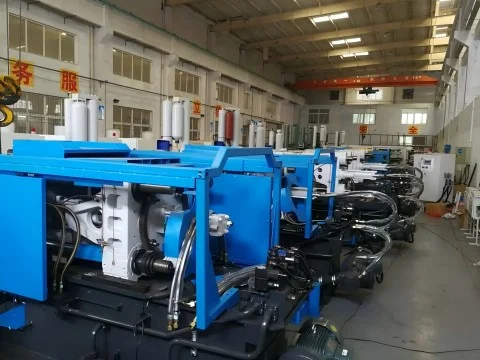
Aluminum radiator die casting machine selection guide covering clamping force, shot size, cooling, and automation for production efficiency.
Choosing the right aluminum radiator die casting machine is essential for producing high-quality, efficient radiators. The lightweight, high corrosion resistance, and high thermal conductivity are reasons why aluminum radiators are extensively used in automotive, electronics, and industrial applications.
This guide covers the key aluminum radiator die casting machine selection criteria — press type, clamping force, shot size, cooling system, automation, and energy efficiency — with real production examples from HAICHEN installations.
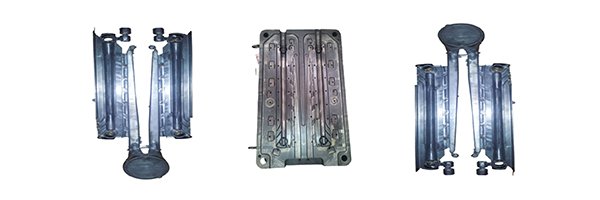
Key Machine Selection Criteria for Aluminum Radiator Die Casting Machines
Type of Die Casting Machine
Cold chamber die casting machines are the preferred type for the production of aluminum radiators. Their precision in controlling the injection of molten aluminum into the die cavity ensures capture of every intricate detail, thus the structural integrity of the radiators.
Cold chamber devices are the best for high temperature alloys, especially aluminum, because they eliminate the danger of safely containing the molten metal. They also enable selection of different alloys and have the advantage of accommodating parts that are more complex and larger in size, making them suitable for advanced high precision parts such as aluminum radiators.
Clamping Force
During die casting, the clamping force of the machine should enable handling of the pressure during the process. Inadequate clamping force results in die deformation and parts of inadequate quality.
HAICHEN provides machines with clamping forces ranging from 30 tons to 3000 tons, assisting in the selection of appropriate machines depending on the size and intricacy of the aluminum radiator parts.
Clamping Force Calculation:
Use the formula F = (p × A) / 10,000, where F = tons, p = injection pressure (bar), A = projected area (cm²). For a 600×400mm radiator (A ≈ 2400 cm²) and aluminum injection pressure of 800 bar, the base requirement is (800 × 2400)/10,000 = 192 tons. Apply a safety factor of 1.2-1.5, yielding 230-288 tons.
Shot Size
The shot size refers to the amount of molten metal that the machine can handle in one cycle. Shot size of the machine should correspond to the dimensions of the radiator being manufactured for efficiency and consistency.
HAICHEN offers a variety of cold chamber die casting machines with specific shot sizes designed for different sizes of radiators:
| Machine Model | Best For | Radiator Size |
|---|---|---|
| HCD300-C | Small size radiators | 350mm length |
| HCD580-C | Medium size radiators | 500mm length |
| HCD880-C | Large radiators | Up to 600mm length |
Cooling System
It is critical to implement a robust system designed to rapidly cool molten aluminum after casting, so that the parts solidify uniformly, maintaining their shape. Contemporary die casting machinery possesses sophisticated cooling systems with individually controllable, multi-circuit cooling systems. Each coolant circuit can be managed independently with temperature set points for control during the cooling period of the casting cycle.
Automation
Production efficiency can dramatically improve and labor costs lower with the use of automated machines. Purchasing machines that include automation for material handling and part removal increases precision and reliability. A steady supply of molten aluminum can be assured with automated material handling systems, and finished components can be removed from the mold using robotic arms or ejector systems.
Energy Efficiency
Overall costs that the business incurs during production will be greatly reduced by choosing machines optimally designed for energy efficiency. Servo-driven hydraulic systems reduce energy consumption by 30-60% compared to fixed displacement pumps. HAICHEN’s energy monitoring dashboard tracks kWh per shot, helping identify optimization opportunities.able for the manufacturing of advanced high precision parts such as aluminum radiators.
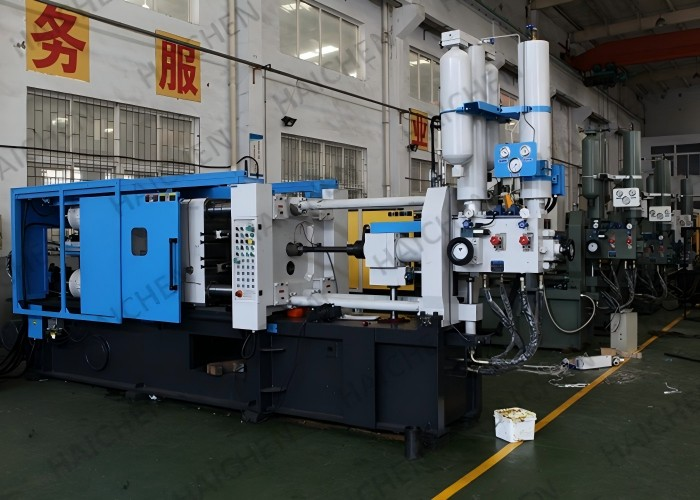
HAICHEN Application Example: Aluminum Cooling Plate Production
HAICHEN provided a customized die-casting solution for a customer’s production line of aluminum cooling plates for new energy vehicle battery packs, successfully addressing the challenges of manufacturing large, thin-wall components.
Project Background & Core Challenges
The product was a large, complex cooling plate with overall dimensions of approximately 600×400mm and internal channel walls as thin as 2mm. Requirements included extremely high sealing, flatness, and a fast production cycle to meet batch delivery schedules.
HAICHEN’s Targeted Solution
Equipment Selection: Recommended an HAICHEN 880-ton cold chamber die casting machine to ensure sufficient clamping force and mold space.
Process Configuration: Equipped with a high-speed injection system and a large-capacity closed-loop mold temperature controller to optimize filling and temperature management.
Process Optimization: Optimized the gating and venting system through simulation analysis and applied vacuum assistance to ensure perfect filling and internal density of the ultra-thin channels.
Results Achieved
| Metric | Result |
|---|---|
| First-pass yield | 98.2% |
| Production cycle time | 75 seconds |
| Porosity | Below 0.5% (vacuum system) |
| Stable low energy consumption | Significantly reduced cost per part |
Why the 880-Ton Machine Was Chosen
The final selection was 880 tons due to large mold dimensions and high thin-wall filling demands. Always verify two more parameters: shot speed (minimum 4-6 m/s for thin aluminum radiators) and die platen size to accommodate the mold.
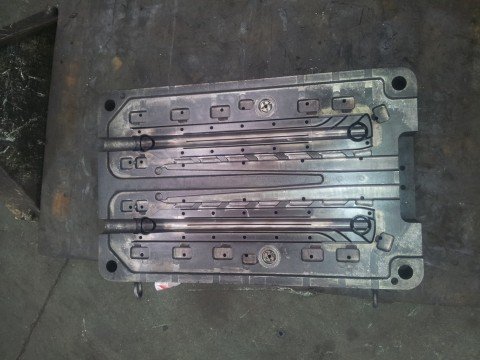
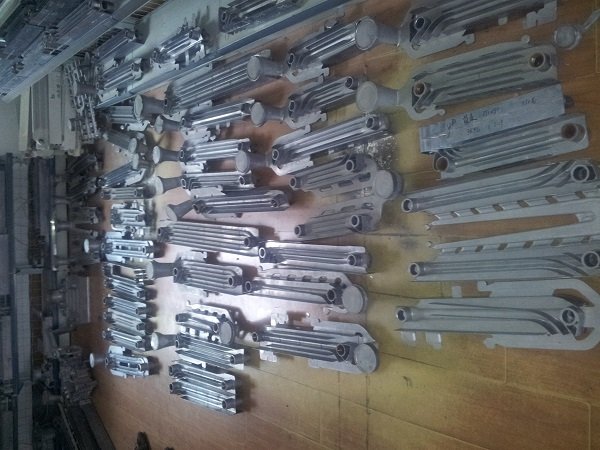
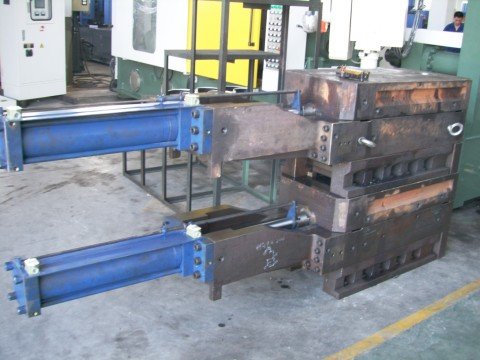
Machine selection for aluminum radiators
HAICHEN: Manufacturer of Aluminum Radiator Die Casting Machines
HAICHEN specializes in the manufacturing of cold chamber die casting machines, specifically focusing on processes related to the production of aluminum radiators.
Cutting-edge controls, cooling, and automated part handling guarantee consistent quality and high production efficiency. As leaders in the die casting industry for over 20 years, HAICHEN is fully capable of meeting your aluminum radiator production needs, delivering dependable solutions and advanced technology.
Frequently Asked Questions
Q: What type of die casting machine is best for aluminum radiators?
A: Cold chamber die casting machines are the preferred choice for aluminum radiators. They offer precise control over molten aluminum injection and are suitable for high-temperature alloys and complex part geometries.
Q: How do I calculate the required clamping force for an aluminum radiator?
A: Use the formula F = (p × A) / 10,000, where F is clamping force in tons, p is injection pressure in bar, and A is projected area in cm². Apply a safety factor of 1.2-1.5 for reliability.
Q: What shot size do I need for aluminum radiator production?
A: Shot size should match the radiator dimensions. HAICHEN offers machines with shot sizes for small (350mm), medium (500mm), and large (up to 600mm) radiators. The HCD880-C is recommended for large aluminum cooling plates.
Q: How important is the cooling system in aluminum radiator die casting?
A: Critical. A robust cooling system ensures uniform solidification, prevents shrinkage and warping, and maintains dimensional accuracy. Multi-circuit independently controllable cooling systems provide the best results.
Q: Can HAICHEN machines handle automated production?
A: Yes — HAICHEN machines support full automation including material handling, robotic part removal, and continuous operation for high-volume production.
Q: How much energy can a servo-driven machine save?
A: Servo-driven hydraulic systems reduce energy consumption by 30-60% compared to fixed displacement pumps, significantly lowering operational costs.