An aluminum die casting design guide provides essential information on optimizing part design, material selection, and process parameters to ensure high-quality, efficient production of aluminum castings.
Die casting is a manufacturing process where parts are made by injecting molten metal under high pressure into a metal mold. Aluminum die casting, in particular, offers unique advantages for producing complex, lightweight, and durable components across automotive, aerospace, electronics, and consumer goods industries.
This guide provides essential information on optimizing part design, material selection, and process parameters to ensure high-quality, efficient production of aluminum castings. Understanding these design principles helps manufacturers reduce defects, lower costs, and accelerate time-to-market.
Understanding Aluminum Die Casting
Aluminum alloy die casting is a manufacturing method that injects molten aluminum alloy into a steel mold. Its core advantages are reflected in three aspects:
- High production efficiency: This process can quickly complete the mass production of complex parts and significantly shorten the manufacturing cycle.
- Accurate dimensional control: Even for parts with rich details or complex structures, it can ensure that the dimensional accuracy of the final product meets the design requirements.
- Good surface quality: The molded parts almost do not require additional polishing and have a usable appearance quality directly.
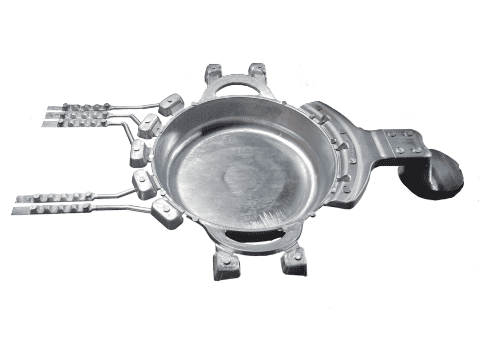
Key Design Considerations for Aluminum Die Casting
Wall Thickness
In order to avoid warping, wall thickness should be uniform throughout for even cooling. Uneven wall thickness leads to differential cooling rates, causing internal stresses, warpage, and porosity.
Recommended wall thickness guidelines:
- Small parts: 1.5-2.5mm
- Medium parts: 2.5-3.5mm
- Large parts: 3.5-5.0mm
- Minimum recommended: 0.8mm (with high-pressure die casting)
Draft Angles
Core and cavity portions should have appropriate draft angles to permit easy withdrawal from the die.
Recommended draft angles:
- External surfaces: 1-2°
- Internal surfaces (cores): 2-3°
- Deep cavities: 3-5°
- Textured surfaces: 5-8°
Rib and Boss Design
Ribs and bosses must be placed in thin sections to reinforce areas without leading to excessive stress concentrations. Rib thickness should be 40-60% of the adjacent wall thickness to prevent sink marks.
Key guidelines:
- Rib thickness: 0.4-0.6 × wall thickness
- Boss height: ≤ 2 × diameter
- Minimum distance between bosses: 2 × wall thickness
Gating and Risering
Efficient gates and risers are essential for complete filling of the mold cavity and for compensating material shrinkage during solidification. Gate location should promote directional solidification and minimize turbulence.
Material Selection
Aluminum alloys are non-ferrous metals having varying degrees of corrosion resistance. Different parts in an assembly require different properties, which requires careful selection of a suitable alloy.
| Alloy | Key Properties | Typical Applications |
|---|---|---|
| A380 | Excellent castability, good mechanical properties, corrosion resistant | General purpose, electronics, automotive housings |
| A356 | High strength, good ductility, heat-treatable | Structural components, engine blocks, wheels |
| A360 | Excellent corrosion resistance, good machinability | Aerospace, marine, high-performance automotive |
| A206 | Heat-treatable, high strength, fatigue resistance | Aircraft parts, high-stress engine components |
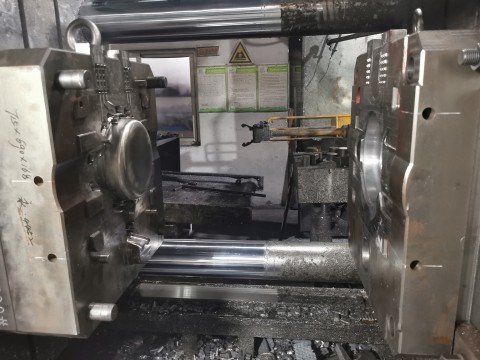
Design Checklist for Aluminum Die Casting
Before finalizing your design, review this checklist to ensure manufacturability:
| Design Element | Check | Recommendation |
|---|---|---|
| Wall thickness | Is it uniform? | Keep within 1.5-5.0mm range, minimize variations |
| Draft angles | Adequate for ejection? | External 1-2°, internal 2-3°, deep cavities 3-5° |
| Ribs and bosses | Properly placed? | Rib thickness 40-60% of wall thickness |
| Corners and radii | Sufficient radius? | Minimum 0.5-1.0mm radius at corners |
| Undercuts | Avoided or designed for side cores? | Eliminate or design with side cores |
| Gate location | Optimal for filling? | Promote directional solidification |
| Ejector pins | Properly positioned? | Avoid critical surfaces, use flat pins |
Common Problems and Remedies in Aluminum Die Casting Design
Porosity and Shrinkage
Causal Analysis:
- Excessive injection velocity traps air in the cavity
- Inadequate mold venting obstructs air passage
- High gas content in the raw material
- Irregular cooling rates causing uneven solidification
Solutions:
- Optimize injection speed to reduce air entrapment
- Enhance mold venting with adequate vents and overflow wells
- Implement vacuum-assisted casting to minimize gases
- Design cooling channels for uniform temperature control
Surface Defects
Causal Analysis:
- Poor mold surface condition (scratches, uneven coating)
- Material quality issues (inclusions, impurities)
- Excessive injection speed or pressure causing turbulence
Solutions:
- Regular mold maintenance and surface polishing
- Use high-quality raw materials with minimal impurities
- Optimize injection parameters to reduce turbulence
Deficient Mechanical Strength
Causal Analysis:
- Improper alloy selection for the application
- Rapid cooling creating internal stresses
- Incorrect injection parameters affecting microstructure
Solutions:
Apply heat treatment to enhance strength and toughness
Select the appropriate aluminum alloy for mechanical requirements
Design efficient cooling channels for uniform cooling
Optimize injection speed, pressure, and holding time
Advantages of Aluminum Die Casting
| Advantage | Benefit | Application Impact |
|---|---|---|
| Strength and Durability | High strength-to-weight ratio, excellent fatigue resistance | Automotive structural parts, aerospace components |
| Cost-Effectiveness | Low per-part cost for complex shapes due to high production efficiency | Mass production, consumer electronics |
| Versatility | Wide application range from automotive to consumer goods | Multiple industries and product types |
| Lightweight | 40-60% weight reduction vs. steel | EV components, portable electronics |
| Corrosion Resistance | Natural oxide layer provides protection | Outdoor and marine applications |
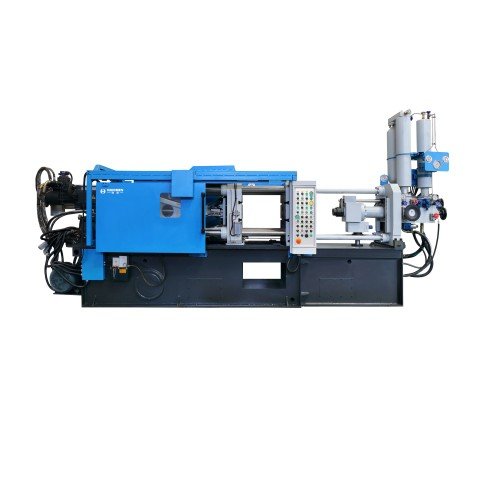
HAICHEN Aluminum Die Casting Machines
HAICHEN Machinery is a manufacturer of aluminum die casting machines built to precise standards. We can process a variety of complex components with consistent quality and performance.
Key features of HAICHEN aluminum die casting solutions:
- Cold chamber machines from 160 to 2500 tons for aluminum alloys
- Multi-stage injection control for optimized filling and reduced defects
- Vacuum assistance for porosity reduction
- Intelligent temperature management for consistent quality
- Real-time monitoring for process stability and traceability
Reduce costs and improve production efficiency with advanced die-casting solutions from HAICHEN Machinery. Our machines help you maintain consistent quality even at high production volumes.
Frequently Asked Questions
Q: What is aluminum die casting?
A: Aluminum die casting is a manufacturing process where molten aluminum alloy is injected into a steel mold cavity under high pressure, producing complex, high-precision metal parts.
Q: What are the most important design considerations for aluminum die casting?
A: Key considerations include uniform wall thickness (1.5-5.0mm), adequate draft angles (1-3°), proper rib and boss design, optimal gate location, and suitable alloy selection for the application.
Q: What is the minimum wall thickness for aluminum die casting?
A: The minimum recommended wall thickness is 0.8mm for small parts with high-pressure die casting. For most applications, 1.5-2.5mm is recommended to ensure proper fill and structural integrity.
Q: How do I prevent porosity in aluminum die castings?
A: Prevent porosity by optimizing injection speed, ensuring adequate mold venting, using vacuum-assisted casting, and maintaining uniform mold temperature through proper cooling channel design.
Q: What are the most common aluminum alloys used in die casting?
A: A380 is the most common for general-purpose applications. A356 is used for structural components requiring higher strength. A360 offers excellent corrosion resistance, and A206 is heat-treatable for high-strength applications.
Q: Does HAICHEN offer machines for aluminum die casting?
A: Yes — HAICHEN offers cold chamber die casting machines from 160 to 2500 tons, optimized for aluminum alloys with multi-stage injection control, vacuum assistance, and intelligent temperature management.


