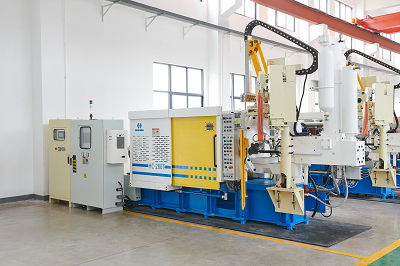
A chiller in casting purpose is to control the solidification sequence of the casting, accelerate local cooling to improve the casting quality.
The core role of the chiller in die casting is to solve the problems of mold overheating and slow cooling of castings through precise temperature control and efficient heat dissipation, thereby improving product quality, production efficiency and equipment life, while reducing energy consumption and scrap rate.
The purpose of a chiller in casting has the following five main functions:
- Control mold temperature,ensure product quality
- Shorten production cycle and improve efficiency
- Extend equipment life and reduce maintenance costs
- Shorten production cycle and improve efficiency
- Energy saving, environmental protection and process stability
Water-cooled chillers suit high-temperature shops and high-volume production. Air-cooled chillers are easy to install for small to medium equipment. Oil-cooled chillers suit magnesium and other temperature-sensitive materials.
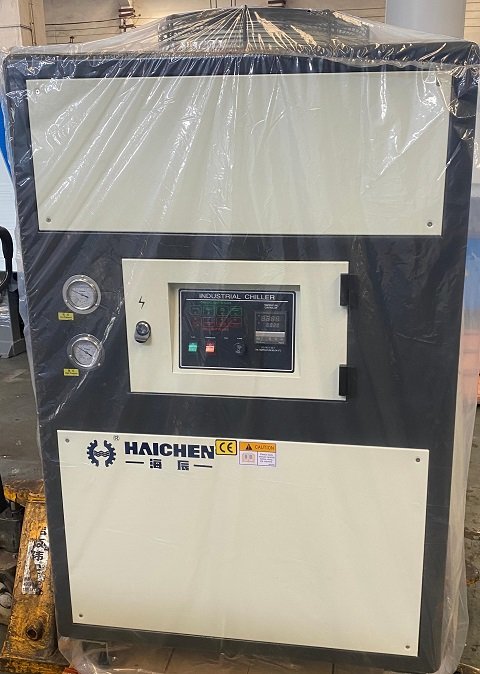
Control mold temperature,ensure product quality
- Mold temperature directly affects the quality of castings
- Uneven mold temperature
- Maintains thermal balance
- Surface hardening
- Controlling thermal stress
Mold temperature directly affects the quality of castings
The chiller removes heat from the mold through circulating cooling water to ensure that the mold is in a reasonable operating temperature range (usually adjusted in real time by temperature sensors and flow meters), avoiding defects such as shrinkage holes, hot bubbles, and surface depressions in castings due to excessive temperature.
Haichen produce die casting chiller for more than 10years. For different die casting production requirement, it has water cool caused industrial chiller and air cooled caused industrial chiller series.With Haichen industrial chiller it can greatl improve the working efficiency of die casting machines. Also improve die casting machine products quality.
Uneven mold temperature
Uneven mould temperature can cause problems such as unstable casting dimensions and deformation. The constant temperature control of the chiller in die casting can significantly improve the density and surface quality of the product.
Maintains thermal balance
In aluminum alloy and magnesium alloy die casting, the chiller maintains thermal balance to prevent the scrap rate from increasing due to sticking or material expansion.
Surface hardening
A chill in casting, in some cases, condensate can also be used for surface hardening to make the surface of the casting hard and durable, suitable for applications requiring wear resistance.
Controlling thermal stress
Application of cooling chiller in die casting, for example the condensate can reduce thermal stress caused by temperature gradients by accelerating cooling in local areas, thereby preventing cracks.
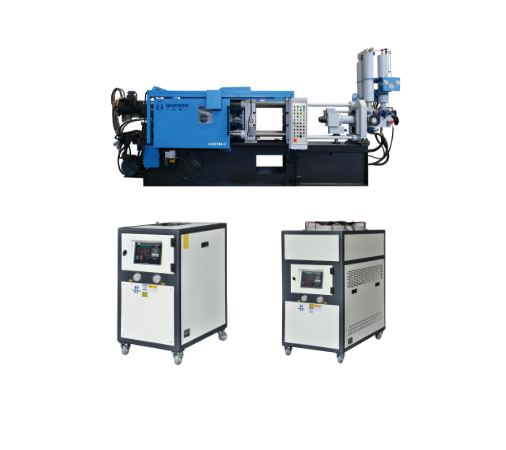
Shorten production cycle and improve efficiency
- Shorten casting solidificate time
- Solidify quickly
Condenser is a material with high heat capacity and thermal conductivity. It is often placed at the edge or inside the mold cavity to accelerate the cooling rate in that area. This helps to change the solidification sequence of the casting so that the casting solidifies in the desired order.Accelerate the crystallization and solidification of castings through low-temperature cooling.
Shorten casting solidificate time
The chiller can shorten the solidification time of castings, reduce the die-casting cycle (such as filling, cooling, and spraying time), and improve production efficiency by 20%-30%.
Solidify quickly
Rapidly cool plastic or molten metal to make the product solidify quickly (such as plastic cooling in injection molding machines) to avoid production delays.
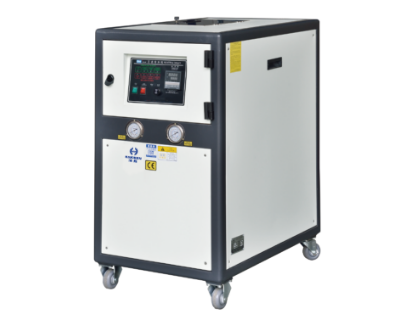
Extend equipment life and reduce maintenance costs
- Reduce thermal stress damage to equipment
- Reduce maintenance costs
Reduce thermal stress damage to equipment
Effectively cool the die-casting machine and mold, reduce thermal fatigue, wear and corrosion, and extend the service life of the mold. For example, stable thermal balance can delay mold cracks and reduce the risk of thermal cracking of steel.
Reduce maintenance costs
Prevent equipment from overheating failure and reduce downtime maintenance caused by high temperature.
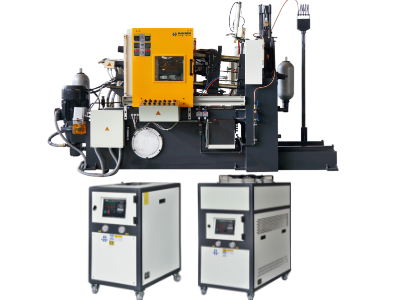
Shorten production cycle and improve efficiency
Using condensate can increase the feed distance of the riser and reduce the number of risers required, thereby improving production efficiency.
- Accelerate the crystallization and solidification of castings through low-temperature cooling.
- The chiller can shorten the solidification time of castings, reduce the die-casting cycle (such as filling, cooling, and spraying time), and improve production efficiency by 20%-30%.
- Rapidly cool plastic or molten metal to make the product solidify quickly (such as plastic cooling in injection molding machines) to avoid production delays.
Energy saving, environmental protection and process stability
- Enviroment protection
- Optimize colling process
- Stable process
Enviroment protection
The chiller adopts a closed-loop circulation system (industrial pure water for internal circulation and soft water for external circulation), and dissipates heat efficiently through a heat exchanger:
Optimize colling process
Optimizing the cooling process can reduce energy consumption and water waste (cooling water is recycled and not discharged).
Stable process
The constant temperature, constant flow and constant pressure design ensures process stability and reduces production fluctuations.
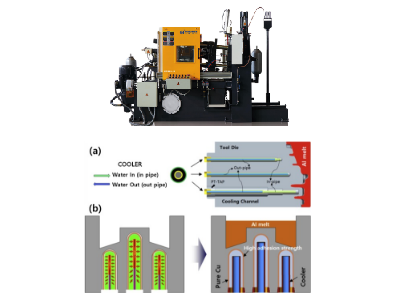
Die Casting Chiller Cooling Methods and Selection
Die casting chillers come in several types based on heat dissipation and cooling medium. Selection must match actual working conditions.
- Water-cooled chiller
- Air-cooled chiller
- Oil-cooled chiller
Water-cooled chiller
Uses water as the heat dissipation medium. Requires an external cooling tower or recycle water tank. High heat exchange efficiency, 2-4 times better than oil cooling. Suitable for high-temperature workshops and high-volume continuous production. Needs regular water treatment to prevent scale and corrosion. Temperature range typically 10-30℃.
Air-cooled chiller
Discharges heat directly into the air through built-in fans. No external water circuit needed. Easy to install, saves space. Suitable for small to medium equipment or workshops without convenient water supply. Efficiency decreases on hot days. Self-contained unit with compressor, condenser, evaporator, and control system.
Oil-cooled chiller
Uses thermal oil as the circulating medium. Operating temperature range 200-300℃. Excellent thermal stability. Suitable for magnesium and other alloys sensitive to temperature changes, avoiding thermal shock from water cooling. Higher maintenance cost, risk of leakage and fire.
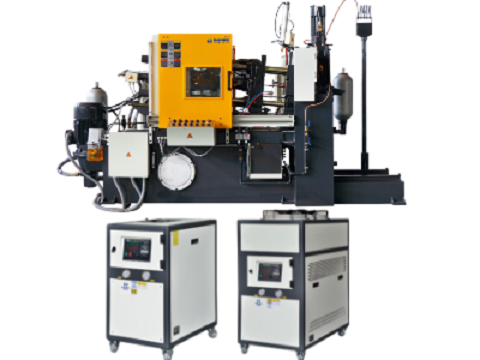
Auxiliary functions
- Safety assurance
- Environmental control
- System compatibility
Application of cooling chiller in die casting, it achieves multiple goals such as improving casting quality, extending mold life, and improving production efficiency through precise temperature control and reliable circulation system.
Safety assurance
In magnesium alloy die-casting, the chiller is combined with a gas protection system to prevent the metal from burning when it melts.
Environmental control
Some chillers also have the function of cooling down the factory positions to improve the high-temperature working environment.
System compatibility
Supports time control (timing opening and closing solenoid valve) or temperature control (automatically adjusted according to the mold temperature) to meet different process requirements.
Case Study of Haichen die casting chiller practice
HAICHEN not only manufactures high-performance die casting machines but also provides supporting industrial chillers for seamless main unit and auxiliary integration.
- One-stop supporting capability
- Customized cooling solutions
- Deeply integrated control system
- Application case
One-stop supporting capability
HAICHEN provides a complete range of auxiliary equipment including chillers, mold temperature controllers, vacuum systems, and extraction robots. Customers do not need to deal with multiple suppliers, reducing equipment selection and installation complexity. Matched chillers are designed specifically for the cooling interface and heat load requirements of HAICHEN die casting machines, plug-and-play.
Customized cooling solutions
HAICHEN engineering team analyzes heat flow in the mold to calculate required water temperature and flow for each cooling circuit, then customizes chiller specifications. For complex molds with local hot spots, HAICHEN also supports conformal cooling channel design to improve cooling uniformity.
Deeply integrated control system
HAICHEN chiller and die casting machine share a common PLC control platform. Operators can monitor and adjust cooling parameters on the main machine screen. Chiller operating status, water temperature, and alarms are in-time synchronized to the machine control system, enabling centralized management and traceability.
Application case
One Haichen application cooling chiller in die casting case: An automotive parts manufacturer uses a HAICHEN machine to produce aluminum steering knuckles. Uneven wall thickness caused local hot spots. Shrinkage porosity reject rate was 8%. HAICHEN designed a high-flow water cooling circuit at the hot spot with a dedicated chiller, water temperature controlled at 15℃. After reducing water temperature from the original 30℃ to 15℃, solidification speed increased. Shrinkage porosity reject rate dropped below 1.5%. Cycle time shortened 12%. Thermal fatigue cracks on the mold decreased, extending maintenance intervals by 30%.
Haichen die casting chiller
Haichen, is one Chinese machine manufacturer produces high pressure die casting machines. It includes cold chamber die casting machines and hot chamber die casting machines.They have high durable and precise features. we have auxiliary machine-cooling chillers for option.