The motor power of a cold chamber die casting machine is the amount of electrical energy consumed or output by the motor per unit of time. It is a physical quantity that measures the amount of electrical energy consumed by the motor during operation.
In a cold chamber die casting machine, the motor power is usually measured in kilowatts (kW), which indicates the amount of electrical energy that the motor can convert in one hour.
For a die casting machine, the motor power is directly related to the machine’s working efficiency and production capacity.
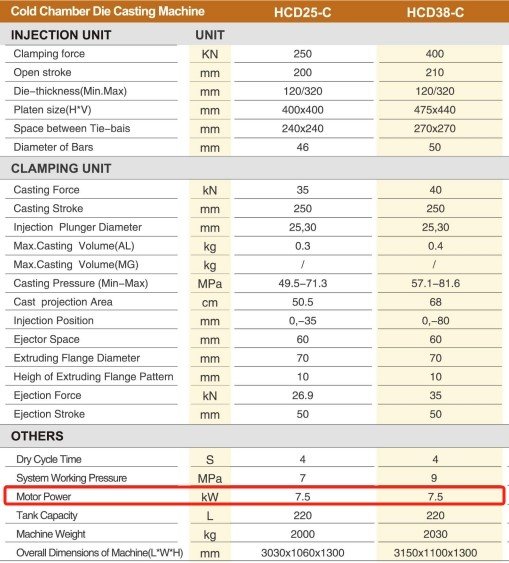
The role of motor power
- Providing powe
- Ensure production efficiency and quality
- Determine load capacity
- Affect energy consumption
Providing power
The motor is the core power source of the die-casting machine. It converts electrical energy into mechanical energy to drive the various components of the die-casting machine.
Ensure production efficiency and quality
The size of the motor power directly affects the working efficiency of the die-casting machine and the quality of the castings. High-power motors can provide greater power, allowing the die-casting machine to be tested at full speed and full pressure without alarm, thereby ensuring production efficiency and casting quality
Determine load capacity
High-power motors have stronger overload capacity and can run for a long time under extreme conditions without alarm, which is very important for ensuring continuous production.
Affect energy consumption
Motor power is directly related to energy consumption. While providing strong power, high-power motors may also be accompanied by higher energy consumption. The use of servo motors and frequency conversion controllers can significantly reduce noise and improve energy efficiency.
Factors Affecting Motor Power
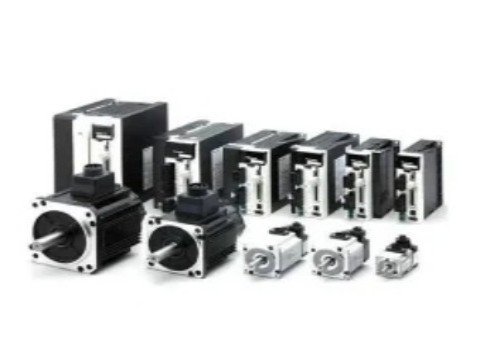
- Motor Type
- Material properties
Motor Type
The motor type is one of the key factors that determine the motor power requirements. Different types of motors vary in efficiency and performance, which directly affects the power required.
DC Motors
DC motors generally provide good starting torque and speed control, and are suitable for applications that require precise control. However, they may not be as efficient as modern AC or servo motors.
AC Motors
As we know AC motors (AC) are often used in industrial applications because they are more rugged and have low maintenance costs. AC motors have a higher efficiency and power factor and are suitable for continuous operation.
Servo Motors
We all know servo motors are the first choice for precision control applications, such as accurate position and speed control. Servo motors can respond to commands very quickly, but they are more expensive and are usually used in situations that require high precision and high performance.
Material properties
The melting point and fluidity of the material used for die casting will affect the motor power requirements. For example, zinc alloys are generally easier to flow than aluminum alloys, so lower injection forces may be required during the injection process, reducing the motor power requirements.
Melting point
The melting point of a material determines the energy required to heat it to a temperature suitable for injection. Materials with higher melting points require more energy to heat, which may require higher motor power.
Fluidity
The fluidity of a material affects the force required during the injection process. Materials with poor fluidity require greater injection forces to fill the mold, which increases the motor power requirements.
Mold design
The mold design must take into account the motor power of the die casting machine to ensure an efficient production process and high quality castings. Complex mold designs may contain more details and thin-walled sections, which may require higher injection pressures and precise control, increasing the motor power requirements. Optimizing mold design can reduce unnecessary energy consumption and improve production efficiency.
Mold Size
The size of the mold and the size of the casting directly affect the injection force required. Larger molds and castings require more force to fill, which generally means a higher motor power is required.

Ejector pin layout:
The number and layout of ejector pins affect demoulding efficiency, which may affect the required ejection force and thus the motor power.
Advantages of Haichen Cold ChamberDie Casting Machinery
Motor power is an important indicator of the performance of cold chamber die casting machines, which is directly related to the efficiency of die casting production and the quality of castings. Reasonable selection and maintenance of motors are essential to improving production competitiveness and meeting the market demand for high-quality castings. Haichen’s die casting machines can provide a variety of motor configuration options to meet different production needs and ensure energy efficiency and operational reliability.
- High-efficiency and energy-saving motors
- Accurate power control
- Stable performance
- Intelligent control system
High-efficiency and energy-saving motors
Haichen Machinery uses high-efficiency and energy-saving motors, which consume less electricity during operation and help reduce energy costs.
Accurate power control
Provide accurate power control to ensure the consistency of injection speed and pressure, which is essential for producing high-quality die castings.
Stable performance
The stability of the motor ensures the continuity and reliability of the production process and reduces unexpected downtime.
Intelligent control system
Equipped with advanced intelligent control system, it can monitor and adjust the motor power in real time to adapt to different production conditions.

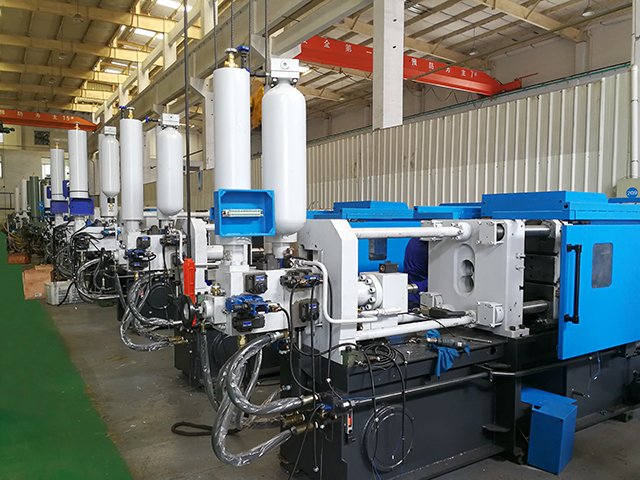
If you are looking for a high-performance cold chamber die casting machine to meet your production needs, please contact Haichen Machinery. Our team of experts will provide you with professional advice and customized solutions to help you achieve your production goals.
Haichen Corporation extensively employs servo motor technology across our range of die-casting machines, primarily for precise control of injection units, energy-saving optimisation, and automated integration.
Our servo system technology solutions fully demonstrate the pivotal role of servo systems in enhancing die-casting quality and efficiency. Concurrently, they enable environmentally conscious production, meeting modern industry’s demand for green manufacturing.


