Die casting machine platens selection guide includes platen type, select guide devices and material, clean and maintenance, etc.
The die casting machine platens are the cornerstone for ensuring high-pressure injection accuracy. Two-template models have become a trend due to their high efficiency and compactness, but they rely on high-rigidity materials and advanced hydraulic control technology.
Platens are the main structural parts of a die casting machine. They hold the mold and take the die casting machine clamping force. Wrong selection can cause mold deformation, flash, or part size errors. This guide explains four key areas: platen material, rigidity design, size matching, and thermal stability. It helps buyers build a clear evaluation system.
Different machine sizes need different platens. Small and medium machines focus on accuracy and surface hardness. Large machines care more about bending stiffness and weight control. Also, cooling channel design, tie bar hole layout, and mold mounting slot sizes affect daily use. This guide explains each parameter one by one.
When choosing a die casting machine platens, we suggest you to consider about five main factors as below:
- Platen Type
- Selection of guides devices
- Material selection
- Selection of mold steel
- Other accessories

Platen material selection guide
Platen material decides its compression strength and impact resistance. Die casting machine platens mainly use ductile iron or cast steel. Buyers should choose the right material grade and surface hardness based on machine tonnage and cycle frequency.
- Compare ductile iron and cast steel
- Common material grades and their uses
- Hardness and wear resistance requirements
Compare ductile iron and cast steel
Ductile iron (like QT600-3) has good damping. It absorbs clamping impact energy. It works well for small and medium machines.
Cast steel (like ZG270-500) has higher strength. Its fatigue life is about 30% better than ductile iron. Therefore, cast steel suits large machines or high-cycle production.
Buyers should check the tensile strength of each grade. QT600-3 needs at least 600 MPa. ZG270-500 needs at least 500 MPa.
Common material grades and their uses
For machines under 1000 tons, QT600-3 is a common choice because it costs less and machines well.
For machines over 1000 tons or over 2000 cycles per day, ZG270-500 or higher cast steel is recommended.
Also, Haichen uses cast steel platens on large machines. It adds a wear-resistant layer on contact areas to extend life. If you produce parts with hard particles, ask for surface quenching.
Hardness and wear resistance requirements
Platen surface hardness should reach HB 200–240. This prevents mold indentation and wear.
If hardness is too low, frequent mold changes cause dents on the platen surface. On the other hand, too high hardness increases brittleness risk.
Thus, buyers should specify the hardness range in the Die casting machine platens selection guide. Haichen provides hardness test reports for every platen.
HAICHEN’s Platen Stiffness Testing and Quality Assurance
HAICHEN performs strict stiffness tests on every platen. They use finite element analysis to optimize platen structure and provide a displacement map under full load before delivery.
Test data shows HAICHEN platens control deformation within 0.08 mm per meter. This is better than the common industry standard of 0.1 mm per meter.
Buyers should ask suppliers for such test reports to verify platen performance under real working conditions.
Platen Type
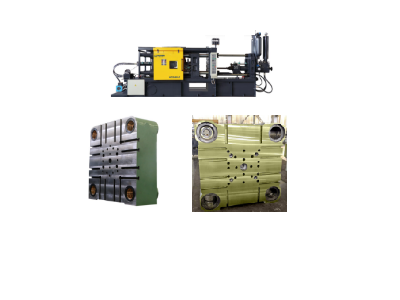
Die casting machine platen type selection depends on the die casting machine design and requirements, platens are usually classified as fixed platens, movable platens, and adjustable platens. Fixed platens are located at the “shot” end of the machine. Movable platens are located between the fixed platens and adjustable platens. And adjustable platens are located at the rear of the machine and are used to adjust the die height.
Stationary Platen
Located at the “injection end” of the die-casting machine, it secures the cover die of the mold and aligns it with the injection system (e.g., the shot sleeve).
It must withstand extreme pressure (often exceeding 1,000 tons) and is constructed of thick steel to prevent deformation.
Its surface is designed with T-slots or threaded holes for mold clamping. Regular cleaning is required to ensure parallelism between the mold parting surface and the platen and to ensure efficient heat transfer.
Moving Platen
Located between the stationary platen and the rear platen, it secures the ejector die of the mold.
It uses a hydraulic/mechanical system to actuate the mold opening and closing, enabling mold closure and casting ejection.
It also requires a high-rigidity design, and its surface cleaning and maintenance requirements are the same as those for the stationary platen.
Adjustable Platen
Equipped on some machine models, it slides along tie rods to adjust mold height or accommodate molds of varying sizes.
This is particularly critical in ultra-large die-casting machines (e.g. single die plate size up to 4m×4m/60 tons) to compensate for the assembly tolerance of giant molds.
Platen rigidity design parameters
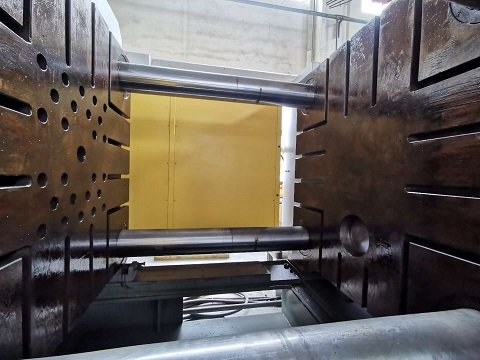
Platens bend under die casting clamping force. If deformation exceeds the mold’s limit, flash appears. Therefore, rigidity design needs finite element analysis and local reinforcement measures.
- Stiffness formula and allowed deformation
- Local reinforcement near tie bar holes
- Process defects caused by low rigidity
Stiffness formula and allowed deformation
Generally, the fixed platen center deformation should not exceed 0.1 mm per meter.
- Stiffness design uses a simple beam model. Deformation is proportional to clamping force and inversely proportional to the cube of platen thickness.
- So increasing thickness is the direct way, but it adds weight and cost.
- During die casting process, the Die casting machine platens selection guide suggests buyers ask suppliers for a displacement map under full load and confirm the deformation value.
Local reinforcement near tie bar holes
A better way is to locally thicken the area around tie bar holes because stress is highest there.
- Also, add longitudinal ribs on the back side. Rib height should be over 60% of platen thickness.
- Moreover, cross ribs can further improve bending stiffness.
- Haichen provides platen stiffness test data for every machine. Deformation is controlled within 0.08 mm per meter.
Adaptive Clamping Force Adjustment Technology
HAICHEN uses adaptive die casting machine clamping force adjustment technology. This technology adjusts clamping force in real time based on actual production conditions. It makes clamping force distribution more uniform, improving product consistency and quality. Through closed-loop control, the machine adjusts high-pressure clamping position and pressure based on the previous mold’s clamping force. This ensures accuracy and consistency for every clamping cycle. This technology also helps shorten dry cycle times and boost productivity.
Process defects caused by low rigidity
- If rigidity is too low, first you see flash on the mold parting line. Then tie bar holes wear faster. Finally clamping force becomes uneven.
- These defects directly increase scrap rate and mold repair cost. Therefore, in the Die casting machine platens selection guide, rigidity should be a pass-or-fail item.
- Buyers should watch the platen deformation test under full load on site.
Platen size and mold matching
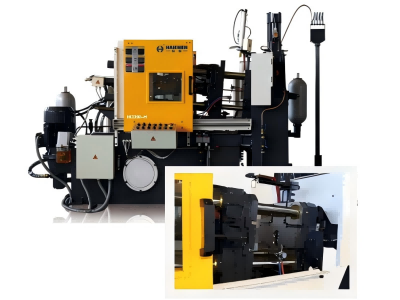
Platen size must be larger than the mold outer size. Correct size matching ensures stable mold mounting and even force distribution. Also, measurement of tie bar distance and mounting slot sizes need careful checking.
- Effective platen area vs. mold projection
- Tie bar distance vs. mold outer size
- Mold mounting slot sizes and layout
Effective platen area vs. mold projection
The fixed platen effective area should be at least 1.2 times the mold projection area. This gives enough support around the mold.
If the area is too small, the mold edge hangs without support. This causes uneven clamping force.
Therefore, buyers should calculate the mold projection area and compare it with the platen support area in the Die casting machine platens selection guide.
Tie bar distance vs. mold outer size
Tie bar distance decides the maximum mold width and height. If mold width is close to tie bar distance, the mold cannot enter.
Usually mold width should be at least 50 mm smaller than tie bar distance. For odd-shaped molds, check diagonal passage. Haichen offers optional extension platens.
They increase the mounting area without changing tie bar distance. This helps users keep old molds.
Mold mounting slot sizes and layout
Common T-slot sizes are 14 mm, 18 mm, and 22 mm. Slot spacing should be even.
More slots are needed near the platen center to hold large molds. When buying, check the thread size and depth of mounting holes.
This prevents thread stripping. Also, slot positions should align with mold clamping points. Otherwise, extra adapter plates are needed.
Customization and Compatibility for Platens
HAICHEN recognizes that different molds have special platen needs. They offer optional extension platens. These increase the mounting area without changing tie bar distance, helping users keep old molds. For very large molds or those with unique mounting needs, HAICHEN can provide custom platens with special hole patterns or extra thickness. This ensures the platen fits the customer’s specific mold perfectly
Selection of mold steel
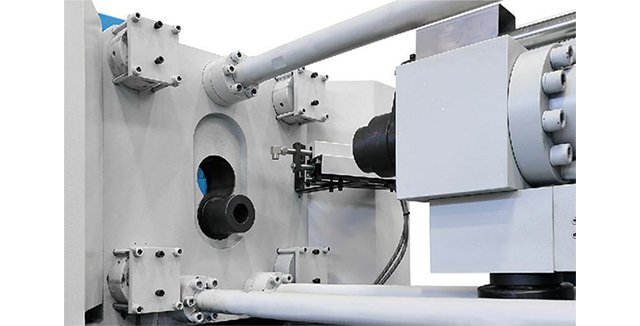
The choice of mold steel directly affects the durability and corrosion resistance of the mold. The appropriate mold steel should be selected according to the specific application requirements. Such as considering its dimensional stability, corrosion resistance, casting convenience and cost.
High-Temperature and High-Pressure Resistance
Die-casting molds must withstand extreme conditions (temperatures > 600°C and pressures > 1000 tons), requiring steel with high thermal fatigue resistance, wear resistance, and toughness.
Recommended hot-work die steels include H13, SKD61, 8407, and 2344, as these materials maintain strength and resistance to melting loss even at high temperatures.
Matching Production Requirements
- Batch Size: High-wear-resistant steel (such as H13) is required for large-scale production (>100,000 pieces). For small and medium-sized batches, the more cost-effective P20 steel (suitable only for low-melting-point alloys such as zinc alloy) can be considered.
- Product Precision: High-precision parts require steel with minimal heat-treatment deformation (such as D2 steel).
- Mold Size: Large molds should be made from a steel grade with excellent machinability and long life (such as pre-hardened 718 steel).
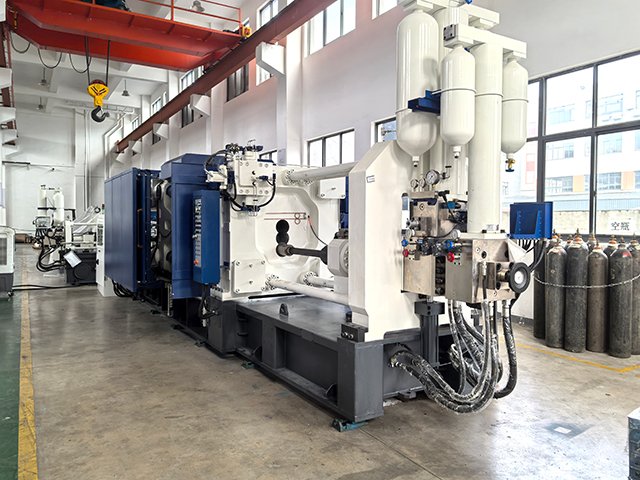
HAICHEN die casting machine platens selection guide
Haichen is one Chinese die casting machine manufacturer for more than 10years. We produce both high pressure cold chamber die casting machine , hot chamber die casting machine and spare parts. They have durable and highly precise features. It builds platens to match the machines’ performance and clients’ requirement.
HAICHEN Machinery has nearly two decades of experience in die casting machine platen design and manufacturing. Its platens are known for high rigidity, high precision, and high reliability. HAICHEN can process ultra-large platens weighing over 40,000 pounds, giving it a significant competitive advantage in the ultra-large die casting machine market.
- Robust Design for Heavy-Duty Cycles
- Customizable Options for Special Molds
- Integrated System Compatibility
Robust Design for Heavy-Duty Cycles
HAICHEN platens use high-grade cast steel. They are thick and have strong ribbing. This is crucial for machines running high-pressure aluminum casting all day. Our platens stay flat and true, cycle after cycle.
Customizable Options for Special Molds
Some molds are very large or have unique mounting needs. HAICHEN can provide platens with special hole patterns or extra thickness. We work with clients to make sure the platen fits their specific mold.
Integrated System Compatibility
A HAICHEN platen is made for a HAICHEN machine. The dimensions and hole patterns are precise. This guarantees perfect fit and force distribution. It also makes service and parts replacement simpler.
A Critical Choice for Your Operation
Selecting the right platen is a critical part of your die casting machine platen selection guide. It directly impacts part quality, setup speed, and machine life. Do not choose a platen that is just “big enough.” Choose one that is strong, precise, and perfectly matched to your mold and machine. HAICHEN provides this engineered compatibility, offering platens that are built to last and perform reliably in demanding production environments.


