Aluminum alloys types mainly includes Al-Cu alloys, AI-Si alloys, AI-Mg alloys, AI-Zn alloys and so on.
Aluminum alloys can be classified according to their application fields, mainly into two main groups: wrought aluminum alloys and cast aluminum alloys. These two groups of aluminum alloys have significant differences in performance, processing methods and application scenarios, so they play different roles in different industrial fields.
Then, die casting aluminum alloys fall into four main series: Al-Si, Al-Cu, Al-Mg, and Al-Zn. Al-Si alloys (ADC12, A380) have the best fluidity, account for over 70% of aluminum die casting, and suit general structural parts. Al-Mg alloys (A514) offer excellent corrosion resistance for marine parts. Al-Cu alloys (A206) give the highest strength but poor corrosion resistance. A356 is a typical Al-Si-Mg alloy. After T6 treatment, it reaches 280MPa tensile strength and 5% elongation, with better toughness than ADC12. Silicon at 10-12% gives best fluidity. Each 1% copper added raises strength by 15-20MPa. Control iron content between 0.7-1.2% to balance mold sticking and toughness.
They can divide into many types according to different classification standards. The following are several common types of aluminum alloys:
- Al-Cu alloys: contain copper, have good strength and corrosion resistance.
- Al-Si alloys: contain silicon, usually used for casting alloys.
- Al-Mg alloys: contain magnesium, have high corrosion resistance and welding performance.
- Al-Zn alloys: contain zinc, have excellent corrosion resistance and welding performance
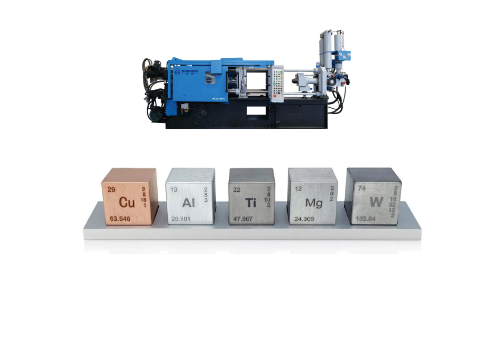
Aluminum alloys types Classification by alloy elements
Aluminum alloys are usually classified according to their main alloying elements. Common alloying elements include copper (Cu), magnesium (Mg), silicon (Si), manganese (Mn), zinc (Zn), etc. The addition of these elements will significantly change the properties of aluminum alloys, such as strength, corrosion resistance, machinability, etc.
Al-Cu alloy (2xxx series)
Al-Cu alloy (2xxx series) with copper as the main alloying element, it has good heat treatment performance and is often used in fields with high strength requirements such as aerospace and automobiles.
Al-Mg alloy (5xxx series)
Al-Mg alloy (5xxx series) with magnesium as the main alloying element, it has good corrosion resistance and welding performance and is widely used in construction, shipbuilding and automobile industries.
Al-Si alloy (4xxx series)
Al-Si alloy (4xxx series) with silicon as the main alloying element, it has good casting performance and wear resistance and is often used in casting and machining.
Al-Mn alloy (3xxx series)
Al-Mn alloy (3xxx series) with manganese as the main alloying element, it has good corrosion resistance and processing performance and is suitable for general industrial use.
Al-Mg-Si alloy (6xxx series)
Al-Mg-Si alloy (6xxx series) with magnesium and silicon as the main alloying elements, it has good heat treatment performance and weldability and is widely used in construction and transportation industries.
Al-Zn-Mg alloy (7xxx series)
Al-Zn-Mg alloy (7xxx series) with zinc and magnesium as the main alloying elements, it has extremely high strength and good heat treatment performance and is suitable for aerospace and high-performance structural parts.
Other alloys (8xxx series)
Other alloys (8xxx series) include aluminum alloys containing other alloying elements (such as iron, titanium, etc.), usually for special purposes.
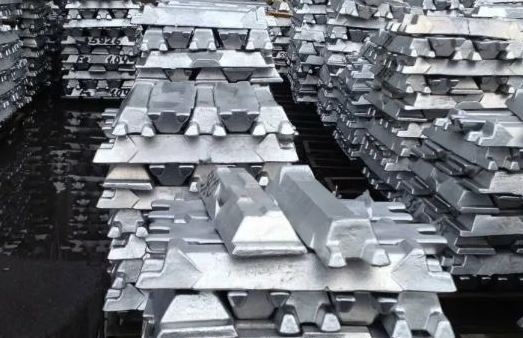
Classification by alloy state of Aluminum alloys types
Deformed aluminum alloys
Deformed aluminium alloys refer to aluminum alloys that can be formed by pressure processing (such as rolling, extrusion, forging, etc.). These alloys usually have high strength and good plasticity, and are suitable for structural parts that need to be formed by cold working or hot working. Deformed aluminum alloys can be further divided into two categories:
Non-heat-treatable alloys
This type of alloy cannot be heat treated to improve its strength, and mainly relies on cold processing (such as cold rolling and cold extrusion) to enhance its performance. Common non-heat-treatable aluminum alloys include:
- Aluminum-manganese alloy (Al-Mn)
- Aluminum-silicon alloy (Al-Si)
- Industrial pure aluminum (1xxx series)
- Rust-proof aluminum (LF series)
Heat-treatable alloys
This type of alloy can be significantly improved in strength and hardness by heat treatment (such as solution treatment, aging treatment). Common heat-treatable aluminum alloys include:
- Aluminum-copper alloy (Al-Cu)
- Aluminum-magnesium alloy (Al-Mg)
- Aluminum-zinc alloy (Al-Zn)
- Duraluminum (LY series)
- Superduraluminum (LC series)
- Forged aluminum (LD series)
Case Study: Aluminium Alloy Die-Casting
https://www.youtube.com/watch?v=Mi5h_o6R27g
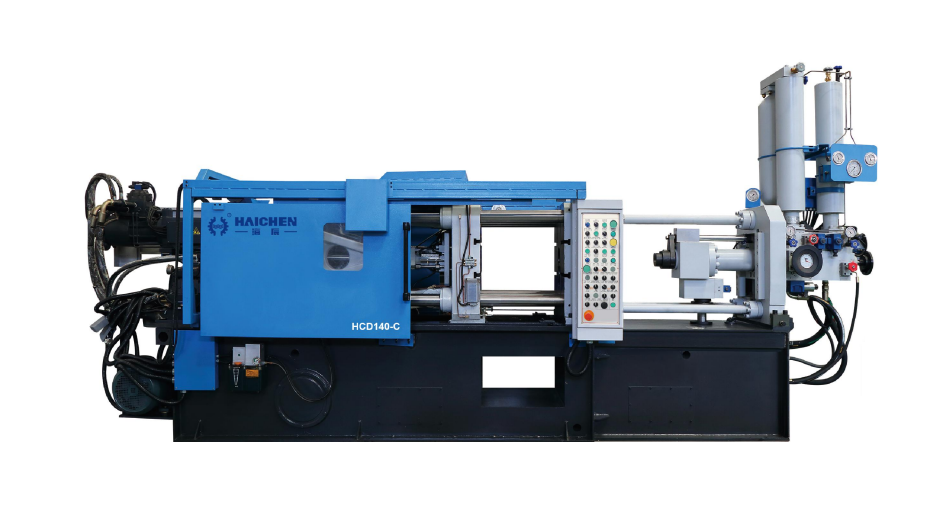
Haichen is one Chinese die casting machine manufacturer for more than 10years. We not only produce both high pressure cold chamber die casting machine , but also hot chamber die casting machine this machine is suitable for differet types of zinc alloys They all have durable and highly precise features. Haichen with rich experience of understanding application of die casting alloys and help customers to choose the suitable die casting alloy materials.
Aluminum allooy road stud die casting
Haichen Machinery provides aluminium alloy road stud die-casting solutions for traffic safety equipment manufacturers, demonstrating its technical prowess in aluminium alloy processing.

Production demand of aluminium alloy road studs
A traffic safety equipment company secured an order for reflective road studs for motorways, with a monthly demand of 500,000 units.
Road stud specifications: 100×100×20mm, requiring a compressive strength exceeding 30 tonnes.
Aluminium Alloy Selection Rationale
- ADC12 aluminium alloy was recommended for its superior fluidity, ideal for thin-walled studs.
- ADC12 exhibits tensile strength of 320MPa, meeting the 30-tonne compressive requirement
- Possesses good corrosion resistance
- Offers moderate material costs, suitable for high-volume production
Haichen Die-Casting Equipment Configuration
- Configured with Haichen HCD300-C cold-chamber die-casting machine, clamping force 3000kN
- Dual-cavity mould design enables production of 2 studs per cycle
- Intelligent temperature control module maintains aluminium melt temperature within ±2°C
- Integrated automatic part removal robot and spraying system
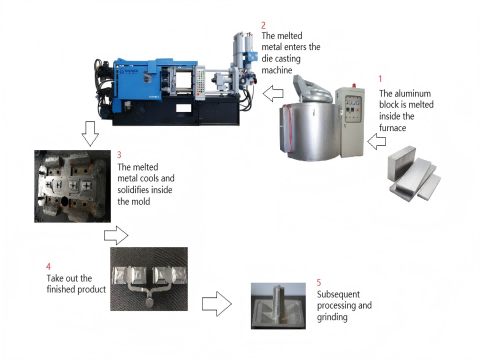
Aluminum alloy cookware pot die casting
We select ADC12 aluminium alloy for our cookware customer to produce pot and pan. Because ADC12 aluminium alloy has superior fluidity. It is ideal for thin-walled cookware. Morover, it exhibits tensile strength of 320MPa, suitable for cookware pot usage.
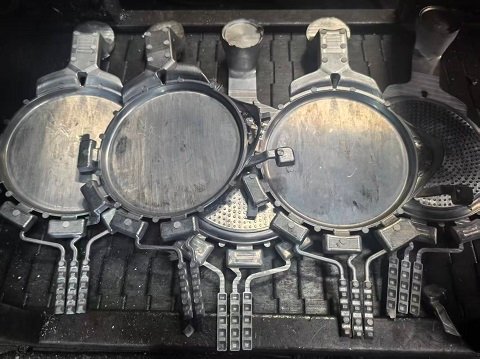
Selecting the appropriate aluminium alloy grade requires comprehensive consideration of factors. Including fluidity, strength, corrosion resistance, and cost. Leveraging specialised die-casting equipment and extensive process expertise, Haichen Machinery assists clients in achieving advantages of efficient, high-quality, and cost-effective production of aluminium alloy products.
Process Optimisation and Technical Advantages
- Optimised injection curve for ADC12 reduces filling time to 0.03 seconds
- Integrated vacuum system minimises entrapped air, reducing casting porosity by 70%
- Optimised mould temperature distribution narrows cavity temperature differential from ±15°C to ±5°C
- Nitriding treatment extends injection chamber lifespan to 63,000 mould cycles
Implementation Outcomes and Value Creation
- Yield rate increased from 85% to 98%, with porosity defects virtually eliminated
- 99.5% pass rate for casting compressive strength testing
- Annual cost savings for client: approximately ¥500,000; equipment investment recouped within 15 months
Haichen Technical Support and Services
- Aluminium alloy selection guidance: recommending suitable grades based on product performance
- Mould design optimisation recommendations: enhancing cooling efficiency and mould longevity
- Remote monitoring system providing real-time alerts for potential faults
- Timely spare parts supply ensuring production continuity
Cast aluminum alloys (Cast Alloys)
Cast aluminum alloys refer to alloys that are formed into castings by pouring molten aluminum alloy into a mold and cooling it. Such alloys are usually used to make parts with complex shapes, such as engine blocks, gearboxes, etc.
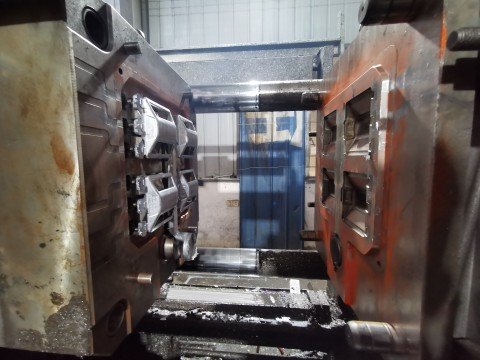
Haichen produce cast aluminium alloys molds. The die-casting molds components mainly include: a fixed mold and a moving mold, a cavity, core, inserts, and a gating system. It also with an overflow and venting system. For some complex strucutre Like alulminum alloys cookware handle with chamfer. Haichen designs it with a slider die casting mould. It need has an ejection system, including ejector pins, return pins, ejector plates, and ejector plate guide pillars/sleeves. It used to eject the solidified casting from the mold after mold closing.
Cast aluminum alloys have relatively low strength, but have good fluidity and are suitable for casting processes. Common cast aluminum alloys include:
- Aluminum-silicon alloy (Al-Si)
- Aluminum-copper alloy (Al-Cu)
- Aluminum-magnesium alloy (Al-Mg)
- Aluminum-zinc alloy (Al-Zn)

Classification by application field
Wrought aluminum alloys
Wrought aluminum alloys refer to aluminum alloys formed by cold working, hot working or mechanical working (such as rolling, extrusion, forging, etc.). These alloys have good plasticity and machinability and are suitable for parts that require high strength and good formability. Wrought aluminum alloys can generally be further divided into non-heat treatment strengthening type and heat treatment strengthening type.
Aluminum alloys for automobiles
such as 2xxx series, 5xxx series, and 6xxx series. These alloys are widely used in automobile body panels due to their light weight and high strength.
Aluminum alloys for construction
Aluminum alloys for construction: such as 6063-T6, 6070-T5, etc. These alloys have good processing performance and corrosion resistance.
Aluminum alloy for ships
Aluminum alloy for ships: high strength and corrosion resistance, suitable for shipbuilding.
Cast aluminum alloys
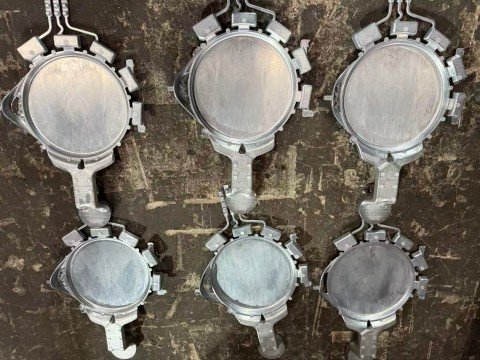
Cast aluminum alloys (Cast Alloys) Cast aluminum alloys refer to aluminum alloys formed by casting process. They are characterized by low melting point and suitable for manufacturing complex shapes, but poor plasticity and unsuitable for cold processing.
Automobile
Automobile: used to manufacture engine cylinders, pistons, wheels, etc.
Aerospace
Aerospace: used to manufacture engine parts, aircraft structural parts, etc.
Architecture
Architecture: used to manufacture doors, windows, roofs, curtain walls, etc.
Electronics
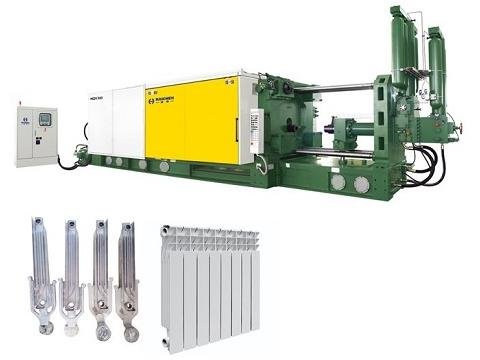
Electronics: used to manufacture radiators, wires, electronic housings, etc.
Classification by special properties
Heat-resistant aluminum alloy
Heat-resistant aluminum alloy: such as heat-resistant aluminum alloy used for power transmission lines.
Functionally gradient aluminum alloy
Functionally gradient aluminum alloy: different mechanical properties are achieved by changing the alloy composition and porosity.
Therefore, the above are some of the main classification methods of aluminum alloys, each of which has its specific application areas and performance characteristics. These aluminum alloys play an important role in modern industry and meet the material needs of different fields.


