Chiller prices correlate directly with die casting machine tonnage or cooling capacity. Larger machines generate more heat and require more powerful chillers. As a general rule, adding 10 tons to your die casting machine may raise chiller costs by 10,000–15,000 yuan (approximately $1,400–$2,100).
Price impact: Higher tonnage means higher chiller cost. Always match your chiller capacity to your machine size.
Cooling Method: Air-Cooled vs. Water-Cooled
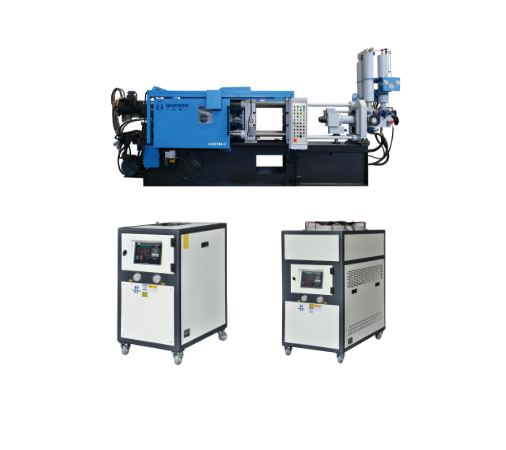
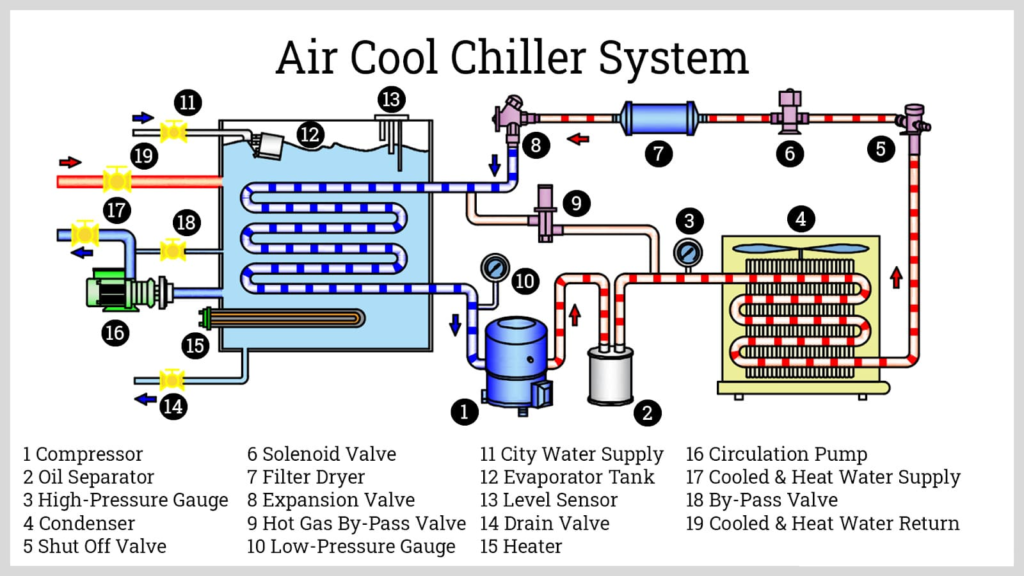
Air-cooled chillers use ambient air to remove heat. They do not require a cooling tower or external water source, which makes them easier to install and maintain. However, they typically cost more upfront and operate less efficiently in high-temperature environments.
Water-cooled chillers use water from a cooling tower or other source. They offer higher efficiency and better performance in hot climates but require additional infrastructure.
Price impact: Air-cooled units often have higher initial costs, while water-cooled systems may have lower purchase prices but higher installation expenses.
Material and Customization Requirements
Standard chillers use carbon steel and standard materials. However, non-standard customization—such as stainless steel or titanium alloy components, explosion-proof designs, or waterproof enclosures—increases costs significantly.
Price impact: Customization can add 30–50% to the base price.
Refrigeration System Quality
The compressor is the heart of any die casting chiller. High-quality compressors from brands like Emerson (Copeland) provide better efficiency, lower noise, and longer service life. Cheaper units may use refurbished or low-grade components that fail prematurely.
Price impact: Premium compressors add to the upfront cost but reduce long-term operating expenses.
Control System and Features
Modern die casting chillers offer advanced features like:
- Variable-frequency drives for energy savings
- PID temperature control with ±1°C accuracy
- Dual-circulation systems for redundancy
- Smart monitoring and remote diagnostics
Price impact: Advanced controls typically add 10–30% to the base price but deliver significant energy savings over time.
Common Types of Die Casting Chillers and Their Price Drivers
Air-Cooled Scroll Compressor Chillers
These units use scroll compressors and air-cooled condensers. They work well for small to medium die casting operations where water availability is limited.
Example: A 5HP air-cooled scroll compressor chiller for die casting costs around $7,200 per set.
Price drivers: Compressor brand, cooling capacity (HP/kW), and build quality.
Water-Cooled Chillers
Water-cooled chillers use water from a cooling tower or closed-loop system. They offer higher efficiency than air-cooled units and suit larger operations.
Price drivers: Cooling capacity, condenser type, and pump quality.
Centralized vs. Decentralized Chillers
Decentralized chillers are smaller units (typically under 10 tons of cooling capacity) that serve individual machines. Centralized chillers have capacities over 10 tons and cool multiple machines from a single system.
Price drivers: Centralized systems cost more upfront but offer better energy efficiency for large facilities.
High-Temperature and Specialized Chillers
Some applications require chillers that handle higher return water temperatures or provide very low outlet temperatures. These specialized units cost more.
Price impact: Specialized designs can increase costs by 20–50% compared to standard models.
How to Choose the Right Die Casting Cooling Chiller for Your Budget
Step 1: Calculate Your Cooling Capacity Requirement
Your chiller must remove the heat generated by your die casting process. This depends on:
- Machine tonnage – larger machines generate more heat
- Cycle time – faster cycles require more cooling
- Mold design – complex molds may need more cooling channels
- Alloy type – aluminum and magnesium have different heat capacities
Haichen engineers recommend a three-stage thermodynamic simulation based on your specific production parameters: casting projected area, wall thickness, alloy-specific heat capacity, ejection temperature, mold temperature setpoint, and cycle requirements.
Step 2: Choose Between Air-Cooled and Water-Cooled
Choose air-cooled if:
- You lack access to cooling water
- Your facility has limited space
- You want simpler installation
Choose water-cooled if:
- You have a cooling tower or water source
- You operate in a hot climate
- You need maximum energy efficiency
Step 3: Evaluate Total Cost of Ownership
The purchase price matters, but do not stop there. Consider:
- Energy consumption – chillers run continuously; efficiency matters
- Maintenance costs – some designs require more frequent service
- Expected service life – quality units last 10+ years
- Downtime costs – chiller failure stops production
What this means for you: A cheaper chiller that consumes more energy or fails frequently costs more over its lifetime.
Step 4: Check Energy Efficiency Ratings
Look for chillers with a COP (Coefficient of Performance) of 3.0 or higher. Higher COP means lower energy bills. Variable-frequency drives also reduce energy consumption by matching chiller output to actual demand.
Step 5: Plan for Future Expansion
Choose chillers with modular designs and expansion capabilities. This allows you to add cooling capacity later without replacing the entire system.
Common Mistakes Buyers Make
Choosing the cheapest option. Units priced below 5,000 yuan (around $700) may include refurbished or second-hand equipment, low energy efficiency, or poor after-sales support. Avoid “scrapped machine modifications.”
Under-sizing the chiller. A chiller that is too small cannot remove enough heat, leading to longer cycle times and quality defects. Always calculate your actual cooling requirement.
Ignoring energy efficiency. Two chillers with the same capacity can have very different operating costs. Check the COP and consider variable-frequency drives.
Overlooking maintenance requirements. Some chillers require frequent filter changes, refrigerant top-ups, or compressor service. Factor this into your operating budget.
Forgetting about installation costs. Air-cooled chillers need adequate ventilation. Water-cooled chillers need piping and cooling tower connections. Budget for installation.
Questions
- “What cooling capacity do you recommend for my machine tonnage and alloy?” – Get a specific recommendation based on your production parameters.
- “What is the COP (energy efficiency ratio) of this chiller?” – Look for COP ≥ 3.0.
- “What is the temperature control accuracy?” – Haichen offers ±1°C accuracy for precise temperature management.
- “What is the expected service life and maintenance schedule?” – Know what you are getting into before you buy.
- “Do you offer variable-frequency drives or energy-saving features?” – These reduce long-term operating costs.
- “What warranties and after-sales support do you provide?” – Look for warranties exceeding 3 years and 24/7 technical support.
- “Can you provide references from similar die casting operations?” – Proven results matter more than promises.
Haichen’s Die Casting Cooling Chiller Solutions
Haichen Machinery has produced die casting chillers for more than 10 years. We offer both water-cooled and air-cooled industrial chiller series to meet different production requirements. Our chillers feature temperature control accuracy of ±1°C, which meets the strict cooling requirements of aluminum alloy, magnesium alloy, and zinc alloy production.
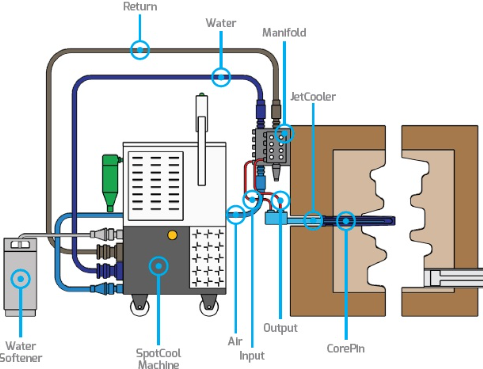
Haichen adopts a multi-loop independent temperature control system that flexibly adjusts water temperature in different areas of the die-casting process, preventing scale formation that hinders heat transfer. Our die casting chillers rapidly and stably absorb heat, optimizing cooling for faster cycle times.
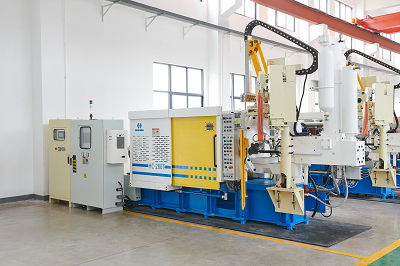
Beyond chillers, Haichen provides complete die casting solutions including cold chamber and hot chamber machines, conveyors, vacuum systems, mold temperature controllers, and industrial robots. This integrated approach ensures all your equipment works together seamlessly.
Haichen’s cooling chiller price starts from conventional models at 5,000–20,000 yuan for small to medium machines, with high-end custom solutions available for special processes. We provide precision thermal load matching based on your specific production parameters.
| Cooling Capacity | Typical Application | Price Range (USD) |
|---|---|---|
| Small (under 10 tons) | Machines below 50T | $700 – $2,800 |
| Medium (10–50 tons) | Standard production | $1,400 – $7,000 |
| Large (50+ tons) | High-volume, special alloys | $14,000 – $42,000+ |
We telling
| Factor | What to Check | Cost Impact |
|---|---|---|
| Cooling Capacity | Match to machine tonnage and heat load | High |
| Cooling Method | Air-cooled vs. water-cooled | Medium-High |
| Materials | Standard vs. stainless steel/titanium | Medium (adds 30–50%) |
| Energy Efficiency | COP ≥ 3.0, variable-frequency drive | Medium |
| Control System | PID control, ±1°C accuracy | Medium |
| Customization | Special alloys, explosion-proof designs | High |
Need help selecting the right cooling chiller for your die casting operation? Contact Haichen Machinery. We will analyze your machine tonnage, alloy type, and production targets to recommend the optimal chiller solution for your specific needs.


